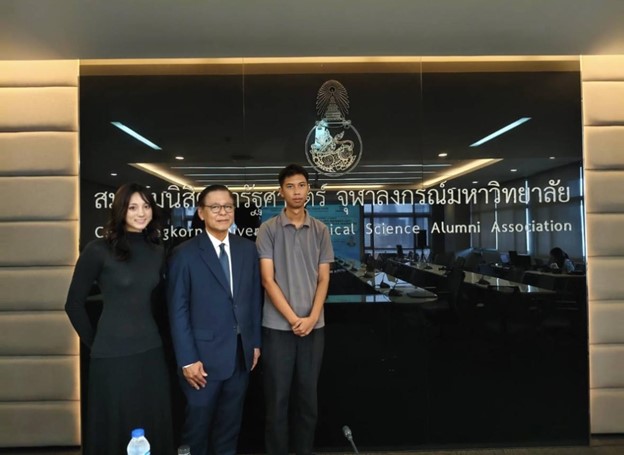
From left to right: Audrey Choo-Scott (HDFF), Mr. Sihasak Phuangketkeow (former Permanent Secretary of the Ministry of Foreign Affairs), and Phassakorn Sukjan (HDFF)
On June 19, 2025, the HDFF team attended a timely public seminar titled Thai Foreign Policy Towards Myanmar: Past, Present and Future hosted by the Nelson Mandela Center of the Faculty of Political Science, Chulalongkorn University, in collaboration with the Hanns Seidel Foundation. The keynote speaker, Mr. Sihasak Phuangketkeow—former Permanent Secretary of the Ministry of Foreign Affairs—shared his insights on Thailand’s evolving diplomatic approach to Myanmar amid the country’s ongoing political crisis.
Thailand’s Shifting Approach to the Myanmar Crisis
The session began with a historical overview of Thailand’s foreign policy trajectory towards its western neighbor. Mr. Sihasak emphasized that geography has always been the primary factor shaping Thai policy toward Myanmar. With a shared border stretching over 2,000 kilometers, Thailand has long embraced “constructive engagement” as a guiding principle—though in varying forms, ranging from passive acquiescence to proactive diplomacy. He recalled moments of Thailand’s more assertive leadership, including the “flexible engagement” strategy championed during the Democrat Party’s leadership in the early 2000s and regional initiatives such as the Bangkok Process.
Navigating Post-Coup Realities: Crisis, Engagement, and Missed Opportunities
Reflecting on the present, Mr. Sihasak identified three crises stemming from Myanmar’s 2021 coup: the humanitarian and political crisis within Myanmar, its spillover effects on neighboring countries, and the crisis of ASEAN’s credibility. He criticized ASEAN’s lack of collective strategy to implement the Five-Point Consensus, noting the gap between rhetoric and action. He also offered a candid assessment of Thailand’s diminished regional leadership following years of military-led governance.
The discussion also explored Thailand’s post-coup posture. Mr. Sihasak recounted the Thai-led initiative to establish a humanitarian corridor, describing the diplomatic complexities of engaging both Myanmar’s military regime and ethnic armed groups. Despite initial breakthroughs, political changes in Thailand and resistance from Naypyidaw stalled further progress. He stressed the need for sustained, strategic engagement—one that does not confer legitimacy to the regime but facilitates practical cooperation and dialogue.
Looking Ahead: The Case for Strategic Leadership
Looking to the future, Mr. Sihasak urged Thailand to calibrate its approach by taking a proactive, legitimacy-sensitive leadership role in facilitating inclusive dialogue. He warned that without a clear and realistic roadmap, the region risks either deepened instability or missed opportunities for peace. In particular, he highlighted the importance of engaging neighboring powers like China and India, as well as aligning regional efforts through “multi-track diplomacy” involving both official and informal channels.
The Q&A session drew a range of questions, including the role of diaspora communities, engagement with the National Unity Government (NUG), and the rising influence of transnational organized crime in conflict-affected areas. Mr. Sihasak advocated for a comprehensive approach that includes policy coherence within Thailand, support for displaced persons, and the strategic use of regional platforms to build a more credible and inclusive negotiating front.
The seminar concluded with a clear message: Thailand cannot afford passive diplomacy. As a frontline state, it has the geographic, strategic, and moral imperative to play a leading role in shaping the region’s path to peace in Myanmar. As Mr. Sihasak emphasized, 2025 may prove to be a decisive year—either to “win the peace” or lose it.
HDFF is thankful to the Nelson Mandela Center of the Faculty of Political Science, Chulalongkorn University and the Hanns Seidel Foundation for the invitation to participate and is looking forward to future cooperation.
Comments are closed