
The Mekong River is an important resource for approximately 60 million people across six countries: China (where it is called the Lancang), Myanmar, Laos, Thailand, Cambodia, and Vietnam. Today, its management is a central issue, with different groups pursuing distinct approaches. The Mekong River Commission (MRC) focuses on promoting sustainability and cooperation among downstream countries, while the China-led Lancang-Mekong Cooperation (LMC) emphasizes infrastructure development and economic growth. As discussions continue over water sharing, environmental impacts, and transparency, the future of the river remains uncertain, with potential implications for the ecosystems, food supply, and economics of the Lower Mekong region.
The Mekong River Commission (MRC)
The MRC was created in 1995 by Cambodia, Laos, Thailand, and Vietnam (downstream countries) to promote cooperation in managing the Mekong River. It is guided by the Mekong Agreement and focuses on sustainable development and protecting the environment. The MRC helps its members work together to manage floods and droughts, plan hydropower projects, protect fisheries, and adapt to climate change. One key role of the MRC is to share river data and coordinate planning, which builds trust and helps prevent harm from unilateral actions by any one country. The commission also organizes meetings and involves local communities in its work. The MRC makes many reports on river flow, water quality, and sediment, which help countries understand how to better manage the river.
The Lancang-Mekong Cooperation (LMC)
The LMC was launched in 2016 and includes all six Mekong countries, including Myanmar, and China. Unlike the MRC, China plays a leading role in the LMC. The LMC focuses on technical cooperation, building infrastructure such as hydropower dams, and financing development projects. China’s central role means it guides the LMC’s agenda and investments. This is a key difference from the MRC, where China is only a dialogue partner and does not have a formal vote. Because of China’s influence, some downstream countries feel pressure and worry that their interests might not be fully protected. The LMC promotes faster project implementation but has been criticized for weaker environmental protections and less transparency compared to the MRC.
Membership and Power Dynamics
One of the main reasons for tension is the difference in membership and power. The MRC includes four downstream countries but only treats China as a dialogue partner, limiting China’s influence. The LMC includes all six countries, with China as a full member and leader. This gives China more control over decisions in the LMC. Downstream countries sometimes feel that the LMC is dominated by China’s interests and priorities. This difference creates mistrust between the two organizations and among the countries in the region.
Data Sharing and Transparency
Another area of tension is how the two organizations share data and communicate. The MRC provides a public data portal with important information about river flow, rainfall, and sediment. However, downstream countries say this data is sometimes not enough to fully understand or respond to changes caused by upstream dams. China shares some flow data through the LMC, mostly to warn about floods, but it does not always share detailed information about dam operations or water releases. This lack of transparency causes uncertainty and fear among people living downstream. Experts suggest that both organizations need to improve data sharing and create governance systems that involve communities and hold countries accountable.
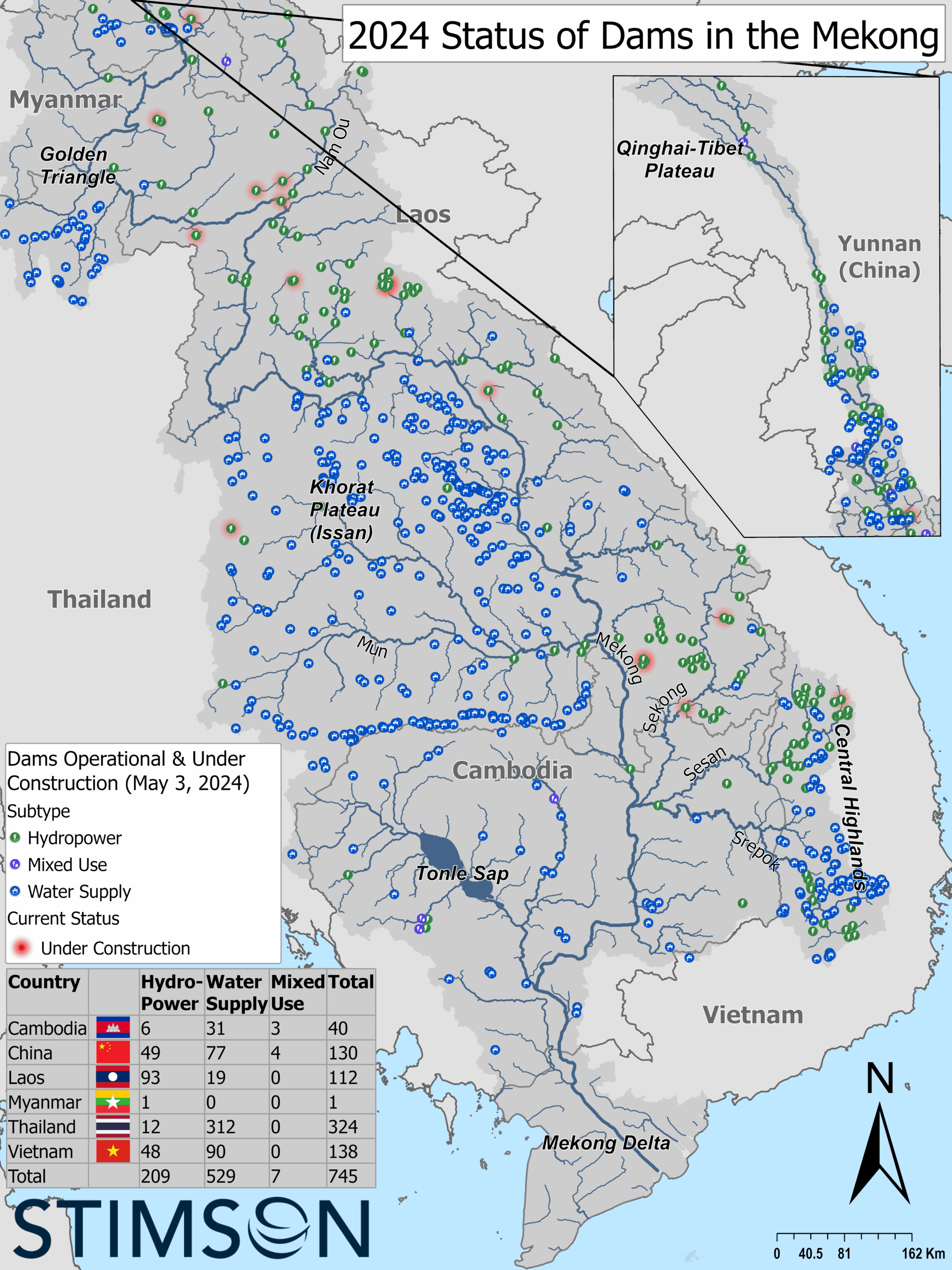
All Dams Map of the Mekong Basin mapping Credit Stimson Center
Environmental and Climate Challenges
The Mekong River Basin is highly vulnerable to drought, floods, and the impacts of climate change. Changes in rainfall patterns and rising temperatures have made droughts more frequent and severe, putting pressure on farms, fisheries, and communities that rely on a steady flow of water. At the same time, hydropower dams in the upper basin, especially those built by China, have intensified these challenges by altering natural water flows. In early 2024, for example, the Tuoba Dam withheld 1.215 billion cubic meters of water, sharply reducing river levels from Chiang Saen in Thailand to Nakhon Phanom and harming fisheries and agriculture along the Thai–Lao border. In late April, the Nuozhadu Dam held back another 892 million cubic meters, cancelling out other dam releases and worsening drought conditions in Cambodia and Vietnam’s Mekong Delta. Meanwhile, in May, the Jinghong Dam engaged in hydropeaking for 11 consecutive days, causing sharp daily fluctuations in water levels that disrupted fish migration in Cambodia’s Tonle Sap and devastated the livelihoods of riverine communities. Both the MRC and LMC recognize these challenges but have different ways of responding. Coordinated efforts are needed to protect fish, soil, and people’s livelihoods from these environmental threats.
Cooperation Efforts and Challenges
Despite tensions, the MRC and LMC have tried to work together. In 2019, they signed a Memorandum of Understanding to share data and jointly monitor droughts and floods. This shows a willingness to collaborate and reduce competition. However, deeper cooperation is difficult because the MRC follows a rules-based, multilateral approach that requires consensus, while the LMC is more China-led and project-focused. Sometimes, the overlap between these two organizations causes confusion and competition for influence, rather than helping countries work better together.
Towards Sustainable Cooperation
Experts recommend several steps to reduce tensions and improve river management in the Mekong Basin. The LMC’s funding and technical projects could be aligned with the MRC’s environmental standards and inclusive processes, and data sharing should be expanded to incorporate local knowledge and guide decision-making. Clear governance rules must be established to hold countries accountable and ensure that projects do not harm communities or ecosystems, while planning must also prioritize climate change impacts on water availability and river health. The MRC and LMC reflect different approaches, one focusing on sustainability and cooperation, the other on development and infrastructure, but closer collaboration between these frameworks offers a promising path forward. Through open data sharing, inclusive decision-making, and jointly respected regulations, the Mekong River can be managed more fairly and sustainably, safeguarding the lives and livelihoods of millions who depend on it.
Sources
https://www.bangkokpost.com/business/2091291/sharing
https://th.boell.org/en/2020/11/27/mekong-lancang-river-needs-accountable-water-governance
https://www.stimson.org/2024/mekong-dam-monitor-annual-report-2023-2024/
Comments are closed