
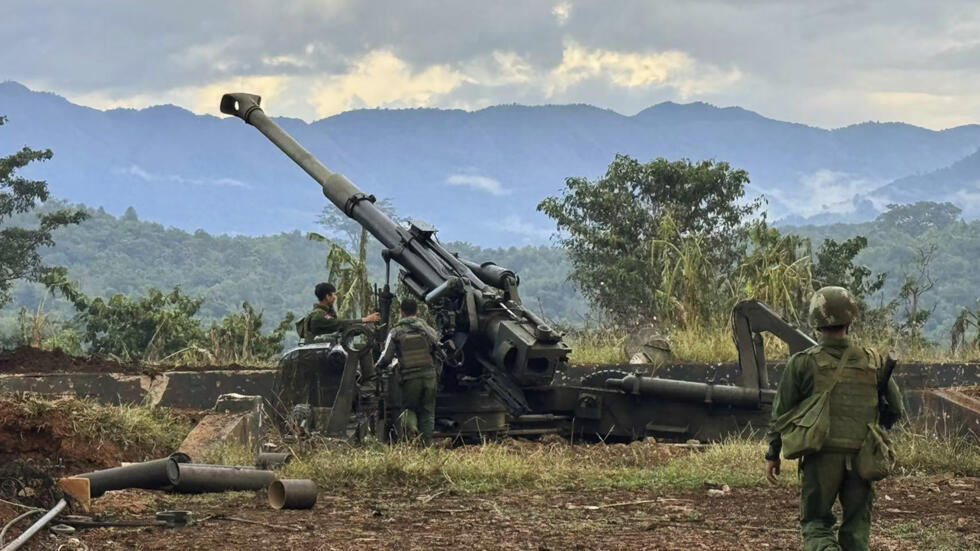
To resist Myanmar’s military, the Three Brotherhood Alliance was formed in 2019. This coalition consists of the Ta’ang National Liberation Army (TNLA), the Myanmar National Democratic Alliance Army (MNDAA), and the Arakan Army (AA). These three ethnic armed groups united by a common goal: to oppose military oppression and fight for the right to govern their own communities. From the beginning, the alliance focused on launching coordinated attacks to more effectively weaken the military’s control. Since its formation, it has carried out numerous joint offensives, particularly in northern Shan State, significantly challenging the military’s presence there. In 2021, the alliance issued a statement condemning the junta’s violent crackdown on peaceful protesters. When the military ignored this warning and killed nearly 100 demonstrators, the alliance responded with a retaliatory attack on a police station. This is one example about how the Three Brotherhood Alliance unites together. Their most impactful campaign to date has been Operation 1027, marking a major escalation in their resistance and inflicting substantial losses on the military.
Ta’ang National Liberation Army
One of the most organized ethnic armed groups in Myanmar is the Ta’ang National Liberation Army (TNLA), which primarily operates in the northern region of Shan State. The TNLA’s mission is to defend and unify the Ta’ang people, also known as the Palaung, who live not only in northern Myanmar but also in bordering areas of Thailand and China. The group is widely recognized for its strong anti-drug stance, actively destroying opium fields and dismantling trafficking routes.
Among Ta’ang families, it is common for at least one child, if the family has more than one, to be sent to join the TNLA. Rather than confronting the Myanmar military directly, the TNLA typically employs indirect tactics. Their strategy involves supporting other ethnic armed groups, conducting training operations, and engaging in political resistance. However, direct conflict is sometimes unavoidable.
The TNLA is also known for its ability to negotiate temporary ceasefire agreements with the military. In addition, its territory often serves as a refuge for activists fleeing persecution. At its core, the TNLA seeks to create a better and more just society for the Ta’ang people.
In April 2025, peace talks between the military and the Ta’ang National Liberation Army were held with China acting as mediator. However, the negotiations collapsed after the military demanded control over significant areas of TNLA held territory. Since then, clashes have escalated, with the military launching multiple operations against TNLA positions. As of July 2025, the military is advancing closer to key TNLA controlled townships, and the threat of territorial loss continues to grow. Although the military has superior manpower, the TNLA is actively reinforcing its defenses to protect its land. Ongoing fighting has forced thousands more civilians to flee, adding to the already large number of displaced people in the region.
Myanmar National Democratic Alliance Army
The Myanmar National Democratic Alliance Army (MNDAA) was established to promote the interests of the Kokang people, an ethnic Chinese minority living in northern Shan State, near the border with China. The Kokang region has deep historical ties with China as it was once part of the Ming Dynasty, and many Han Chinese settled there, bringing their language, culture, and religious beliefs. As a result, Mandarin is widely spoken in the area, and Chinese culture remains strongly preserved. The Communist Party of Burma, which formed before World War II, opposed the Burmese government. Although the party eventually collapsed, a former military leader from its ranks went on to establish the MNDAA. Due to their ethnic and cultural connections to China, the MNDAA has maintained a close relationship with the Chinese government. China has gradually increased its influence over the group, and the two often cooperate when their interests align.
In 2009, the Myanmar military ordered the MNDAA to become part of the Border Guard Force under its control. The MNDAA refused, resulting in conflict and the group retreating temporarily into Chinese territory. In the years that followed, the MNDAA re-emerged, rejoining the armed struggle to reclaim their land and resist the Burmese military. The MNDAA has a troubled history, including the use of child soldiers, and reports have emerged of Chinese citizens crossing the border to join their fight against the military. Given their shared ethnic background and strategic interests, MNDAA likely receives support or at least tolerance from China. The group also relies on China for political backing and sees it as a potential mediator in peace negotiations with the Burmese military.
In March 2025, China pressured the Myanmar National Democratic Alliance Army (MNDAA) to withdraw from Lashio, a key city in northern Shan State. To force the handover, China cut electricity and internet access, closed border crossings, and reportedly increased military support to the junta. Although the MNDAA had captured Lashio in a hard-fought and costly battle, losing many soldiers in the process, the city was ultimately returned to military control under Chinese pressure. The loss has been deeply felt by the MNDAA, as Lashio had not only strategic value but also represented a significant symbolic and military victory that came at a high cost.
Arakan Army
The Arakan Army (AA) is a powerful ethnic armed group based in Rakhine State, Myanmar. Since its founding in 2009, the AA has grown into one of the most organized and formidable ethnic armies in the country. It has achieved significant victories against the military junta and its allies, establishing itself as a major force in the broader resistance movement. The AA’s main objective is the liberation of Arakan (Rakhine) and the restoration of independence and self-rule for the Arakan people. The Myanmar-Bangladesh border is now entirely controlled by the AA, and the group is expanding its presence along the border with India as well. In addition to Rakhine State, AA fighters are reportedly active in other regions, including Shan State and Karen State. The AA frequently collaborates with other ethnic armed groups, providing military support and strategic guidance in their shared struggle against the junta.
In recent years, some Rohingya refugees living in camps in Bangladesh have reportedly joined the AA, hoping that participation might lead to citizenship or formal recognition in the future. However, the AA has a troubled history with the Rohingya population in Rakhine State. There have been numerous reports of violence, discrimination, and destruction directed at Rohingya communities by AA forces. The AA’s ultimate goal is to expel all outside military forces from Rakhine State, asserting complete control over the region and preventing any external influence or occupation on their land.
As of July 2025, the Arakan Army is actively collaborating with eight other ethnic armed groups across Myanmar. These groups are not only coordinating closely with the AA but are also participating in joint military operations. Their geographic spread across the country highlights the AA’s growing influence, extending far beyond its traditional base in Rakhine State. Currently, the AA controls nearly all of Rakhine State, with only a few townships still remaining under military control.
Operation 1027
In October 2023, the Three Brotherhood Alliance launched a major offensive against Myanmar’s military junta. Known as Operation 1027, the attack marked a turning point in the resistance against military rule. Carefully planned and highly coordinated, Operation 1027 became the most significant and devastating blow to the junta since its 2021 coup.
During the operation, the alliance successfully captured over 50 towns and military strongholds, severely weakening the junta’s control in key regions. The offensive also inspired other ethnic armed groups to join the fight, further expanding the loss of territory under junta control. Targets included major supply depots, military checkpoints, and bases. The alliance even managed to seize ruby mines and vital trade routes, further disrupting the junta’s economic and military infrastructure.
Although the junta lost considerable ground and manpower, it responded with a brutal wave of airstrikes, resulting in heavy civilian casualties. Despite this, the operation increased pressure on the regime, aiming to destabilize military rule and pave the way for a democratic transition.
One major consequence of the offensive was the junta’s introduction of a mandatory military conscription law for both men and women, highlighting the scale of its personnel losses. The regime’s inability to maintain its forces exposed growing vulnerabilities within its ranks.
Operation 1027 also had serious implications for the peace process. In response, the junta officially designated the Three Brotherhood Alliance as a terrorist organization, effectively shutting down the possibility of formal peace talks. This classification further isolates the alliance and complicates international engagement, as many nations are restricted in dealing with groups labeled as terrorists.
The Present
Following the March 2025 earthquake, the Three Brotherhood Alliance announced a series of ceasefires to support humanitarian efforts in the affected regions. These ceasefires were intended to allow relief to reach communities in need and to begin restoring a sense of normalcy. The most recent ceasefire was declared to last through the end of June. However, such ceasefires are often seen as largely superficial, as they are frequently disregarded when tensions or conflicts arise.
In a notable act of cooperation, the Three Brotherhood Alliance jointly established a hospital in Muse, located in Shan State which was a region that previously lacked such a facility. This hospital has significantly improved access to medical care, as residents had previously been forced to travel long distances to receive treatment. The project stands as a powerful example of the Alliance’s unified commitment to supporting their communities and strengthening local infrastructure.
The nature of the Three Brotherhood Alliance has evolved significantly since its formation. Today, their collaboration is largely formal, limited to public ceasefire announcements, symbolic gestures like opening hospitals, and issuing joint statements. In contrast to their earlier, more unified military campaigns such as Operation 1027, there is now far less coordination on the battlefield. Each member of the alliance is pursuing its own distinct goals and vision for Myanmar’s future, shaped by the needs and interests of their own ethnic communities and regions. As a result, the alliance now functions more as a political front than an active military coalition, highlighting the diverging priorities and fading unity among its members. The fading cohesion of the Three Brotherhood Alliance reflects the broader challenges facing Myanmar’s resistance movements. Without unity, their ability to bring lasting change may be increasingly difficult to achieve.
Sources
Arakan Army in Myanmar’s Rakhine state (July 2025)
Understanding the Arakan Army • Stimson Center (April 2023)
How Operation 1027 Transformed War Against Myanmar Junta (October 2024)
EXPLAINED: What is Myanmar’s Arakan Army? – Radio Free Asia (November 2024)
What is Myanmar’s Three Brotherhood Alliance that’s resisting the military? | Conflict News | Al Jazeera (January 2024)
The Myanmar National Democratic Alliance Army (MNDAA): A Historical Overview – A Complicated War (July 2025)
Myanmar National Democratic Alliance Army (MNDAA) (January 2025)
The Long War Pt.5; The Myanmar National Democratic Alliance Army – Burma’s Long War – Military Matters (November 2023)
MNDAA second anti-junta armed group to call for peace talks | Frontier Myanmar (December 2024)
Who is the Ta’ang National Liberation Army (TNLA)? (February 2025)
THE THREE BROTHERHOOD ALLIANCE: Political ups and downs – Shan Herald Agency for News (June 2025)
CONQUERED TERRITORIAL OWNERSHIP CONTROVERSY: The case of TNLA and MNDAA – Shan Herald Agency for News (June 2025)
The Post-Coup Rise of Myanmar’s Ta’ang National Liberation Army – The Diplomat (September 2023)
Treading a Rocky Path: The Ta’ang Army Expands in Myanmar’s Shan State | International Crisis Group (September 2023)
Junta Just Outside TNLA-Held Naungcho Town | Burma News International (July 2025)
Three Brotherhood Alliance establishes public hospital in Muse 105 miles | Burma News International (July 2025)
Three Brotherhood Alliances Declare One-Month Truce for Earthquake Relief | Burma News International (April 2025)
Eight out of 23 AA-backed revolutionary groups working alongside AA: ISP-Myanmar (July 2025)
Comments are closed