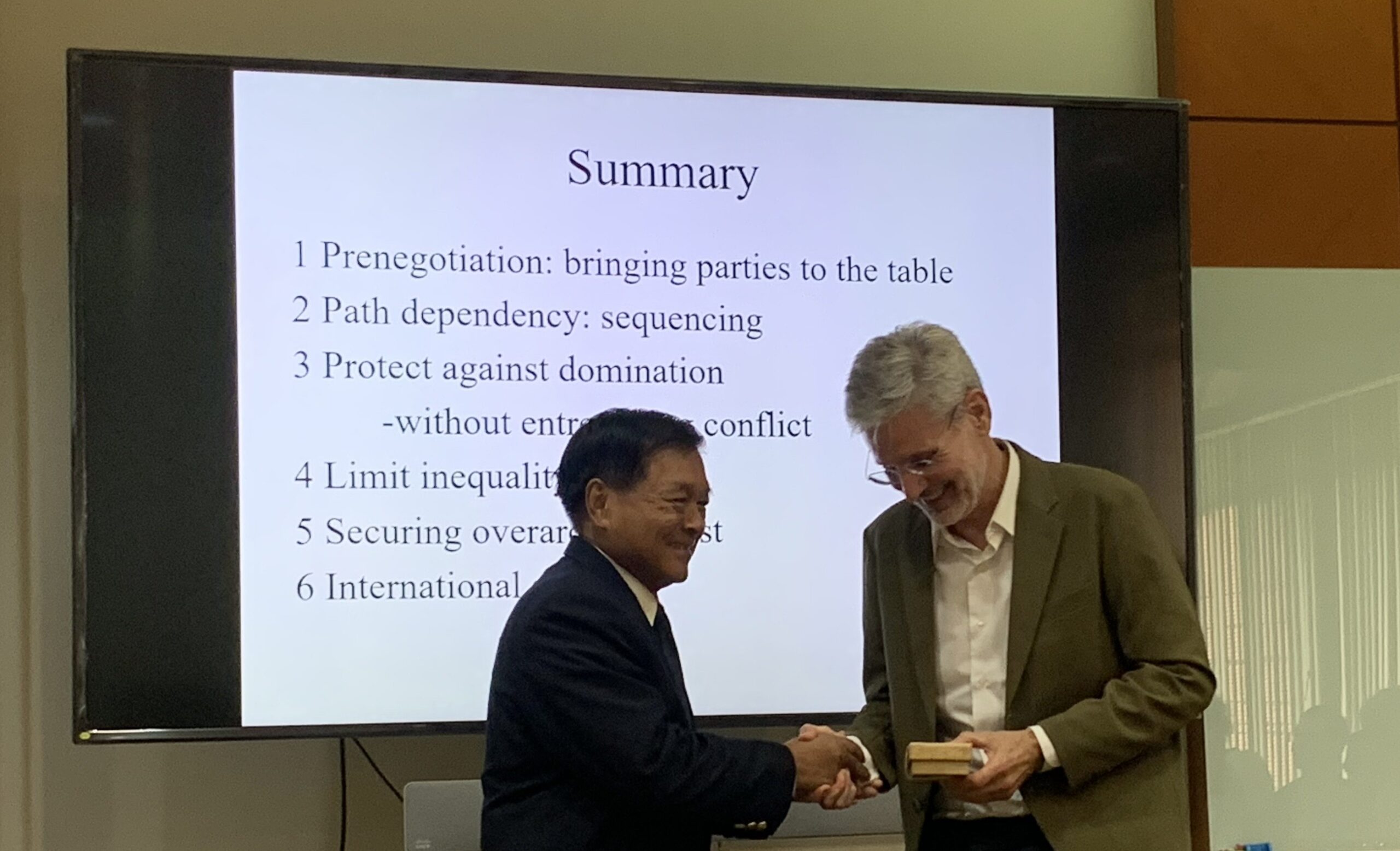
On June 14, 2025, a HDFF team attended a seminar titled “(Con)federal Lessons for Paths Toward Just Peace in the Middle East”, hosted by the CPG Peace & Security Center (CPSC) and Asian Governance Foundation (AGF) at Thammasat University.
The keynote speaker, Mr. Andreas Follesdal — Prof. Dr., Faculty of Law, University of Oslo —shared his insights on how confederal arrangements -neither full separation nor unification- could offer alternative paths to peace in deeply divided regions. Drawing lessons from past peace processes globally, the lecture considered how unbundling sovereignty and carefully designed power-sharing mechanisms might reduce violence and promote coexistence.
Inaugural Speech: A Plea for Peace in the Middle East
The session began with opening words highlighting how by the shores of the Mediterranean, Black and Caspian Sea, Red Sea and Persian Gulf, civilizations emerged long ago, sharing ancestors and religious beliefs, and yet soon found themselves divided. From crusade wars to today, atrocities have repeatedly harmed the region. With more than 60,000 Palestinians brutally killed since October 2023 by Israel, one of the most sophisticated militaries on Earth, with total immunity, the speaker pleaded for humanity and peacebuilding, through community and dialogue.
The session then started by reminding participants that sympathy is not a zero-sum game, a key lesson to the following demonstration.
Lessons from History: Paving the Way to Peace
The need to learn lessons from previous attempts to negotiate violent conflicts of the past, be they successful or not, was first underlined. The European Union, Bosnia-Herzegovina (especially when commemorating 30 years of the Srebrenica massacre), Northern Ireland and the Good Friday Agreement, or the Nepal Civil War were notably cited. These events testified to a willingness to allocate political authority strategically to bring peace and enable intermingled national groups to generate and maintain unity and diversity.
Participants were however warned that confederations were not to be idealized, mechanisms of power sharing frequently bearing complex unforeseen effects. Indeed, implementing confederations involves numerous design challenges such as providing sufficient domains of self-determination for each group to prevent domination and allow both self and joint rule.
(Con)federal Insights for Achieving Just Peace in the Middle East
The following steps were suggested in paving the way towards confederacies and just peace in the region:
- Pre-negotiation and bringing parties to the table: sufficient trust must be fostered to pre-commit to negotiate institutional safeguards and high-risk sectors for joint decisions (such as coal and steel for Germany and France after World War 2) in order to reduce understandable fears. The background (historical, demographical…) and interests of each party must also be acknowledged not only in negotiations but also to plan ahead, especially since new factors may emerge along the way (such as economic disparities between Catholic and Protestants in Northern Ireland). Finally, historically marginalized groups and minorities including women must be involved in negotiations and institutions.
- Path dependency: what must be settled early, what need not, foreseen: early institutions and procedures must be crafted to resolve unknown unknowns. This can take the shape of guardrails, discussions on what must be decided jointly, or the facilitation of civil society on the long term through trade unions and political parties.
- Protect against domination but avoid entrenching present actors and conflicts: for instance, inBosnia Herzegovina, the main political groups shared the role of President, which reduced conflict levels. Yet, while constitutionalized immunity and veto power to some groups may at times be necessary to protect them from domination, it should be ensured that sunset clauses for reverse discrimination be reviewed regularly, as is encouraged in Nepal.
- Limit inequality within/ across constituent units: federations have larger economic disparity, partly because units have autonomy on educational and industrial policies. Yet disparities are often sources of conflicts and must hence be acknowledged and addressed (as seen through transfer mechanisms in Germany or Canada).
- Securing sufficient mutual overarching and fostering a “we”: this does not necessarily refer to emotional ties to the (con)federation as a home or homeland, but rather to strong and impartial federal courts, a shared “secular” faith, education, memorials, public reparations, inclusive truth commissions, and a fair political turnover.
- The importance of international actors: global and regional players may push for negotiations or shift bargaining positions and provide more impartial monitoring. But they must be careful not to reproduce schemes of domination.
It was then underscored how awareness about (con)federal practices and theory had helped in the past, for instance in the case of Mo Mowlam for Northern Ireland, whose expertise on Swiss cantons was central in the Good Friday agreement, and may be helpful in the future by fostering constitutional creativity, reducing pessimism and keeping suggestions at hand.
The final discussion allowed participants to voice their concerns on any long-term solutions which would fail to address Palestinian needs, on the struggle to conduct negotiations without bringing terrorist organizations to the table or on the legitimacy of ASEAN to intervene in the region.
Concluding remarks reminded participants of the importance of cultural and political allocations in confederations and of the need for dialogue to extend beyond theoretical framework and into concrete action. Paths to just peace are complex but hopefully not beyond reach and it is our collective responsibility to envision and strive for a peaceful future for populations in the Middle East.
HDFF would like to thank the CPG and AGF or the invitation and opportunity to participate. HDFF is looking forward to future opportunities and exchanges.
Comments are closed