
Credit Photo: Sunil Pradhan/Anadolu/Getty Images
Abstract
Nepal’s September 2025 protests, triggered by the abrupt banning of over 26 social media in the country and resulting in the deadliest political movement since the republic’s establishment in 2008, testify to a regional wave of youth-led mobilization against corruption, inequality and an increasing feeling of hopelessness for a better future. Like in Sri Lanka’s 2022 uprising, Bangladesh’s 2024 anti-quota protests and Indonesia’s 2025 student demonstrations, the so-called “Gen Z” along other partisans has thus helped force concessions, elite resignations, and even regime change in Bangladesh and Nepal.
This article aims to understand Nepal’s recent uprising not only through its immediate triggers but through deeply rooted lasting frustration with the system, also visible at the regional level. It also advocates for Nepal’s interim government to prioritize accountability for security-sector violence, rights-based internet governance, and institutionalized youth participation at a crossroad where the current transition could offer both opportunity and hazard.
From Platform Bans to an Eruption of Political Violence
By early 2025, nearly half of Nepal’s population used social media, around 13.5 million on Facebook alone (The Conversation, 14. Sept. 2025). Social media represents 80% of online traffic (The Katmandu Post, 5. Sept. 2025) making platforms central to business, education, and communication, especially as around 2 million or around 7.5% Nepali live abroad (Nepal Economic Forum 2021), using these platforms to keep in touch with their families.
Government efforts to regulate platforms since 2023 through the introduction of new social media regulations, such as the prohibition to create anonymous or disguised identities and the need to register with the government and appoint a designated contact person based in Nepal (Overview of Directives for Managing the use of Social Media, 2080 by Law Gandhi Associates) culminated in a January 2025 bill and a stemming ban on 26 services, justified as a response to disinformation and fraud.
However, not only was this move perceived as a concrete threat to civil liberties, with both the ban and the bill functioning as means to enhance censorship (The Conversation, 14. Sept. 2025), but it was also seen as disproportionately harming small businesses, students, and ordinary users. Nepali’s heavy reliance on social media, with over 80% of youths interviewed by Nepal Live Today in 2022 admitting to spending more than 10 hours a day on the internet, notably to access educative material or on social media platforms, thus transformed the ban into a trigger for mass dissent.
Hence, within hours, protests escalated across the capital Kathmandu and other main cities. Demonstrators, among which the majority were teenagers and young adults, took to the streets and set fire to the Parliament, the Supreme Court, and the residences of prominent political figures, expressing their anger and despair. These violent acts were allegedly committed by “infiltrators”, a claim echoed by the army as the protesters reminded the movement “was and remains non-violent and rooted in the principles of peaceful civic engagement” (BBC, 10 Sept. 2025). However, government forces rapidly responded using force, with live ammunition, rubber bullets, and water cannons, killing at least 19 on 8 September alone, including a 12-year-old child (India Today NE, 8 Sept. 2025). By mid-September, the Health Ministry estimated the death toll at 72, with over two thousand injured (Reuters, 14 Sept. 2025). Prime Minister K.P. Sharma Oli, serving his fifth term, eventually resigned under such pressure. Parliament was dissolved, and the army took to the streets, raising concerns over a potential return of the impunity that defined the civil war era.
International condemnation was immediate. The UN called on “all protestors to exercise (…) fundamental freedoms peacefully and refrain from violence” while urging “authorities to ensure that all law enforcement responses remain proportionate and in line with international human rights standards”, as the Office of the High Commissioner for Human Rights declared itself “shocked” by the killings and demanded investigations consistent with international standards. Human Rights Watch and Amnesty International likewise called for independent inquiries, emphasizing on the risk for Nepal’s role as leading contributor to UN peacekeeping missions to be significantly jeopardized without accountability.
From a Fragile Republic and to a Complete Erosion of Trust
Said accountability is even more crucial for Nepali as the ongoing crisis tells not only of anger regarding the social media ban but also over governance, accountability, and the legitimacy of post-2008 democracy.
While the ban on social media was the immediate trigger for the protests, the latter testified to frustration and concerns accumulated over the past two decades.
In fact, when over 240 years of monarchy came to a halt with the establishment of a federal democratic republic in 2008, Nepali had high hopes for a lasting transformation, one which would favor growth, stability and sustainability for the country. However, reality was very different. The people have instead been facing lasting chronic instability, as over a dozen governments succeeded to one another over the past 17 years, nearly all led by leftist parties (the Nepali Congress, the Communist Party of Nepal, and the Maoist Centre) and yet unable to be solid and unified enough to complete a full five-year term (Links, 2025).
Far from consolidating democratic norms, succeeding parties instead allegedly resorted to corruption, nepotism, and prioritization of their own interests over national priorities. Since 2015 promulgation of a new constitution, the role of Prime Minister has been alternatively assigned to .P. Sharma Oli, Pushpa Kamal Dahal, and Sher Bahadur Deuba, all of whom have repeatedly faced criticism over such allegations. Hence, public trust in political institutions and leaders eroded over time, notably among younger generations.
From scandals around pandemic relief funds to collusion in lucrative infrastructure projects, frustration grew consistently and came to a no-return as elite families visibly displayed accumulated wealth on social media. The gap between the Nepali youth, suffering from an unemployment rate affecting 20.8% of aged 15-24 in Nepal (World Bank 2024) and politicians’ children parading in luxury brands was denounced through the #nepobabies campaign, highlighting inequalities and the impunity of an immoral elite.
In Nepal’s economy, perceived as structurally weak, about one-third of the country’s Gross Domestic Product stems from remittances sent by the diaspora, testifying to limited opportunities within the country. Furthermore, the few sectors perceived as productive sectors (among which banking and real estate) are also largely monopolized by these same elites (Britannica Encyclopedia), fueling further resentment.
This sentiment was eventually exacerbated by the security forces’ actions, as it triggered what Rumela Sen, lecturer at Columbia University, designated as the “fear of uniform”, a legacy of the 1996-2006 civil war, during which extrajudicial killings remained largely unpunished (New York Times, 10. Sept. 2025). Hence, demonstrators emphasized how their claims included the end of impunity along that of corruption, a non-negotiable condition in restoring legitimate democracy.
Digital Public Spheres as Spaces of Community and Coordination
These demonstrations highlighted the importance of digital spheres in contemporary South Asia as upon the ban of mainstream platforms, youth activists migrated to Discord servers and other still authorized tools. The latter allowed the community to organize among themselves, to deliberate or even to select representatives.
The ban on social media thus backfired. Instead of silencing dissent, it legitimated narratives of authoritarian overreach and pushed activists toward to resort to digital organization in interacting with formal politics. Consensus around Sushila Karki’s nomination, former Chief Justice sworn in as interim Prime Minister on 13 September 2025, was for instance majorly organized on Discord. Coordinated by Hami Nepal, a Gen Z group behind the protest with more than 160,000 members, debates on the country’s future gathered more than 10,000 people, including many from the Nepali diaspora (Al Jazeera, 15. Sept. 2025). This was a first in the history of democracy, resulting from a lack of transparency in traditional practices whereas virtual polls were perceived to allow real time results and questions on legitimacy. While this strategy is not without risks, such as disinformation or infiltrators, Karki (notably Chief Justice from 2016 to 2017) was sworn in until future March 2026 elections.
Despite having been called to power without reaching for it, she acknowledged that she must “work in accord with the thinking of Generation Z,” and pledged to leave office after this six-month period (Le Monde, 14 Sept. 2025).
Regional Wave: From Sri Lanka to Nepal
This situation reminds that of Nobel Peace Prize-winning economist Muhammad Yunus, urged to take power as interim head of government in Bangladesh in 2024, “three days after Prime Minister Sheikh Hasina was forced to resign and flee to neighboring India” (Al Jazeera, 8. Aug.2024). Nepal’s recent uprising can indeed hardly be understood as an isolate event, rather belonging to a wave of mobilization across South Asia and into Southeast Asia over the past 3 years (Links, 2025).
Sri Lanka’s Aragalaya protests erupted in 2022 amid an economic collapse driven by years of Rajapaksa family dominance in political roles, tax cuts, and corruption. Persistent shortages of food, fuel, and health necessities, adding to general mismanagement and an ill-timed fertilizer ban, led millions of Sri Lankans to the street. Protesters managed to oust Gotabaya Rajapaksa, but Ranil Wickremesinghe’s access to power was then criticized as a form of continuity rather than systemic reform, leaving cries for deeper accountability and “systematic change” unanswered (Carnegie Endowment for International Peace).
In Bangladesh, student-led protests started with anger against a Supreme Court ruling that reinstating a 30% quota for descendants of freedom fighters. They morphed into “the largest political mobilization in Bangladesh in at least a decade” (International Crisis Group) that culminated in the ousting of Prime Minister Sheikh Hasina. With the economy in hardship and fewer jobs for younger generations, notably due to mismanagement and corruption, came mounting frustration at the government’s authoritarian turn, which allowed it to stay in office for a fourth consecutive term in January (BBC, 8. Jan. 2024). Hundreds of people, mostly students, were killed in violent protests before Hasina resigned and fled to India. Muhammad Yunus was resultantly installed until upcoming elections in August 2026 to attempt to restore order through necessary reforms. Yet, political parties are today unable to agree on election dates and both political attacks and hostility to vulnerable minority groups by religious parties are on the rise as the interim government struggles to counter radicalization (International Journal of Criminal Common Statutory Law).
In Indonesia, protests have repeatedly taken place over the year. Since February 2025, Indonesians, especially students, mobilized against austerity measures (with President Prabowo cutting $18bn of government spending on education, public works and healthcare) and military expansion in political affairs (Al Jazeera, 5. Sept 2025). However, discontent grew in late August after revelations that lawmakers enjoyed $3,000 housing allowances, far exceeding ordinary wages in such times of economic hardships (idem). Violence peaked after the death of 21-year-old delivery driver Affan Kurniawan during clashes in Jakarta, the latter perceived as a symbol of gig-economy workers, drivers being emblematic of inequality and economic precarity.
Common Threads and Symbols of Youth Protest
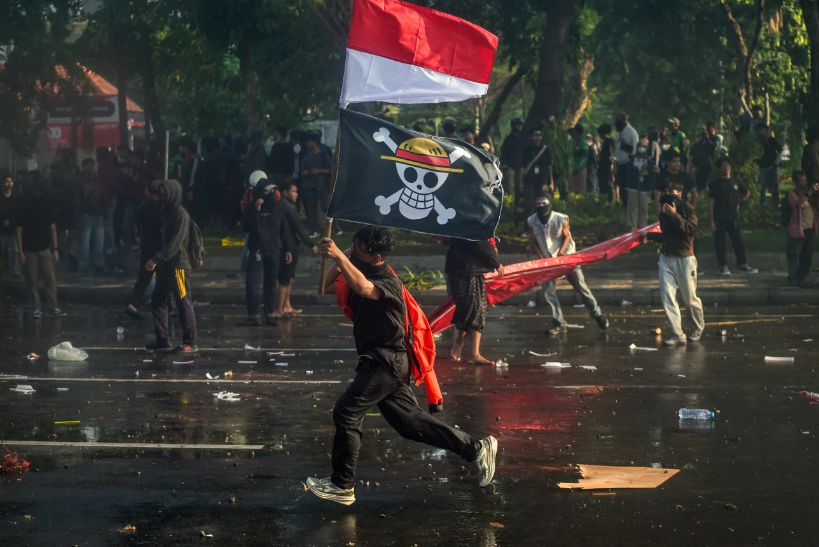
Photo Credit: Juni Kriswanto/AFP/Getty Images
While outcomes vary (regime collapse in Bangladesh, negotiated transition in Sri Lanka, concessions in Indonesia), all these cases testify to the interplay of youth demographics, digital repertoires, and perceptions of elite impunity.
Indeed, youth-led protests have inspired one another across the region, as emphasized by Ashish Pradhan, Nepal expert from the Crisis group, “There was a lot of chatter online about taking inspiration from the Bangladeshis, from the Sri Lankans and from what’s happening with the student movement in Indonesia.” (The Guardian, 16. Sept. 2025).
Furthermore, shared symbols and narratives have been observed, notably across Southeast Asia. Among them are the targeting of #nepokids or the use of Jolly Roger flags, used as key tools to illustrate systemic injustice and inequalities. Using their own cultural compasses, activists are hence able to materialize their demands through symbols understood by the widest number. The Jolly Roger flag, face of the One Piece anime series, for instance represents characters who “have made it their mission to challenge a draconian regime and fight for freedom” (BBC, 7. Aug. 2025). Its use, which began in Indonesia in July as a response to the President’s call to fly the country flag on Independence Day, became a widespread symbol of rebellion against corrupt and authoritative governments.
The development of such symbols, facilitated by the same social media which governments perceive as a risk exacerbators, matters not only for mobilization but also for legitimacy as they pacifically go against elite orders, reinforce generational solidarity, and make repression more costly in the global media environment. For policymakers, to dismiss these narratives as mere trivial “youth culture” is an understatement of their capability, instead they are constitutive elements of dissension.
The Philippines are an exemplification of such dynamics as students from the University of the Philippines walked out of classes on the 12th of September in subordination against Ferdinand Marcos Jr’s government, advocating for transparency and accountability. They here “denounced budget cuts, delayed infrastructure projects and alleged corruption (…) after two senators were accused of receiving kickbacks linked to flood-control projects” (Euronews, 12. Sept 2025). Since, the funding for said projects has been suspended, while public figures such as “church leaders, former officials and business groups issued a joint statement condemning the corruption” (idem). Further massive protests are meant to take place on September 21, on the 53rd anniversary of former President Ferdinand Marcos Sr’s declaration of Martial Law (Asia News Network, Sept.19. 2025).
Karki’s Interim Government and Challenges ahead
The appointment of Sushila Karki, “a former chief justice and staunch anti-corruption campaigner” (New York Times, 12. Sept. 2025), is perceived as a pragmatic compromise to the current crisis. The former has committed herself to treat slain protesters as martyrs, provide compensation to their families as well as free treatment for the injured (Reuters, 14. Sept. 2025), and ensure accountability for excessive use of force.
Her time as interim head of state will turn this transition either to a stabilized democracy or to a merely postponed crisis. Factors to consider this provisional government a success would include first and foremost independent investigations into the killings of the past demonstrations. Without such commitment, elections will be haunted by grievance and foster division. Internet governance must likewise be rendered transparent and rights-based, avoiding further bans and censorship, which merely generate boomerang effects. Finally, youth participation must be institutionalized through consultative councils or representation in electoral reforms. While online servers such as Discord have been crucial this far, political processes must ensure sustainability through concrete and real-life legacy, in accordance with the people’s revendications.
The need to listen to Nepali in reconstructing the country is further underscored by the country’s pivotal role on the broader geopolitical scene. In fact, India, China and the US also understand Nepal to be strategically relevant for their respective interests. Karki will thus have to balance Indian demands for stability along its Himalayan frontier, Chinese fears of protest further spreading across the region and the United States views of Nepal’s turmoil through the lens of Indo-Pacific democracy promotion.
Conclusion
Nepal’s uprising testifies to the fragility of post-monarchical democracies when corruption and elite impunity become so prominent they result in youth disillusionment and digital repression. Such upheaval is part of a wider regional wave of discontent, in which digitally networked youth force entrenched elites to step down through unprecedented repertoires of protests blending memes, occupations, and demands for accountability.
Sushila Karki’s nomination and the prospect of March 2026 upcoming elections offer a narrow corridor for democratic renewal. But such hopes will not be met unless deaths are investigated, digital repression comes to a halt and youth are sustainably included in national reforms. Nepal sits at a crossroads: it can either shift this “Gen Z revolt” into a dynamic democratic start over, or it can relapse into systemic repression and resignation. This decision, like the ones which will soon be taken in other involved countries, will not only determine Nepal’s political future but that of the entire region.
Al Jazeera. (2024, August 8). Muhammad Yunus takes oath as head of Bangladesh’s interim government. Al Jazeera. https://www.aljazeera.com/news/2024/8/8/muhammad-yunus-takes-oath-as-head-of-bangladeshs-interim-government
Al Jazeera. (2025, September 5). Indonesia in chaos: Five Indonesians give views on why and how to fix. Al Jazeera. https://www.aljazeera.com/news/2025/9/5/indonesia-in-chaos-five-indonesians-give-views-on-why-and-how-to-fix
Al Jazeera. (2025, September 15). More egalitarian? How Nepal’s Gen Z used gaming app Discord to pick PM. Al Jazeera. https://www.aljazeera.com/news/2025/9/15/more-egalitarian-how-nepals-gen-z-used-gaming-app-discord-to-pick-pm
Amnesty International. (2025). Népal: Gen Z, mobilisation massive pour les droits. Amnesty International. https://www.amnesty.fr/actualites/nepal-gen-z-mobilisation-massive-droits
Ariful Islam Rone, Sheikh Md. Abdullah Bin Kalam, Ripon Chandra Das, Mostafa Kabir Siddiqui, Kawsar Mia, Md. Atikur Rahman, & Md. Ariful Islam. (2025). The rise of religious extremism in Bangladesh: Security threats and diplomatic challenges. International Journal of Criminal, Common and Statutory Law, 5(1), 82-89. https://doi.org/10.22271/27899497.2025.v5.i1b.122
AsiaNews. Network. (2025). Universities to join Philippine anti-corruption protest on Sept-21 in Quezon City. AsiaNews. Network. https://asianews.network/universities-to-join-philippine-anti-corruption-protest-on-sept-21-in-quezon-city/
BBC News (2024, January 8). Bangladesh election: PM Sheikh Hasina wins fourth term in controversial vote. BBC. https://www.bbc.com/news/world-asia-67889387
BBC News. (2025, August 7). How a cartoon skull became a symbol of defiance in Indonesia. BBC. https://www.bbc.com/news/articles/c3ezvj4d111o
BBC News. (2025, September 8). Nepal Gen Z protest: 19 killed as security forces fire on demonstrators. BBC. https://www.bbc.com/news/articles/cjd1ndmrej0o
BBC News. (2025, September 12). Nepal protests: Leader Karki and Gen Z movement. The New York Times. https://www.nytimes.com/2025/09/12/world/asia/nepal-protests-leader-karki-gen-z.html
BBC News. (2025, September 16). Colombo to Kathmandu: Youth movements toppling entrenched elites. BBC. https://www.theguardian.com/world/2025/sep/16/colombo-kathmandu-youth-movements-nepal-toppling-entrenched-elites
BBC News. (2025, September 10). Nepal protests ‘hijacked’, Gen Z claim, as army patrols the streets. BBC News. https://www.bbc.com/news/articles/cjd1ndmrej0o
Britannica Encyclopedia. (2025). 2025 Nepalese Gen Z protests. Britannica. https://www.britannica.com/event/2025-Nepalese-Gen-Z-Protests
Carnegie Endowment for International Peace. (2025, August). Sri Lanka’s Aragalaya protest movement: Ousting Wickremesinghe and Rajapaksa. Carnegie Endowment. https://carnegieendowment.org/research/2025/08/sri-lanka-aragalaya-protest-movement-oust-wickremesinghe-rajapaksa?lang=en
The Conversation. (2025, September 14). How hardships and hashtags combined to fuel Nepal’s violent response to social media ban. The Conversation. https://theconversation.com/how-hardships-and-hashtags-combined-to-fuel-nepals-violent-response-to-social-media-ban-264932
Crisis Group. (2025). Bangladesh on the edge after crushing quota protests. International Crisis Group. https://www.crisisgroup.org/asia-pacific/bangladesh/bangladesh-edge-after-crushing-quota-protests
Euronews. (2025, September 12). University of the Philippines students protest budget cuts [Video]. Euronews. https://www.euronews.com/video/2025/09/12/university-of-the-philippines-students-protest-budget-cuts
The Guardian. (2025, September 16). Colombo-Kathmandu youth movements: Nepal toppling entrenched elites. The Guardian. https://www.theguardian.com/world/2025/sep/16/colombo-kathmandu-youth-movements-nepal-toppling-entrenched-elites
Human Rights Watch. (2025, September 12). Nepal: Protesters demand integrity, rights, rule of law. HRW. https://www.hrw.org/news/2025/09/12/nepal-protesters-demand-integrity-rights-rule-of-law
India Today NE. (2025, September 8). Nepal Gen Z protest: 19 killed as security forces fire on demonstrators. India Today North East. https://www.indiatodayne.in/international/story/nepal-gen-z-protest-19-killed-as-security-forces-fire-on-demonstrators-1274497-2025-09-08
Kathmandu Post. (2025, September 5). Confusion as Nepal bans unregistered social media sites. Kathmandu Post. https://kathmandupost.com/money/2025/09/05/confusion-as-nepal-bans-unregistered-social-media-sites
Lawgandhi. (2023). Overview of Directives for Managing the use of Social Media. Lawgandhi. https://www.lawgandhi.com/directives-for-managing-the-use-of-social-media/
Le Monde. (2025, September 14). Au Népal, la nouvelle Première ministre par intérim promet de répondre aux revendications des manifestants. Le Monde. https://www.lemonde.fr/international/article/2025/09/14/au-nepal-la-nouvelle-premiere-ministre-par-interim-promet-de-repondre-aux-revendications-des-manifestants_6641141_3210.html
Links. (2025). Nepal joins regional wave of revolt: Popular anger, repression, and inequality spreads across South Asia. Links International Journal of Socialist Renewal. https://links.org.au/nepal-joins-regional-wave-revolt-popular-anger-repression-and-inequality-spreads-across-south-asia
Nepal Economic Forum. (2025). On the move: Wither Nepali migrants’ remittances? Nepal Economic Forum. https://nepaleconomicforum.org/on-the-move-wither-nepali-migrants-remittances
Nepal Live Today. (2022, May 31). Internet addiction: Nepali students locked down in virtual world. Nepal Live Today. https://www.nepallivetoday.com/2022/05/31/internet-addiction-nepali-students-locked-down-in-virtual-world
The New York Times. (2025, September 10). Nepal security forces deploy army alongside police in response to protests. The New York Times. https://www.nytimes.com/2025/09/10/world/asia/nepal-security-forces-army-police.html
The New York Times. (2025, September 12). Nepal protests: Leader Karki, Gen Z movement. The New York Times. https://www.nytimes.com/2025/09/12/world/asia/nepal-protests-leader-karki-gen-z.html
Office of the High Commissioner for Human Rights (OHCHR). (2025, September). Nepal: Call for prompt, transparent investigation into killings of protesters. OHCHR. https://www.ohchr.org/en/press-releases/2025/09/nepal-call-prompt-transparent-investigation-killings-protesters
Reuters. (2025, September 14). Death toll in Nepal’s anti-corruption protests raised to 72. Reuters. https://www.reuters.com/world/asia-pacific/death-toll-nepals-anti-corruption-protests-raised-72-2025-09-14
United Nations Nepal. (2025). Statement of the United Nations in Nepal. UN Nepal. https://nepal.un.org/en/301226-statement-united-nations-nepal
World Bank. (2025). Human capital: Nepal. Human Capital Project. https://humancapital.worldbank.org/en/economy/NPL
Comments are closed