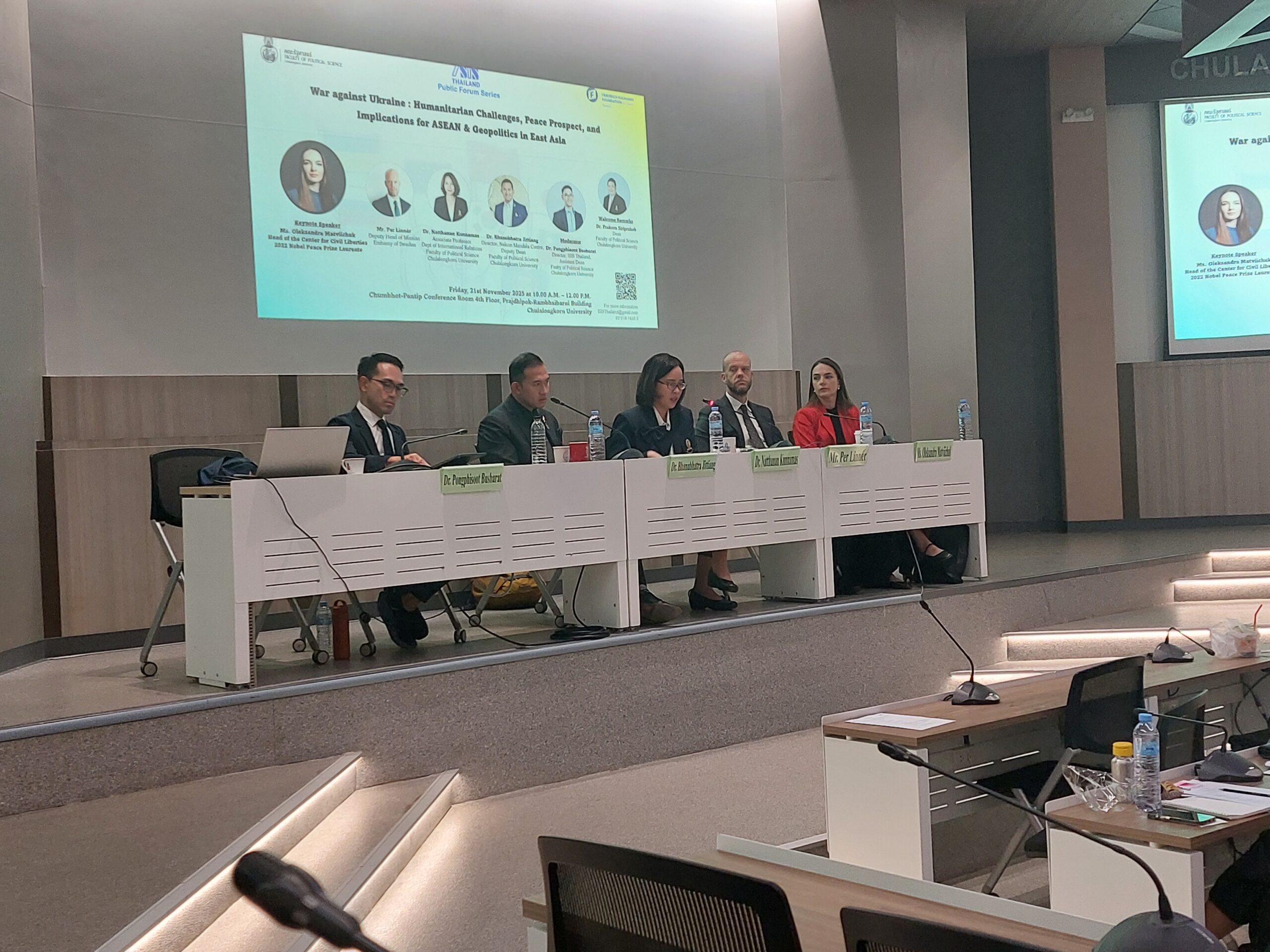
On the 21st of November 2025, HDFF was invited to a public forum titled “War against Ukraine: Humanitarian Challenges, Peace Prospects, and Implications for ASEAN and Geopolitics in East Asia.”
The panelists were Ms. Oleksandra Matviichuk, the head of the Center for Civil Liberties and the 2022 Nobel Peace Prize Laureate; Mr. Per Linnér, the deputy head of mission of the Embassy of Sweden in Bangkok; Dr. Natthanan Kunnamas, the Jean Monet Chair and Director of the Centre for European Studies; and Dr. Bhanubhatra Jittiang, the director and deputy dean of the Nelson Mandela Center.
These distinguished individuals contributed a variety of nuanced insights to the discussion. Ms. Matviichuk brought her knowledge of the Ukraine-Russia war to the table, while Mr. Per Linnér highlighted his expertise on the actions that Western countries have taken in response to the war, and Dr. Kunnamas and Dr. Jittiang emphasized the relevance of the war to ASEAN countries and East Asian countries in general.
Overall, the seminar touched upon the following topics:
- Ukraine’s Humanitarian Challenges
- The Western Perspective of the War
- Comparisons Between the Humanitarian Responses of Different Actors During the Ukraine-Russia War and Myanmar Civil War
- The Views of Northeast Asia and Southeast Asia on Macro-securitization
Ukraine’s Humanitarian Challenges
Ms. Matviichuk spearheaded the discussion with a keynote speech that emphasized the humanitarian challenges that Ukraine is currently facing in the midst of the war. With her colleagues at the Center for Civil Liberties, she has documented approximately 91,000 war crimes perpetrated by Russian troops. These documentations are not mere numbers but stories of those who have suffered from the Russian attacks and are endeavors to humanize the victims of Russia’s crimes against humanity.
Moving beyond her work, she established that Russia’s attacks on Ukraine have a genocidal character to them. In Russian-occupied territories, the Ukrainian language has been banned, and they have implemented laws that have been designed to erode the culture of Ukraine. Russia has also taken more than 20,000 Ukrainian children from their families and forced them to be raised by Russians to isolate them from their cultural heritage.
Beyond the challenges currently faced by Ukraine, she talked about what the Russia-Ukraine war implies for global order. With Russia’s violations of the UN Charter, Ms. Matviichuk believes that the country is slowly attempting to create a new norm, a norm where strong countries can take from weaker ones with no regard for law and order. If Russia manages to occupy Ukraine, that will not only cause the suffering of the citizens to potentially go unnoticed, but it may also set a precedent for the world.
In spite of this, she ended her speech with a note of hope. She believes that ordinary people can bring about change, and as long as there are those who want to help when legal instruments become obsolete, there is always the chance to fight back and restore order.
The Western Perspective of the War
Mr. Linnér spoke elaborately about the Swedish perspective of the ongoing conflict as well as the actions the European Union has taken to support the country. According to the panelist, Sweden has provided material support to Ukraine while the European Union has funded the country with a total of 190 billion euros.
After the beginning of the conflict, countries such as Sweden and Finland had also decided to join NATO as a defensive alliance, and Ukraine itself has shown interest in joining in spite of its initially neutral stance, suggesting that the war has caused countries to be more wary of security threats.
Mr. Linnér also emphasized the complementary goals of NATO and the EU, supplementing his view with mentions of security organizations that were launched to ensure the region’s safety, such as the Permanent Structured Cooperation (PESCO), the European Defense Fund (EDF), and military mobility initiatives. The goals and priorities of these organizations have changed in response to the invasion.
Like Ms. Matviichuk, the panelist stressed the importance of holding Russia accountable for their crime, emphasizing that all countries should have the right to create their own security policies and that Russia’s ideology of “might is right” should not be allowed to persist.
Comparisons Between the Humanitarian Responses of Different Actors During the Ukraine-Russia War and Myanmar Civil War
Dr. Jittiang compared the responses of different actors to the Russia-Ukraine war and the Myanmar civil war.
For both situations, local actors were the first to support people who needed help. Since they are not bound by rules, they have more flexibility and are quicker to respond. The panelist believes that local actors should be treated as partners to formal organizations rather than liabilities to increase efficiency in distributing humanitarian aid.
Aside from that, information technology was used in both cases to aid humanitarian responses, suggesting that further optimizing the use of this form of technology would ensure efficient responses to crises.
In spite of these similarities, there are differences between how formal organizations, namely the EU and ASEAN reacted to Ukraine and Myanmar respectively.
The European Union and ASEAN differed on how they reacted to the influx of refugees. Although the EU responded quickly and with compassion to Ukrainian refugees, ASEAN countries were wary of the security issues the Burmese refugees may cause and were not quick to respond to the humanitarian crisis.
Compared to the EU, ASEAN has less collectivity as well. The countries react to issues individually; as a result, they are slow to respond. Due to the varying interpretations of the non-interference principle, ASEAN lacks the ability to create effective solutions. The “five-point consensus” is an example of this, as it has been shown to be reliant on the cooperation of Myanmar and does not exert sufficient pressure.
The Views of Northeast Asia and Southeast Asia on Macro-securitization
Finally, Dr. Kunnamas distinguished between Northeast Asia and Southeast Asia in terms of their level of macro-securitization and their perspective on security. Macro-securitization is when a country views a conflict that is happening in a distant geographical location as a threat to their own security. According to the panelist, Northeast Asia has a higher level of macro-securitization compared to Southeast Asia, with Japan suggesting an Asian NATO.
In contrast to Northeast Asia, Southeast Asia has a lower level of macro-securitization and does not view Russia as a threat, with Singapore being the only country that has imposed sanctions onto the country due to their belief in a rules-based system of governance. Southeast Asian countries have also been indifferent to the threat China poses as Russia’s greatest ally.
This lack of foresight has implications for the future, as it may prevent them from implementing the necessary systems to protect the citizens of their country and to stop any incoming attacks. The panelist stressed the importance of sanctions and their value as a deterrent.
Conclusion
A myriad of topics were presented; however, they all culminated into the sentiment that Russia must be held accountable for their actions due to the precedent it may set if they are left uncondemned and the idea that this conflict has various implications for East Asia, particularly the lessons they can learn from the EU’s response to the conflict and the security risks it may be subjected to if it remains neutral and refuses to view distant conflicts in terms of macro-securitization.
HDFF would like to thank the Friedrich Naumann Foundation for the invitation to this informative event and HDFF’s team is looking forward to future opportunities.
Bangkok 24. Nov. 2025
Comments are closed