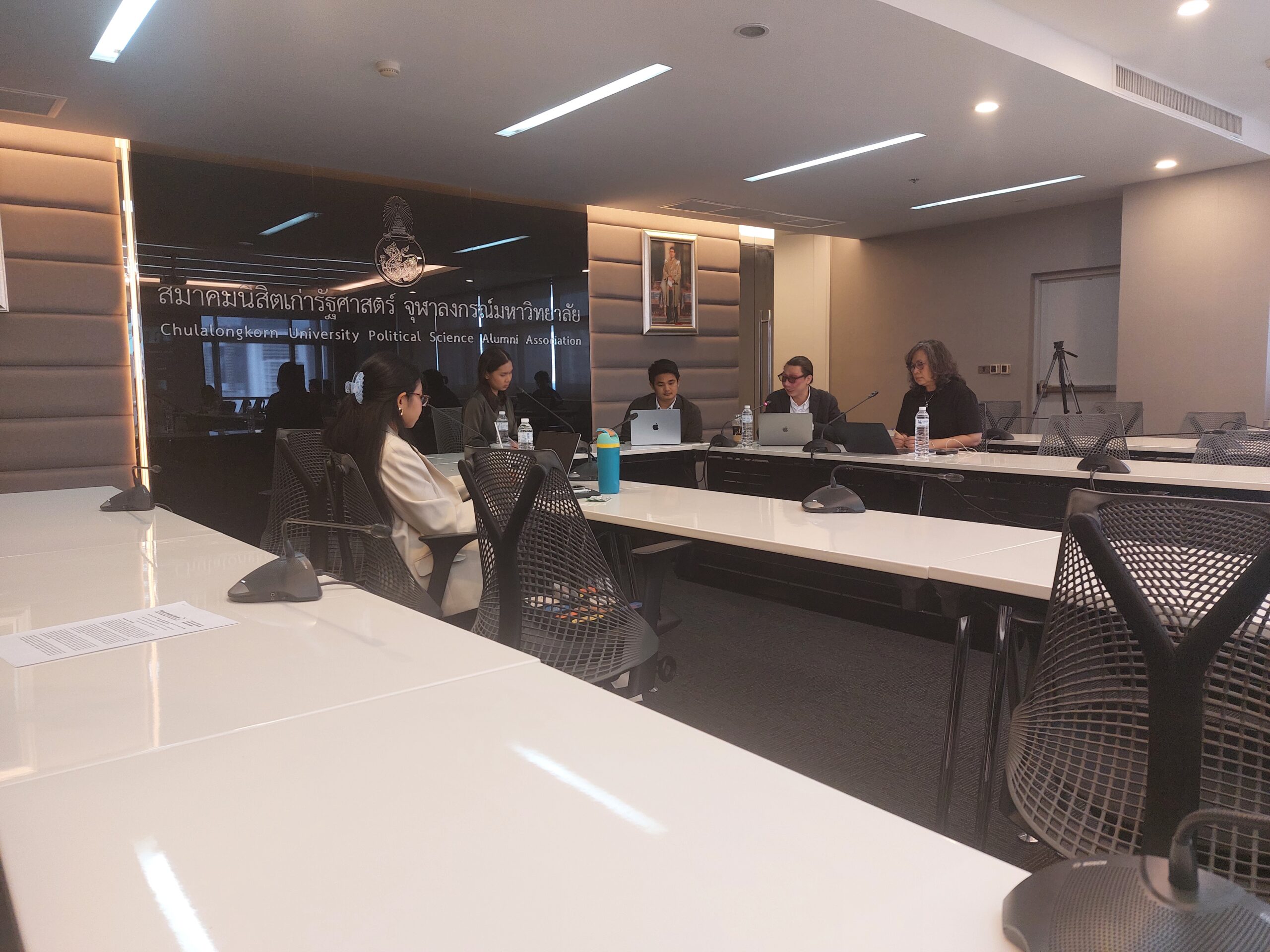
On the 28th of November 2025, HDFF was invited to a seminar titled “Intersection of Policy, Protection, and Securitization: Reflections on Thailand’s National Screening Mechanism.”
The panelists invited to the event were Mr. Chawaratt Chawarangkul from the International Detention Coalition, Ms. Naiyana Thanawattho from Asylum Access Thailand, and Dr. Andrew Wai Phyo Kyaw, the non-residential fellow of the Centre for Asia Pacific Refugee Studies.
The seminar primarily focused on the National Screening Mechanism (NSM) of Thailand, which was developed in 2019 but launched in 2023. The purpose of the mechanism is to allow immigrants to apply to be recognized as “protected persons” to prevent their refoulement. However, as acknowledged by the panelists, the NSM is currently imperfect and is in possession of various limitations.
This report discusses the following two topics in relation to the NSM:
- Thailand’s Approach to the Influx of Refugees
- Limitations of the NSM
Thailand’s Approach to the Influx of Refugees
As noted by Mr. Chawarangkul, Thailand’s approach to refugees has been a balance between three different variables, namely humanitarianism, political self-interest, and national security, mentioning that political self-interest and national security have the capacity to overshadow humanitarianism.
In spite of this grim notion, the NSM should be recognized as a major achievement, as in the past, Thailand had made no attempts to implement legal measures to help refugees, with UNHCR and NGOs supporting them instead of the law. Nonetheless, the NSM has been disputed due to its nature of prioritizing national security over protecting refugees.
Denoting particular policies enforced in response to immigration, Mr. Chawarangkul underscored that over the past ten years, there have been developments in Thailand in their response to refugees, citing international recognition of the issue as one of the possible reasons. Before the establishment of the NSM, the Alternatives to Detention Medium of Understanding (ATD MOU) was implemented in an attempt to end the detainment of children in immigrant detention centers. Moreover, in 2023, the Anti-Torture Act was implemented to prevent the torture and abuse of immigrants during detainment, further protecting them from exploitation and violence. This suggests that Thailand is making strides in their protection of refugees, although it has yet to ratify the 1951 Refugee Convention.
Limitations of the NSM
After Mr. Chawarangkul’s informative detailing of Thailand’s approach to refugees, Ms. Thanawattho and Dr. Kyaw discussed the current limitations of the NSM. The following were discussed:
- Lack of Information Related to the NSM
There is currently no proper system in detention centers to inform immigrants of the NSM, causing them to lose the chance of being protected. Furthermore, the information that is available is not in their native language, further undermining information accessibility.
- The Need to be Arrested to Seek Protection
Immigrants need to be detained to be able to apply for the NSM. This, in the words of Ms. Thanawattho, is a Catch-22, further diminishing the desire of immigrants to apply to become a protected individual. There is also no guarantee that the immigrant in question will be granted the status due to the vagueness of the NSM and its tendency to leave interpretation to the discretion of the committee members in charge of the screening.
- Financial Burdens
After the immigrant is arrested, to be freed, a bail must be paid in accordance with the Immigration Act. This is usually 50,000 baht. In addition to that, the NSM is an additional 20,000 baht, further burdening the immigrant.
- Refugee Information Networks
Refugees have created communities to navigate the system themselves rather than rely on information transmitted systematically. This has caused rumors and misinformation to be disseminated, further confounding the participants.
- Lack of Trust in the System
Throughout the seminar, the sentiment that the NSM prioritizes national security over refugee protection was prevalent, and this was also reflected in the interviews conducted by Dr. Kyaw, with one interviewee saying, “Seems like the purpose is to screen out people rather than genuinely trying to provide protection,” and another saying that “it is a complete risk.” Currently, the incentives of the NSM are not sufficient to outweigh the risk of refoulement or detention.
- Systemic Exclusion
Finally, Dr. Kyaw emphasized the exclusionary nature of the NSM. The mechanism excludes migrant workers from Myanmar, Laos, and Cambodia, and the NSM does not grant working rights to those who successfully pass the system, causing pink card holders (foreigners who are long-term residents of Thailand or entered the country for economic gain) to be prioritized over them. This pushes them towards informal sectors, which can diminish their status.
Conclusion
Thailand is currently in the process of creating effective legal instruments, with NSM being a starting point. The panelists acknowledged that the official document for the NSM requires particular amendments to establish clearer criteria for who is considered a security threat and who is considered a “protected person.” Concerns were also raised pertaining to the use of the term “alien” and the absence of the word “refugee” due to Thailand’s reluctance to acknowledge the Refugee Convention. Optimistically, by removing its vagueness, establishing appropriate terminology, and addressing the aforementioned limitations, the mechanism will become an independent tool that does not require the excessive discretion of its user, allowing it to help more immigrants in need of asylum.
HDFF would like to thank the Nelson Mandela Center for the invitation to this informative event and HDFF’s team is looking forward to future opportunities.
Bangkok 08. Dec. 2025
Comments are closed