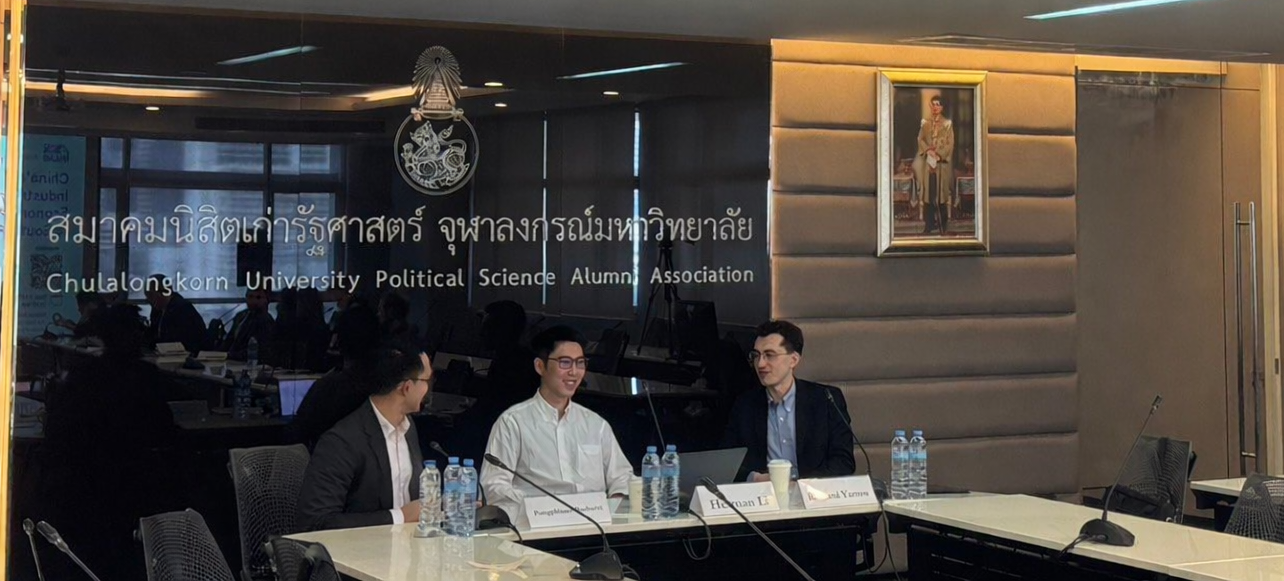
On the 11th of February, a HDFF team attended a seminar entitled “China’s New Industrial Policy and Economic Approach to Southeast Asia” that was organized by the Institute of Security and International Studies of the Faculty of Political Science of Chulalongkorn University.
The seminar featured a senior fellow from the Shenzhen Institute of Financial Stability and Development, Mr. Herman Li. He has worked with the General Office of the Central Committee and Central Organization Committee to develop reports for China’s five-year plans, making him an authoritative individual in matters involving them.
Accompanying him were Mr. Richard Yallow, a research fellow at the Mossavar-Rahmani Center for Business and Government at the Harvard Kennedy School, and Mr. Phongphisoot Busbarat, the Director of the Institute of Security and International Studies of Chulalongkorn University. They posed interesting questions to Mr. Herman Li regarding China’s current economic situation and its future economic policy.
This report is divided into the following four sections:
1.) China’s 14th Five-Year Plan
2.) The Dual Track Dilemma of the 15th Five-Year Plan
3.) China’s 15th Five-Year Plan
4.) Questions from the Panelists
China’s 14th Five-Year Plan
Mr. Herman Li opened the seminar with a brief explanation of what can be expected of the 15th five-year plan with reference to the 14th five-year plan and China’s current economic and industrial situation. Mr. Li emphasized the effects of the 14th five-year plan, which was characterized by China’s shift from the prioritization of scale expansion in the industry to quality improvement along with their shift from technological import to endogenous innovation.
Essentially, in the 14th five-year plan, China decided to focus more on their domestic markets to refine their technological capacity and prioritize research and development to prevent technological reliance on other countries. One particularly interesting case study the speaker mentioned was in the context of Shenzhen. Shenzhen relied heavily on material industries, but during the 14th five-year plan, it shifted to high-tech industries, causing a rise in their economy.
The Dual Track Dilemma of the 15th Five-Year Plan
One of the challenges caused by the 14th five-year plan is the dual-track dilemma. The dual-track dilemma pertains to the balance between China’s traditional and emerging industries. The traditional industries are industries that focus on the production of material goods and processing of raw materials, while the emerging industries are more technologically centered. If the balance shifts towards the emerging industries, China’s traditional industries will be phased out. As a result, the speaker suggested that it is vital for traditional industries to actively transform by getting into e-commerce and reducing labor costs.
Mr. Li also emphasized the synergy between the traditional industries and the emerging industries, mentioning that emerging industries evolve from traditional industries. As such, the question that China needs to answer is what should be done to balance the two types of industries.
China’s 15th Five-Year Plan
In the 15th five-year plan, China will be prioritizing diffusion over exportation. This means that the country will encourage Chinese companies to operate in other countries, thereby introducing China’s industrial capacity in other regions. This is one of the solutions China came up with to allow for the coexistence of the traditional and emerging industries. In addition to that, China will be investing more in human resources, allowing for higher economic sustainability in light of the current unpredictable and volatile geopolitical situation.
In accordance with the Dual Circulation Policy, the focus will still be on developing a self-sustaining economy that does not need to rely on foreign markets. Shifting from exportation to diffusion will allow the country to strengthen the country’s influence in the global market without being dependent on technological advancements of other countries. In the context of diffusion, the Transsion Holdings Company was mentioned as an example other companies can learn from, as it was able to achieve considerable success in the African phone market. In spite of its achievements, it is not very popular, causing it to be dubbed “The Silent Champion” by the speaker.
Another one of China’s goals is the urbanization of rural areas. China will do this through the development of township enterprises, global supply chain integration, and urban-rural fusion. This will allow for a reduction in the country’s urban-rural divide, allowing for enhanced economic growth.
Finally, Mr. Li briefly touched upon Thailand’s role in China’s 15th five-year plan, mentioning that Thailand has the capacity to bridge the Chinese market and the ASEAN market, allowing for economic enhancement in both regions.
Questions from the Panelists
Mr. Yallow’s Question: Traditionally, China’s industrial policies are traditionally administered by the local government, allowing them to experiment with different enterprises that coincide with some general central government directive, and in the past couple of years, real estate developers have been experiencing bankruptcy, causing severe stress on the finances of local governments. How will this affect China’s ability to implement the 15th five-year plan?
Answer: Mr. Li answered the question by first addressing the concern regarding the system involved in the making of industrial policies with regard to the role of the central government and the local governments. He emphasized that in the development of the five-year plans, the local governments typically develop their own plan and forward it to the central government for approval. After that, negotiations are made to come to a consensus regarding the feasibility of the plan. This means that the central government is not dominant in the policy-making process. Instead, the local and central governments work together to develop context-driven plans.
Going back to the issue of real estate developers being bankrupted in the country, Mr. Li mentioned one possible solution to the issue, which is to involve private companies in the industrial decision-making. This involves assigning a leading business as the leader of their sector, allowing them to manage supply chains and develop plans that coincide with the government’s goals in the case of sanctions or economic upheavals.
***
Mr. Yallow’s Question: Do you see the goals of the 15th five-year plan changing as time passes?
Answer: Mr. Li said that it is typical for five-year plans to have multiple goals, and there are times when they contradict one another, citing the goal of ensuring optimal market efficiency and ensuring employment in the sector as an example. During the development of the five-year plan, multiple goals are considered along with multiple methods of achieving the goals.
Using the Dual Dilemma as an example of this contradiction, he mentioned “social dumping” as the possible solution. Social dumping is when companies relocate to areas where the product of the company is still in demand. By moving traditional industries to rural areas, the Chinese government would be able to balance the demand of the emerging sector without removing the traditional industries completely, especially since doing so can cause employment issues.
***
Mr. Busbarat’s Question: How will Southeast Asia benefit intellectually from the diffusion of Chinese companies, as the intellectual property will still remain in China?
Answer: Intellectual property transfer is typically a gradual process. Currently, China is focusing more on capacity-building for individuals in the host country, but these individuals, after accumulating sufficient knowledge through the development of the Chinese company, can get into research and development. Mr. Li also emphasized how collaboration between Chinese companies and locals can also facilitate knowledge transfer through consultations and the demand for country-specific products.
***
Mr. Yallow’s Question: What are the mistakes that China has made with regard to their industrial policies?
Answer: The sudden phasing out of old industries without having a new industry to take its place is one of China’s biggest industrial mistakes. Mr. Li emphasized how this mistake has the capacity to bankrupt local governments for multiple years, considering it an “awkward” situation.
Conclusion
All in all, the informative seminar touched upon multiple vital topics regarding China’s industry, including the 14th five-year plan, the prospective goals of the 15th five-year plan, and the Dual Track Dilemma. Moreover, the questions of the panelists allowed for a more in-depth look at the current situation, further illustrating the complexities of China’s industrial policies.
HDFF would like to thank the Institute of Security and International Studies at Chulalongkorn University, Thailand, for the invitation to this very comprehensive and informative event.
Comments are closed