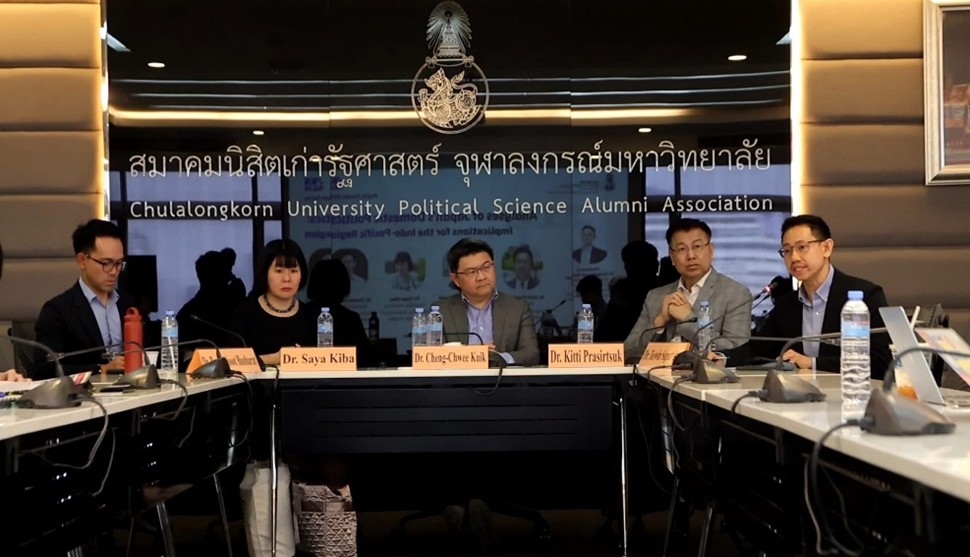
On Friday, 13 February 2026, a team of HDFF attended a public forum at Chulalongkorn University titled “Analyses of Japan’s Domestic Politics: Implications for the Indo-Pacific Region.” Organized by the Faculty of Political Science in collaboration with ISIS Thailand, the event offered an important space to reflect on Japan’s evolving political landscape and its growing strategic role across maritime Asia.
The forum came at a particularly significant moment, following Japan’s February 2026 snap election, which renewed attention on Tokyo’s domestic political direction and its implications for the wider Indo-Pacific order.
A Distinguished Panel of Regional Experts
The discussion was moderated by Dr. Pongphisoot Busbarat, Director of ISIS Thailand and Assistant Dean at the Faculty of Political Science, Chulalongkorn University. The panel featured leading scholars of Japanese politics and Indo-Pacific security:
- Dr Kitti Prasirtsuk, Professor of International Affairs, Thammasat University
- Dr Cheng-Chwee Kuik, Professor of International Relations, National University of Malaysia (UKM), and Visiting Fellow at Kyoto University
- Dr Saya Kiba, Associate Professor, Kobe City University of Foreign Studies, Japan
- Dr Teewin Suputtikun, Head and Assistant Professor, Department of International Relations, Chulalongkorn University
Their combined perspectives provided a multidimensional view of how Japan’s domestic politics are increasingly intertwined with regional security dynamics.
Japan’s Election and Opposition Fragmentation
A central focus of the forum was Japan’s domestic political shifts following the snap election and the rise of Prime Minister Sanae Takaichi.
Dr. Saya Kiba provided detailed insights into the election landscape, highlighting the challenges faced by Japan’s opposition and centrist forces. She noted that centrist parties and smaller coalition actors—including groups with limited coordination time—struggled to mount an effective electoral challenge. Her presentation emphasized the political contest between “PM Takaichi vs. the centric coalition,” as well as the structural difficulties opposition parties face under Japan’s mixed electoral system combining single-member constituencies and proportional representation
Dr. Saya also observed that Japan has not yet experienced intense parliamentary debate following the election, suggesting that domestic political consolidation may continue even amid unresolved economic and diplomatic pressures.
Domestic Priorities: Economy, Inflation, and Security
Several speakers emphasized that Japan’s political future will be shaped not only by external threats but also by domestic concerns, including inflation and economic uncertainty.
Dr. Saya and others noted that Japan’s diplomacy remains deeply anchored in the US–Japan security alliance, with limited “plan B” beyond cooperation with like-minded partners. The discussion returned repeatedly to Japan’s strategic vision of the Free and Open Indo-Pacific (FOIP), rooted in former Prime Minister Abe’s regional framing, including his 2014 Shangri-La Dialogue speech.
The forum also highlighted Japan’s ongoing defense trajectory, including the legacy of Prime Minister Kishida’s commitment to raise defense spending from 1% to 2% of GDP, shaped by the lesson that “Ukraine today could be East Asia tomorrow.”
US–Japan Relations and Strategic Uncertainty
Dr. Kitti Prasirtsuk focused on the evolving nature of the US–Japan alliance and the question of burden-sharing in regional defense. He discussed how Washington increasingly expects Japan, South Korea, and Australia to take on greater responsibilities as part of a broader “regional handoff” strategy.
Dr. Kitti also reflected on the implications of US domestic politics, including the unpredictability of Trump-era approaches. He suggested that Japan may be pushed toward greater strategic clarity on Taiwan contingencies, even as the alliance continues to evolve beyond rhetorical uncertainty
He also noted Japan’s expanding defense partnerships beyond the US alliance, including collaboration with Italy on next-generation jet fighter development.
Japan’s Rightward Shift and Constitutional Debates
Dr. Teewin Suputtikun offered reflections on how Japanese domestic politics may be shaped by economic anxieties as much as by security debates. He discussed the rise of right-wing agendas connected to defense reforms, constitutional reinterpretation, and Japan’s expanding strategic posture.
At the same time, he noted that despite shifts in rhetoric, Japan continues to adhere formally to the “One China” policy while seeking to maintain the regional status quo. He also argued that China’s coercive diplomacy has not been fully effective in reshaping regional alignment patterns
Hedging, Alignment, and Southeast Asia’s Role
Dr. Cheng-Chwee Kuik brought a regional and theoretical lens to the discussion by posing a broader question: how do small and medium-sized countries navigate intensifying major power competition? To unpack this, he introduced his “3As” framework — Alignment, Alliance, and Ambivalence — as a way of understanding the evolving dynamics between Japan and Southeast Asia within the Indo-Pacific strategic landscape.
First, Alignment: Dr. Kuik observed that Japan and many Southeast Asian states have developed one of the highest forms of strategic partnership in the region. This alignment is grounded in long-term trust, economic interdependence, institutionalized cooperation, and a shared interest in maintaining stability and openness in the Indo-Pacific. However, he stressed that alignment does not automatically equate to alliance. It reflects convergence of interests, but without the binding obligations that characterize formal security treaties.
Second, Alliance and Ambivalence: Alliance, he explained, represents the most formalized and institutionalized form of alignment, exemplified by Japan’s treaty alliance with the United States. In contrast, Japan’s partnerships with Southeast Asian countries remain flexible and non-binding. At the same time, Southeast Asian states exhibit strategic ambivalence — welcoming opportunities, investment, and security cooperation, yet avoiding rigid commitments that might constrain autonomy. In this context, Japan’s expanding initiatives such as Official Security Assistance (OSA) interact with Southeast Asia’s preference for calibrated engagement rather than binary alignment choices.
Reflections: Japan at a Crossroads
Attending this forum was a reminder that Japan’s elections are not only domestic political events—they carry significant regional consequences. The discussions underscored how leadership consolidation in Tokyo will influence maritime security, alliance politics, and the broader Indo-Pacific balance.
At a moment of heightened geopolitical uncertainty, the forum provided a timely and grounded analysis of Japan’s evolving position at the crossroads of domestic politics and regional strategy. HDFF would like to thank ISIS Thailand for the opportunity to attend and is looking forward to future events.

A HDFF Team with Dr. Saya Kiba
Comments are closed