
Holding a scarf bearing the names and ages of people killed in Myanmar,
Ambassador Kyaw Moe Tun delivers an emotional message to the United Nations.
His voice breaking as he recalls the victims, he urges the international community to stand with the people of Myanmar and prevent further loss of life.
NEW YORK, October 27, 2026 — For a moment, the focus inside the United Nations shifted from diplomatic statements and political debate to the individual lives lost in Myanmar’s ongoing conflict.
During a briefing before the Third Committee of the 81st session of the United Nations General Assembly, Myanmar’s Permanent Representative, Kyaw Moe Tun, held up a scarf carrying the names of people who had died during the country’s struggle against military rule.
As he began explaining its significance, his voice became increasingly emotional. Seated behind him were three women, one visibly crying as he spoke. The scene conveyed the grief surrounding a conflict that has devastated communities across Myanmar since the military coup in February 2021.
The scarf was produced by Theatre 21, an initiative of Myanmar’s revolutionary community. Its purpose was not simply to commemorate those who had died, but to preserve their names and the ages at which their lives ended.
Among them was a baby just two months old. The oldest person listed was 105.
For Kyaw Moe Tun, the significance of the scarf was impossible to separate from the suffering behind every name.
He explained that reading the names was heartbreaking, adding that he desperately hoped no further names would have to be added.
His appeal was simple: Myanmar had already lost too many people.
A Lifetime Reduced to a Name
The ages displayed on the scarf offer a sobering picture of the human cost of the conflict.
A two-month-old infant and a 105-year-old person represent almost an entire human lifespan between them. Yet both appear on the same piece of fabric.
Their stories are different, but their names have become part of the same record of loss.
In his address, Kyaw Moe Tun described the victims as fallen heroes and innocent civilians who had lost their lives in the pursuit of freedom.
He spoke of children, young people, brothers and sisters, and elderly citizens whose futures had been taken away.
At one point, he made his intention unmistakably clear: he did not want to read any more names from the scarf.
The statement was more than personal grief. It was a warning about the continuing human consequences of Myanmar’s political and military crisis.
The Human Cost Behind the Statistics
The scale of the crisis is also reflected in figures compiled by the Assistance Association for Political Prisoners (AAPP), an independent organisation documenting arrests and deaths connected to the military coup.
According to the AAPP reference briefing dated October 22, 2026, a total of 32,199 arrests had been recorded since the military takeover in February 2021.
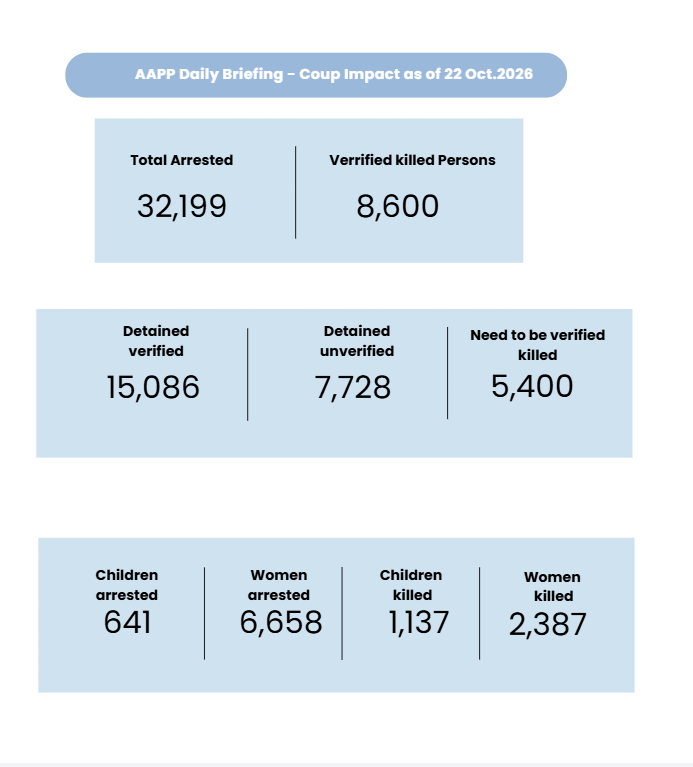
The figures shown above includes 15,086 verified detentions and 7,728 unverified detentions. The organisation also reported 8,600 verified deaths, with approximately 5,400 additional deaths still awaiting verification.
Women and children have been among those affected. The same briefing recorded 641 children arrested and 6,658 women arrested. Among the reported fatalities were 1,137 children and 2,387 women.
These figures represent AAPP’s documented cases as of the stated date. They should not be interpreted as a complete account of all victims, as the organisation continues to collect and verify information.
The figures give a sense of the scale of the crisis, but they cannot convey what each individual death means to the families left behind.
That is precisely what made the scarf such a powerful part of Kyaw Moe Tun’s address. It placed individual identities at the centre of an international discussion that is often dominated by statistics and political developments.
Chin State Among the Areas Affected
The AAPP briefing also highlighted the continuing civilian loss in Chin State.
Between January 1 and October 22, 2026, the organisation documented 64 deaths in the state, including 24 children under the age of 18.
According to AAPP, the identities of these victims had been verified, with airstrikes identified as the leading cause of death during the reporting period.
The organisation also received information about 48 additional civilian deaths whose identities had not yet been confirmed. One incident described in the briefing occurred on October 18, when an aerial attack reportedly struck the Pi Chaung Sone commercial port in Paletwa Township. Nine civilians were reported killed, including a six-month-old child, while others sustained injuries.
A message that goes beyond Diplomacy
Kyaw Moe Tun praised the courage and resilience of those resisting military rule in Myanmar and called for international support for their struggle for federal democracy.
A particularly emotional moment was his scarf bearing the names of people killed by violence since 2021.
the youngest victim was just two months old, while the oldest was 105.
His message is clear: The international community must not ignore the suffering of Myanmar’s people.
The scarf honors the victim and serves as an appeal to prevent further loss of life.
Sources and References
1. Official statement by Ambassador Kyaw Moe Tun – October 27, 2026
Myanmar Permanent Mission to the United Nations. Statement by Ambassador Kyaw Moe Tun at the Combined Briefing on Myanmar, Third Committee of the 81st Session of the UN General Assembly.
2. DVB English – October 28, 2026
DVB English. Myanmar Ambassador holds up scarf bearing victims’ names in tearful address at UN.
3. Assistance Association for Political Prisoners (AAPP) – October 22, 2026
AAPP. Daily Briefing on arrests, detentions and fatalities following the 2021 military coup in Myanmar.
Reference: User-provided AAPP briefing graphics dated October 22, 2026.
Comments are closed