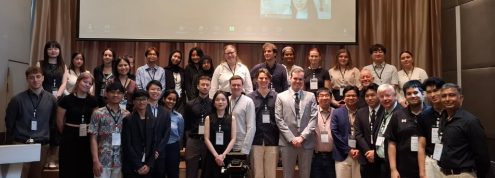
On April 4th, 2025, the HDFF team attended the Asia Centre’s GDC Forum titled “Youths, Democracy and Electoral Legitimacy in Asia”, held at Four Points by Sheraton in Bangkok. This event brought together regional experts, youth activists, and scholars to address the issues revolving around youth political participation, electoral legitimacy, and democratic backsliding. The forum comprised two panel discussions followed by an interactive group session aimed at outlining practical actions for strengthening youth participation.
Mr. Sanjay Gathia, Programme Manager at Asia Centre, and Mrs. Elisinda Balleste Buxo launched the forum by identifying the key tensions surrounding electoral participation in Asia. While questioning whether political disengagement among youth stems from apathy or a broader demand for systemic change, they outlined three main thematics : representativity, transparency, and fairness, which framed the rest of the discussion. The following is a report on subjects discussed during the forum
Youth, Democracy, and Elections in Asia – Issues and Challenges
Moderator: Fatin Arwaeputeh, Partnership Associate, Asia Centre
Speakers
- Chaehyun Kim, Youth Representative, Korea Democracy Foundation (KDF).
- Shelly Mahajan, Program and Research Manager, Political Party Watch, Association for Democratic Reforms (ADR).
- Chikita Edrini Marpaung, Public Interest Lawyer, Legal Aid Organization for the Press (LBH Pers).
1) The Absence of Young Politicians in South Korea : a Choice or an Inevitable Reality?
Ms. Chaehyun Kim addressed the paradox of South Korea’s politically engaged yet underrepresented youth. By mentioning events such as the December 3rd 2024 Martial Law, she explored the dual forces of polarization and structural barriers. According to her, while there is growing youth interest, political fatigue and institutional constraints, such as opaque party nomination processes and a lack of internal party commitment to youth development, highly limit effective participation. Suggested solutions to these issues included expanding proportional representation, fostering civil society advocacy, and encouraging youth to transition from digital engagement to offline political discourse.
2) Electoral Participation and Electoral Representation in Indian Youth : Issues and Challenges
Shelly Mahajan contextualized India’s youth participation against the backdrop of its vast under-25 demographic. Despite record engagement in the 2024 elections, only less than 40% of first-time voters registered. She then proceeded to describe the barriers to participation: electoral apathy, unemployment, systemic corruption, and the domination of gerontocracy and political dynasties. The discrepancy between the average citizen’s age, which is 27.8 years old, and parliamentarians who are on average 55.6 years old, underlined this disconnect. Ms. Mahajan’s solutions ranged from youth quotas and remote voting mechanisms, to revitalizing civic and political education or ensuring inner-party democracy.
3) The Power of Hashtags in the Indonesian Youth Movement and their Challenges to the Status quo
Ms. Marpaung examined Indonesia’s digital activism ecosystem, arguing that movements like the #ReformasiDikorupsi goes beyond “slacktivism” and constitutes a fifth pillar of democracy. However, while digital platforms amplify youth voices on human rights and environmental issues, she warned of the risks of performative activism. Her call was for a broad strategy that blends online presence with offline political action, international solidarity, and press freedom advocacy.
By the end of the discussion, the question of how to counter democratic backsliding in the current global context was addressed by Chikita Edrini Marpaung. She outlined five broader solutions to tackle this issue. She first emphasized the importance of defending democracy itself and then highlighted the role of the press and journalists, advocating for greater independence and underlining the need for meaningful youth participation in shaping legislation. Marpaung also called for inclusive engagement with all stakeholders to ensure more responsive and representative governance. Additionally, she stressed the necessity of guaranteeing access to independent and reliable information, particularly on social media platforms. Lastly, she underscored that the judicial system should operate under the scrutiny and control of society and its citizens, promoting transparency and accountability in the rule of law.
Breaking Barriers for Youth Participation in Politics
Moderator: Ekmongkhon Puridej, Researcher Asia Centre
Speakers
- Jernell Tan, Documentation and Monitoring Coordinator, Suara Rakyat Malaysia (SUARAM).
- Mrs. Liliane, Founder, Politics for Women, Myanmar.
- Dr. Alan H. Yang, Executive Director, Taiwan-Asia Exchange Foundation (TAEF)
- Chompunut Chalieobun, Regional Programme Manager, Westminster Foundation for Democracy, Thailand.
- Nadiia Ivanova, Director, Center for Human Rights and Democracy People in Need (PIN)
1) Strengthening Youth Agency and Civic Action for Human Rights and Social Change in Malaysia
Ms. Jernell Tan traced the historical trajectory of Malaysian student activism, from its suppression under the Universities and University Colleges Act (AUKU) to modern resistance against draconian laws such as the Internal Security Act (ISA). The barriers to youth participation identified included personal challenges like the risk of detention, state and authority restrictions, and organizational challenges like a misalignment with institutional leadership. A dual strategy was proposed: soft approaches like educational programs, and hard approaches including protests and public actions. Universities, she stressed, remain central hubs for civic engagement.
2) Changing Role of the Women and Youth in Politics in Myanmar
Mrs. Liliane provided an informative insight of the post-coup landscape in Myanmar, where youth and women have spearheaded the Spring Revolution. Despite their critical roles in defense, humanitarian aid, and governance, women still face gender-based violence (GBV), economic insecurity, and psychological trauma. She highlighted the inefficiency of the Five-Point ASEAN Consensus promoting calls for immediate end to violence ; delivery of humanitarian assistance ; dialogue among all parties ; appointment of a social envoy to Myanmar and direct engagement with all stakeholders. Mrs. Liliane pointed out the need for inclusive dialogue, international solidarity, and structural reform to restore accountability and civil liberties.
3) Enabling Young Activism Solidarity between Taiwan and Southeast Asia
Dr. Alan H. Yang mapped the evolution of Taiwanese youth activism, from campus-led democratization to modern cross-regional solidarity movements like the Milk Tea Alliance. Emphasizing the New Southbound Policy Plus (NSP+), he advocated for enhanced knowledge exchange, legal empowerment, and network-building between Southeast Asian and Taiwanese civil society actors. According to him, the Taiwanese experience matters to Youth Activism in Southeast Asia, because it allowed the strengthening of international linkage, raised legal and human rights awareness, especially after the Tiananmen Square Massacre. He described Taiwanese activism as actionable, international, and rooted in democratic consolidation.
4) Women’s Participation in Politics : Barriers, Challenges and Violence Against Women in Politics in Thailand
Chompunut Chalieobun underlined the multidimensional obstacles that Thai women are facing in politics. Drawing on regional patterns, she outlined three archetypes of women leaders : the “networker”, the “trailblazer”, and the “activist”, while stressing how financial constraints, institutional sexism, and cultural backlash create a hostile environment, preventing women from having a seat at the political table . Institutional recommendations included gender-sensitive political financing, affirmative action quotas, and stronger media regulation against digital GBV.
5) Safe Mechanisms for Increasing Youth Civic Engagement in the Circumstances of Increasing Repressions : Knowledge Exchange Practices and the Duty of Care
Ms. Iranova analyzed the rising trend of in-country and transnational repression across Southeast Asia, especially in contexts like Vietnam and Thailand. She highlighted the dangers of activism under oppression and advised in favor of secure infrastructures, international protection mechanisms, and tailored capacity-building programs like the Emerging Leaders Fellowship (ELF) to ensure sustainable civic engagement under threat.
Afternoon Group Discussion: Strategic Planning and Action
The forum culminated in a collaborative session where participants mapped out systemic barriers to youth participation and co-developed a roadmap for action over the next 2-3 years. Key themes included: the institutionalisation of youth voices in governance, political parties, and civil society; creating inclusive platforms for cross-national exchange, supporting youth political education and leadership pipelines and finally, advocating for safe civic spaces and legal reforms that protect young political actors
HDFF would like to thank the Asia Centre for the invitation to this very comprehensive and informative event.
Photo source : Asia Centre
Comments are closed