
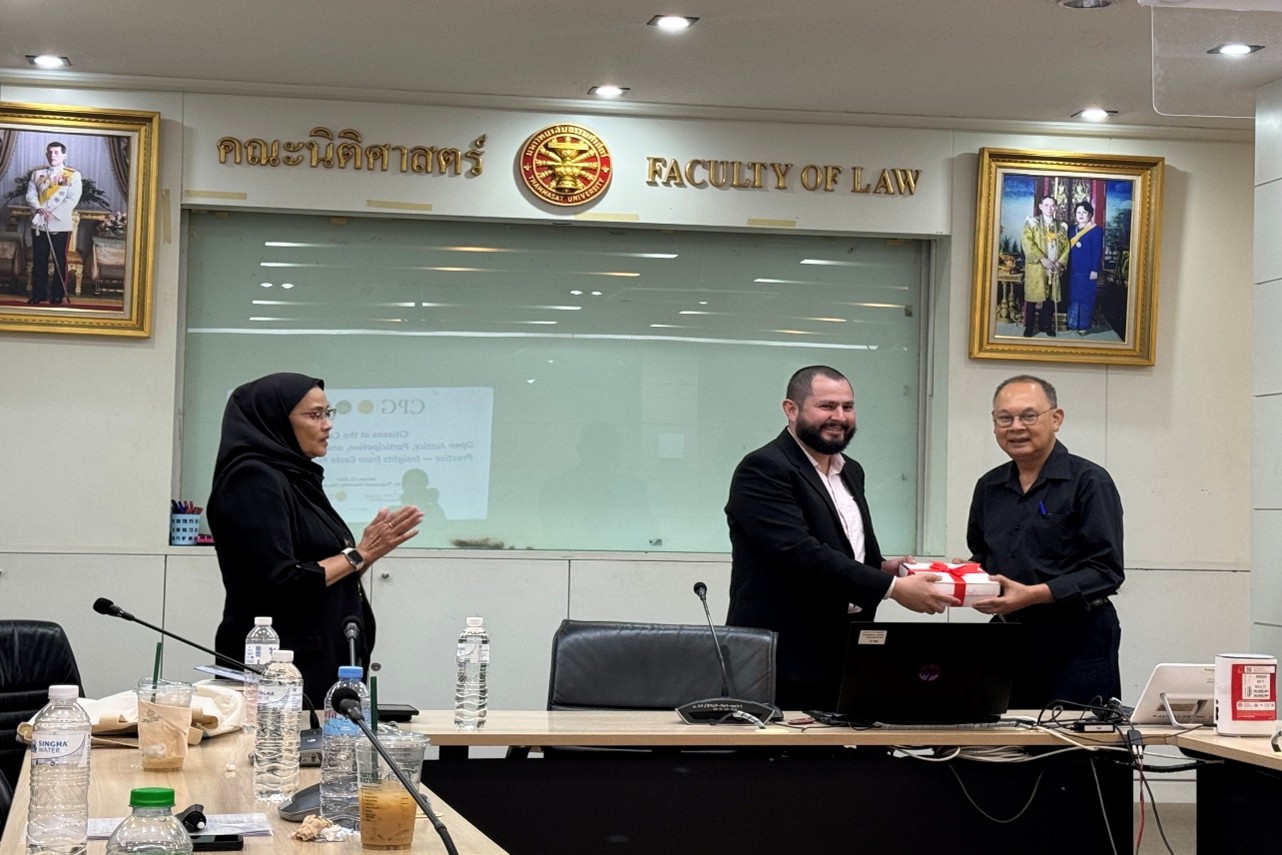
At a time when trust in justice institutions is under strain in many parts of the world, a recent seminar hosted by the Centre for Peace and Governance (CPG) asked a simple but powerful question: what does it really mean to put citizens at the center of justice systems?
The event, Citizens at the Center: Open Justice, Participation, and Accountability in Practice – Insights from Costa Rica and Thailand, brought together scholars, policymakers, and civil society actors to explore how the idea of open justice can move beyond transparency slogans and translate into meaningful participation and accountability in practice. The event was held on 22nd January 2026 at the Faculty of Law, Thammasat University’s Tha Prachan Campus.
From “open courts” to open justice
Open justice is often understood narrowly as public access to courtrooms or judicial decisions. However, speakers emphasized that the concept has evolved significantly. Today, open justice is increasingly seen as a broader reform agenda that includes accessible information, user-friendly procedures, participatory mechanisms, and institutional accountability across the justice sector.
Rather than treating transparency or open data as ends in themselves, the seminar highlighted how they function as enabling conditions: they shape who can engage with justice institutions, how they do so, and whether participation leads to real impact. Without understandable information and usable procedures, openness risks remaining symbolic rather than transformative.
Lessons from Costa Rica: justice rooted in communities
Drawing on experiences from Costa Rica, José Pablo Vargas Cubillo, Assistant Professor at the University of Costa Rica and former professional in the Costa Rican Judiciary’s Citizen Participation Program, revisited the foundations of open justice through a human rights lens.
He emphasized that access to justice is itself a human right, referencing Article 8 of the Universal Declaration of Human Rights. Yet, in practice, many people face barriers that prevent them from exercising this right: lack of information, complex legal language, high legal costs, fear and mistrust of institutions, and geographic isolation—especially for people living in rural or remote areas.
One of the most compelling examples shared was Costa Rica’s judicial facilitators program, which places citizens at the heart of justice delivery. Through trained community facilitators working in close coordination with judges and courts, the program helps communities navigate legal processes, resolve disputes, and access legal education. Today, the initiative operates in more than 40 courts nationwide.
Importantly, the model does not undermine judicial independence. Instead, it is built on clear rules and structured engagement, ensuring that community participation strengthens responsiveness and access to justice without influencing judicial decision-making.
Costa Rica’s experience, Vargas Cubillo noted, demonstrates that open justice works best as a collaborative governance model, involving the judiciary, government agencies, academia, civil society organizations, and international partners.
Thailand: openness, reform, and civic space
Turning to the Thai context, Angkhana Neelapaijit, Senator and former National Human Rights Commissioner, reflected on recent legal and political developments and their implications for open justice.
She highlighted positive reforms, including the passage of Thailand’s Marriage Equality Act in 2024, while also noting gaps in laws affecting ethnic groups and Indigenous peoples. Importantly, she stressed that open justice cannot flourish without freedom to monitor, criticize, and engage with justice institutions.
Key concerns raised included the continued use of criminal defamation laws and strategic lawsuits against public participation (SLAPPs), as well as insufficient protection for human rights defenders, journalists, and academics. Ensuring immunity, witness protection, access to bail, justice funds, and pro bono legal services were identified as essential safeguards for meaningful participation.
Drawing from civil society experience, she described how trial observation by CSOs, lawyers, and families of detainees can face restrictions—particularly in politically sensitive or national security cases—limiting public oversight and transparency.
Open Government Partnership: more than technical reform
Both speakers addressed Thailand’s ongoing process of joining the Open Government Partnership (OGP). While welcomed as a positive step, the discussion cautioned against viewing OGP membership as merely a technical exercise in data disclosure.
Instead, participants argued that OGP commitments must reflect genuine political will—including inclusive drafting of National Action Plans, meaningful civil society participation, and clear, measurable, and verifiable commitments. Open justice, they stressed, is ultimately about accountability, not just openness.
Why this conversation matters
The seminar underscored a central message: open justice is not about opening institutions for their own sake, but about enabling people to use, understand, and shape them. Whether through community-based facilitators in Costa Rica or legal reforms and civic engagement in Thailand, the path toward open justice depends on cultural change, institutional commitment, and sustained citizen participation.
As justice systems around the world grapple with legitimacy and trust, placing citizens at the center is not optional—it is fundamental to the rule of law.
Comments are closed