On July 31st 2025, a HDFF team attended the 4th International Conference on Governance and Development, organized by the College of Public Affairs and Development of the University of the Philippines, Los Baños and Kasetsart University, hosted by at Kasetsart University.
Opening Speech – Suzie Newman, Ph.D., ACIAR General Management for Partnerships, Australian Center for International Agricultural Research
Dr. Newman opened the conference by highlighting regional challenges and the need to evaluate not only how governments allow us to tackle them, but also how to include minorities in doing so. She acknowledged there are today 900 million people facing severe food insecurity, hence the urgency to take action. Especially since every dollar invested in agriculture offers a ten-dollar return, establishing increased agricultural productivity as a key path for poverty reduction.
She emphasized the necessity of knowledge-sharing and innovation through the case of the Black Soldier Fly, which long-running research has established as a key tool for a transformative shift towards a more reliable, profitable and sustainable source of protein for livestock feed and crop fertilizer. Sharing of Kenyan expertise on the viability of a low-cost circular economy solution to the waste and nutrition challenges empowered local farmers all the way to the Pacific region and opened the way for further partnerships and capacity development in Africa and in the Pacific. Further cooperation was encouraged in the future after such a success.
Plenary Session 1 – Lifelong Learning for Sustainable Development
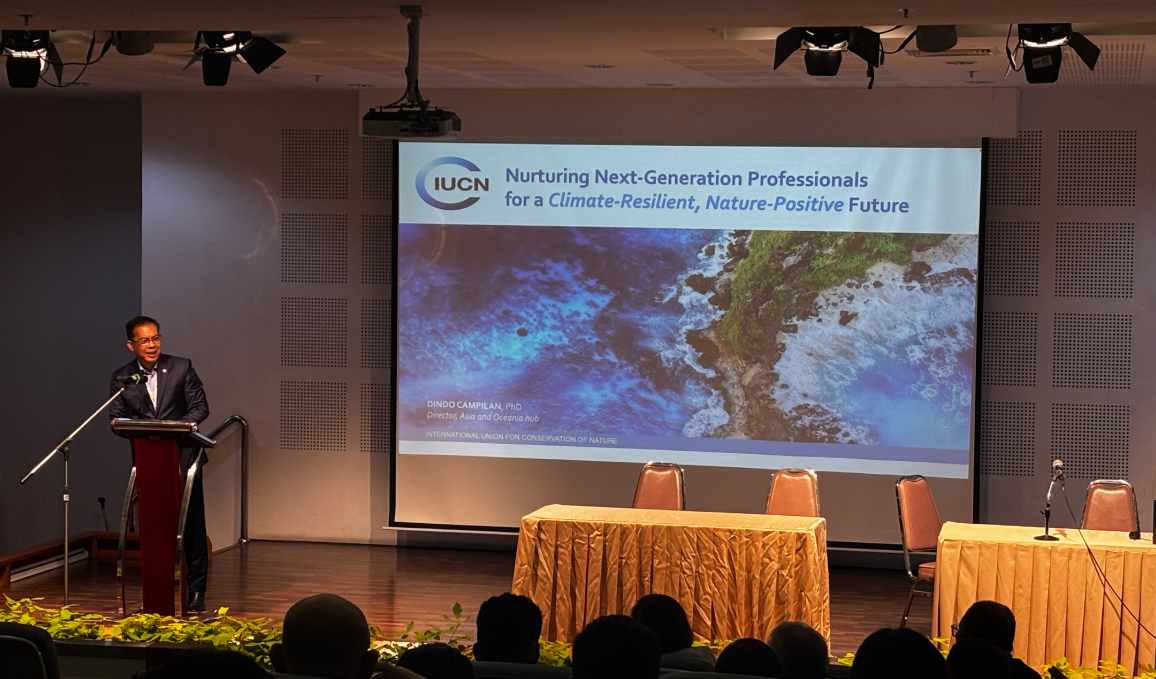
Dr. Dindo Campilan – PhD. In Agriculture and Environment Science, Regional Director for Asia and Hub Director for Oceania, International Union for Conservation of Nature (IUCN) – then took the floor to share his insights on “Nurturing next-Generation Professionals for a Climate-Resilient, Nature-Positive Future”.
He began by acknowledging the climate learning and climate-biodiversity nexus in the context of a triple environmental crisis (climate change, pollution and waste, biodiversity loss), testifying to the need to encourage an agenda for a just and sustainable society.
As the world’s largest and oldest environmental organization, IUCN works with over 1400 state and non-state actors in over 170 countries, including Indigenous people and local communities and has established itself as a global scientific authority on the natural world and its conservation. Thanks to such expertise, Dr Campilan advocated for the implementation of lifelong learning as 1) pedagogically structured, 2) contextually defined (highlighting as an example how in Bangladesh, education in refugee camps in elephant territories is extremely fragilized by the hostile environment), 3) goal-driven (aiming for instance to mitigate negative impact, achieve net zero results and create nature-positive outcomes), 4) real world solution oriented, 5) experiential, 6) empirically measurable and 7) nurturing next generation professionals.
Dr Prasong Tanpichai – Associate Professor, Human and Community Resource Development Department, Kasetsart University – then offered a speech on “Farm Praxis: Creating a Sustainable future through innovative agricultural education farm”.
He went all the way back to the emergence of agricultural education in Thailand in 1898 when the primary education act passed, arising the need for agricultural teachers to today, highlighting Kasetsart University’s long-running expertise on the matter. It was in fact established in 1943 with 4 Faculties: Agriculture, Cooperative, Forestry and Fisheries and has since been working on providing an innovative curriculum by embracing interdisciplinary learning, Kolb’s Experiential Learning Cycle and Freire’s Praxis concept: Theory -> Action -> Reflection.
He also acknowledged the importance of the Buddhist learning cycle in educational frameworks, respectively Pariyatti (theoretical understanding), Patipatti (practical application), Patipak (critical realization) and Pativedha (enlightenment), as reflected in the presence of activity-based learning and social farming within educational programs.
Finally, Dr Panit Khemtong – Associate Professor, School of Integrated Science, Kasetsart University – shared his insights on “Building Resilient Communities through Lifelong Learning”
He defined resilient communities as having the capacity to prepare for, withstand, adapt to, and recover from adverse events such as natural diseases, climate change or economic fluctuations (citing Folke, Cutter, Manyena) while lifelong learning referred to a continuous ongoing process that transcends formal education and encompasses all aspects of life. Hence, to build resilient communities, lifelong learning encompasses a holistic development, active and self-directed, experience-based, beyond formal setting and providing for adaptation and change learning.
He underscored the need the implement the latter to adapt to continuous change, empower individuals and community as well as to promote well-being. Referring to key scholars on lifelong learning, such as Knowles, Jarvis or Brookfield, he recalled the importance of enhancing experience, meaning-making, critical reflection, perspective taking or unlearning before recalling the need for a resilient community to foster cooperation between leaders, policy and networks.
Key drivers of resilient communities also include inclusive and accessible learning opportunities, knowledge sharing and community-based learning, development of adaptive and transferrable skills, empowerment through lifelong policies. However, structural, cultural and technological barriers often limit such implementation, hence the need to build inclusive environments and foster intergenerational and peer learning.
Parallel Session – Community-Driven Approaches to Sustainable Development.
Dr Karen Gay Patria Dy opened the session with her research on “Exploring Lived Experiences through Ayuda in Conflict-Affected Communities: A Phenomenological Study using the PESTLE Framework in Munai, Lanao del Norte” through which she highlighted the need for a transformative ayuda, shifting from mere relief to inclusive, participatory programs fostering justice, empowerment and economic stability. In fact, her study denounced the importance of political affiliation in the selection of recipients, the pervasive influence of patron-client relationships in aid distribution and how these dynamics erode public trust and reinforce systemic inequality. In conclusion, she underscored how true empowerment lies in inclusive, dignified systems recognizing women’s agency and called for respect of these principles.
Gerwyn P. Enerlan, MS then presented shared findings on “Sustainability and Resilience of a Community Savings Program in the Province of Samar, Philippines”. He began by recalling the vulnerability of coastal communities in the Philippines in the face of hazards and climate vulnerabilities (with an average 20 typhoons per year), often left dependent on humanitarian aid. While saving groups were unanimously recognized as central in financial management and resilience building, this study allowed to highlight trainings as the most efficient way to impact participants’ economic well-being (over skills and assistance). Recommendations thus included strengthening training and capacity building, supporting women’s participation or developing crisis-responsive mechanisms to improve community resilience.
Larry Jay G. Samontina, MSc closed the session by “Conceptualizing the Adaptive, Community-Driven, and Sustainable Framework: Towards Innovative and Inclusive Development”, after acknowledging how development models today often fail in marginalized, Indigenous or climate-vulnerable contexts. Highlighting the flaws in current models, he proposed the ASC Framework as one bridging adaptive governance, participatory development and sustainability transitions into a single, responsive model. Illustrative cases included mini-grids in the Philippines, post-disaster microenterprises in Indonesia as well as digital inclusion for rural women in India. The need to develop toolkits, indicators and guides to efficiently apply this method was underscored to ensure its relevance in practice.
The HDFF team is very grateful for the opportunity to have heard first-hand from experts and scholars who have dedicated their time and expertise to topics as important as governance and development. All resources and contact of mentioned participants can be found in the ICGD 4 Book of Abstracts. All credit for above mentioned information goes to respective authors.
Comments are closed