On August 1st 2025, a HDFF team attended the 4th International Conference on Governance and Development, organized by the College of Public Affairs and Development of the University of the Philippines, Los Baños and Kasetsart University, hosted by at Kasetsart University.
Lessons of the previous day can be found in our last conference report.
Plenary Session 2 – Innovative Institutions for Community Development
Dr. Weeparon Thongma – President, Maejo University – opened the panel with a presentation on “Fostering Inclusive Policies and Programs to Enhance Community Engagement and Enrich Cultural Diversity”. After citing Gandhi or His Majesty the King of Thailand in 1974 on the importance of the balance of life, he presented the philosophy of Sufficiency Economy (moderation, reasonableness, self-immunity) in the face of global challenges. Anchoring his presentation in current challenges, he recalled the importance of the 2030 Sustainable Development Goals, 10 years-long promises on which all signatories fall behind, reminding us of the importance of a strong and horizontal commitment for integration, one mirrored at the university level by the need for cross-sector education.
He reminded participants a university is an innovation driven enterprise, which must remain flexible in operation, especially to stay relevant among world-class rankings. The Times Higher Education World University Rankings 2025 are for instance based on teaching (24.5%), research environment (28%), research quality (30%), industry income (10%) and international outlook (7.5%). He closed by highlighting Maejo University’s commitment to sustainable agriculture and meeting future environmental and food security challenges, based both on theory and practice.
Ngamlamai Piolueang – Dean of the Faculty of Social Sciences, Kasetsart University – then shared insights on “Institutional Innovation for Inclusive and Equitable Community Development: Ideas and Experiences from Thailand”. Thanks to an overview of her own experience, she underscored the need for collaborative frameworks between public and private sectors or business people and academics as all equal and concerned. She also testified to the importance of dividing the work and taking responsibility according to each person’s duties. She for instance teaches community studies such as Social Learning Processes or Participatory Research as a professor, immerses herself in communities as a researcher and practitioner, including through the Le Tor Royal Project Development Centre in the Tak Province and its model for opium replacement, or passes down skills as a project manager in the Coconut Sugar Learning Center in the Samut Songkhram Province so they can remain independent upon departure of the team.
She then identified participatory governance, collaborative partnerships, innovative financing models, data-driven decision making, technology integration, equitable resource distribution platforms, capacity building and resilience strategies as key elements of institutional innovation.
Pattamon Rungchavalnont – Sustainable Development Consultant – lastly intervened on “Innovative inclusion: co-creating community-based tourism for all” based on her personal experience at UNDP in the aftermath of Covid-19. Considering the latter as an opportunity to rethink tourism by furthering from big businesses hurting local communities and towards promoting inclusiveness and community-based tourism (or local communities as the key drivers and beneficiaries of sustainable tourism), she suggested pathways for change.
Her speech was not only aimed at raising awareness on the importance of tourism’s “for all” component (with 2.2 million people holding disability in Thailand and 15% of the population being over 60 in 2021) but also at denouncing how solutions were often developed by non-users while actual users never have opportunity to design solutions for their own problems. Hence, the need for co-creation: a process of problem identification, solution design, solution development and testing to then co-crate physical infrastructure as a shared responsibility between experts and users.
Parallel Session 3 – Indigenous Knowledge Systems and Sustainability
Ernesto L. Bastida Jr. opened the session with a lecture on “Designing Micro-Credentials for Indigenous Peoples Education (IPE): A Strategic Response for Leveraging the Performance of Teachers Assigned in Indigenous Communities”.
Acknowledging a range of issues and gaps affecting teachers’ performance in IPE implementation, (particularly teachers who are not originally part of Indigenous communities), among which the non-inclusion of empowerment activities into the school-based management plan, teaching station placements of non-IP teachers in schools located in Indigenous communities, the lack of intangible and tangible documentation about Indigenous communities; the low participation of IP elders and cultural bearers or a lack of understanding of IP rights, he advocated for transformative measures.
Given current discrepancies are not only due to internal factors (personal skills, past experiences…) but also to external factors (budget allocation, program prioritization…), he suggested the implementation of micro-credential courses specifically designed for upskilling, reskilling, and new skilling teachers working in Indigenous communities. To gain in relevance, the former must embrace essential competencies such as intercultural communication, learning dialects, teaching multigrade age-diverse classes, incorporation of IPRA law, and integrating Indigenous Knowledge Systems and Practices into the curriculum.
Dr. Michael John Aytona Jamora, then explored “Eskwilahan Ago Pangadian: Multilingualism, Literacy Practices, and Cultural Identity Negotiation of Maranao Learners in a Migrant Community”. After reminding the audience of the multicultural landscape of the Bicol Region, he defined the practical objectives of this study as understanding situated multilingual discourse and active practice of traditional customs, multiliteracy in academic and communal settings and cultural identity negotiation.
He first emphasized how the Maranao (mostly Muslim ethnic groups) held a strong sense of community, reflected not only in their faith, residential closeness and endogamy but also in their segregation from the dominant group. The study revealed that since participants learned Maranao as their first language at home, Sorsoganon with non-Maranao neighbors, Filipino and English at school and Arabic through their faith, a clear distinction could be made between Maranao and the Christian-mainstream Sorsogueños culture. Hence, children shape their own cultural identities through opposition, assimilation, and straddling (shifting) between the dominant “mainstream” culture and their traditional ethnic customs.
In this regard, recommendations included the implementation of a more culturally-sensitive approach to literacy, the encouraging of a “straddling” strategy allowing them to easily traverse divisive ethnic boundaries and the preservation of their ethnic heritage through continuous exposure to their culture and language, in order to foster peace and acceptance in communities.
Ernesto D. Doloso Jr then presented his and Evelie P. Serrano’s findings on “Community Education Interventions in Disaster Risk Reduction for an Agta Community in Camarines Sur, Philippines”. He began by raising concern on how the Agta community in Camarines Sur is not only especially vulnerable to economic and social hazards, but increasingly so due to a lesser access to quality information and education on disaster-related concerns, telling of the broader story of Indigenous communities in the Philippines.
Their systematic exclusion, especially women’s, from contingency planning and humanitarian response measure in natural disasters goes against the 3rd World Conference on Disaster Risk Reduction’s principle of enforcing equity and equality in disaster risk governance. Typhoons being extremely common in the Philippines, Indigenous People’s social inclusion (participation, sense of belonging, rights and citizenship) and tailored risk management should urgently be ensured.
Community education should thus be implemented, aligning with their rights, learning needs, as well as priorities and delivered through appropriate teaching strategies. Risk mitigation (nonformal education, Hazard Vulnerability Assessment, improved infrastructure), preparedness (telecommunication and response plan, training and exercises…), response (communication and coordination, saving lives training) as well as recovery and rehabilitation are other key protection tools.
Alyssa Camille Dalizon and Sophia Marie Mauleon then took the panel to a completely different perspective on Indigenous and traditional knowledge thanks to their speech on “Safeguarding Traditional Knowledge Through Intellectual Property Rights: A Comparative Analysis of IPR Frameworks in Southeast Asia”.
Defining Intellectual Property as “the creation of the minds, such as inventions, literary and artistic works, designs and symbols, names and images used in commerce” (WIPO), they underscored its critical role in promoting economic growth and innovation before raising awareness on the importance of protecting traditional knowledge through stronger IPRs for purposes of equity, conservation and appropriation prevention. They denounced a huge research gap for a region with over 100 million people identifying as Indigenous (International Work Group for Indigenous Affairs) with existing IPR systems varying in scope and depth, leaving traditional knowledge only partially legally covered.
Furthermore, current tools for protection are often underestimated and misused, such as the 1999 Thai Traditional Medicine Wisdom Protection and Promotion Act. This thus raises concerns on the misappropriation of traditional knowledge, a lack of involvement of Indigenous people in the process and a system prioritizing Western-centric frameworks and leaving developing countries vulnerable to exploitation. Hence, sui generis legal frameworks are necessary to strengthen and adapt current IPR protection tools, as well as to include Indigenous peoples.
Mellany Agaloos-Tolentino finally delved into “Enhancing Reading Skills of Indigenous Pupils: The Case of Kisloyan Minority School”. Acknowledging the systemic barriers faced by Indigenous pupils, she underlined reinforcing cycles of disadvantage, including hardships in balancing educational goals with cultural preservation amid limited resources. She advocated for a PUSH the CART dynamic (Push their Competence, Attitude, Relationship and Treasures) to foster significant improvements. Major strategies to develop reading skills included understanding the participants’ cultural background, establishing a good rapport with the participants, repeated readings, phonemic awareness or role modeling. Key lessons involved the need of the community for consistent support, empathy and patience since reading interventions are only optimal when grounded in pupils’ culture and specific needs.
All panelists thus agreed on the need to include and value Indigenous knowledge in cultural frameworks and advocated for higher flexibility and sensitivity towards Indigenous experiences in everyday practices and multicultural settings.
Plenary Session 3 – Communities of Practice for Glocal Development
Barbara Pamphilon – Professor, Community Learning and Development, Centre for Sustainable Communities, University of Canberra – began with a presentation on “Returning to the source: assessing today’s COP practice against the foundational work of Jean Lave and Etienne Wenger”.
After recalling the importance of their 1991 book “Situated Learning – Legitimate peripheral participation” in which they challenged the individual behaviorist view of learning and showed learning as embedded in a sociocultural context, she called attention to their definition of communities of practice (COP), respectively “groups of people who share a concern or passion for something they do and learn how to do it better as they interact regularly”. These communities revolve around 1) a domain (shared area of interest), 2) a community (building learning relationships through activities and interactions) and 3) practice (practitioners who share experience and resources to develop their own and others’ practices).
As an illustration, the case of teacher professional development in Papua New Guinea was originally developed from outsiders for insiders. Yet, the initiation of a COP thanks to a shared interest in developing local learning materials allowed the introduction of new bilingual children books. Made by locals and experts Likewise, during bushfires recovery in Australia, when community leaders suffered from competing priorities and minimal funding, COPs came to the rescue with a complementary intensive support.
Thanks to peripheral learning (which comprises the importance of relationships and interactions between newcomers and old-timers or more knowledgeable others, and mentored participation, a process by which novices learn through observing and participating in activities alongside more skilled individuals), this glocal dynamic embodies a decolonizing approach, one which allows us to integrate multiple knowledges, especially those that have been marginalized to collaboratively create new ways of knowing, doing and being.
Dr. Moises Neil Seriños – Vice President for Administration and Finance, Visayas State University – went on to share his experience of “Building the Agriculture, Aquatic and Natural Resources Communities of Practice (AAANCoP) in the Philippines”.
He testified to the perceived importance of creating an inclusive network of Australian-educated or Australia-trained Filipinos through an engagement platform for information sharing, expertise, innovation and leadership. The AAANCoP’s mission is to be a responsive and learning and sharing COP for AANR related technology and information in the Philippines. The COP today gathers more than 80 members, mostly alumni from the ACIAR Fellowship and proved successful not only in numbers but also through qualitative forums and learning sessions with high-level experts.
While challenges such as the domination of certain voices, information dissemination or funding at times complicate the process, the COP now aims at further expanding its action in the future.
Jon Morales – Associate Advisor, Coalition for Change, The Asia Foundation – expanded on the topic of COP with a new approach, respectively that of “Doing the right thing for the wrong reasons: Influencing Elites to Concede Reforms”.
He began by emphasizing the importance of an equal distribution of power in a society, a necessary condition for democracy. However, this is far from our current reality. Hence, according to him, reform can almost be perceived as an act of conspiracy which cannot always be made openly in the face of the powerful, thus requiring not only dedication but expertise sharing, as perfectly encapsuled by the COP model.
In a constant asymmetric contest between power and imagination, money and clarity or methods and agility, he underscored the necessity of having clarity. Clarity on who you are trying to help, how, what political terrain you are operating on, where the opposition will come from, why they would oppose it…
For context, the Philippines has a model of feudal elections with 71 out of 82 provinces having dynastic governors and congressional districts controlled by up to 39 years by the same family. Hence, public outrage is significant, especially since the threat of elections has limited influence.
However, because of these families’ influence, COPs are especially important in pushing for action. This was testified to for instance by a case study of Sin Taxes in the Philippines. While smoking was extremely prevalent in the country due to a low ax rate frozen since 1989, a 30 years resistance to reform efforts had long prevented any improvements. COPs thus expected significant opposition from numerous stakeholders. Yet, in practice, the tax regime had created a commercial ‘moat’ around a subtle monopoly, meaning only 2 key actors actually opposed reform. Hence, after accurate identification and negotiation, excise taxes on tobacco and alcohol increased, the tiered system was simplified into a unitary specific rate, and alcohol taxation likewise aligned with WTO rules by treating imported and local products equally.
Key lessons thus included developing a deep understanding of the perceived self-interest of individual elite actors at a deep level, acknowledging the relevance of social, political and economic factors for individual actors and ensuring one’s capacity to negotiate with people or groups you find objectionable.
The closing presentation on “Communities of Practice, Collective Action and Environmental Protection” by Dr. Augustin L. Arcenas – Director, Community Innovation Studies Center, College of Public Affairs and Development, University of the Philippes, Los Baños – delved into the efficiency of COPs in fostering collective and coordinated action.
By recalling how peer-to-peer knowledge sharing, situated learning, learning-by-doing, storytelling and reflection and mentorship together provide for an optimal collective learning experience, he argued for practical link between COPs and collective action. In fact, not only does a shared purpose lead to coordinated action, since actors are likely to mobilize around a shared engagement, COPs also help build trust and respect which allows for further cooperation.
Given most environmental problems are collective action problems, meaning the costs of action are individual (time, money…), while benefits are shared (clean air, climate stability), free-riding is common. Hence, successful environmental protection relies on bottom-up collective action with local rules and monitoring, as well as the inclusion of stakeholders in decision-making.
All panelists thus highlighted the numerous benefits of Communities of Practice, which create space for learning and dialogue, help foster trust and shared understandings, and provide for the development of tools, strategies for coordinated responses as well as the empowerment of stakeholders through peer support.
Organized Panel 7 – CIFAL BKK/Asian Institute of Technology (AIT): Bridging Knowledge and Practice: Empowering Communities, Governance and Climate Action for Sustainable Futures through Lifelong Learning.
The panel started with Dr. Voravate Chonlasin’s – Director UNITAR CIFAL, Executive Director, AIT Extension intervention on “Enhancing Capacity of Local Government and Coomunities in Nan Provinces”. Based on climate smart agriculture in Highlands in Thailand, he made the case for a holistic view in stakeholder engagement to facilitate the transmission of climate disaster messages. Alerting the local stakeholders with challenges to overcome and action to be taken being an obvious first step, Dr. Chonlasin then underlined the need for participatory decision making for instance in crop-selection, in order to consider all benefits to the value-chain and adopt adequate measures.
Dr. Bahul Shrestha from AIT Extension completed such insights with a speech on “Transforming Governance Through Lifelong Learning: A Path to Resilient Public Administration”.
Reflecting on this experience as providing lifelong learning for civil servants in Bangladesh through a seven-year reform initiative as part of a Public Sector Capacity Building, he insisted on the need to support personal development and job satisfaction, maintain and enhance professional competence, stay aligned with societal changes and global agendas as well as to ensure modern, effective governance systems.
The program’s efficiency derived from a focus on Knowledge, Skills and Behaviour (KSB), real-life exposure to counterparts and beneficiaries, Performance Improvement Projecs (PIPs) and Individual Action Plans (IAPs). Among its greatest victories are over 1750 senior Civil Servants trained (including 15% women), scaled institutional impacts as well as an organizational cultural shift toward reform-mindedness.
HDFF’s Dr. Herrmann Wilfried then made the case for further integration of security training and education for vulnerable communities and workers. In a presentation entitled “Knowledge Improves Life – Reflections on a Lifelong Learning Process. How To Protect Vulnerable People and Humanitarian Workers”, he highlighted the need to complement research with field training, in order to protect the people who implement policies and turn academic findings into practice.
Recalling HDFF’s moto “Knowledge improves life”, he underscored the importance not only of learning about safety and security in a world marked by VUCA (Volatility, Uncertainty, Complexity, and Ambiguity) but of relearning often enough to ensure knowledge is up-to-date and matches current threats. This regards not only First Aid Training but also specific courses such as Hostile Environment Awareness Trainings.
While the hope is naturally that such skills never come in hand, training for these situations is crucial in many regards. First, because when they happen, there is no time to look for information. Second, since preparation helps not to freeze or run away. Third, because preparation protects the entire team given every unprepared individual may put the team at risk.
Dr Wilfried nonetheless denounced a lack of consideration for such trainings in many proposals, a hidden cost which in reality only shows once it is too late. He thus ended with a strong message: General knowledge builds life but specific knowledge saves lives. BE AWARE – PREPARE – SURVIVE. Training is a silent form of respect, dignity and responsibility.
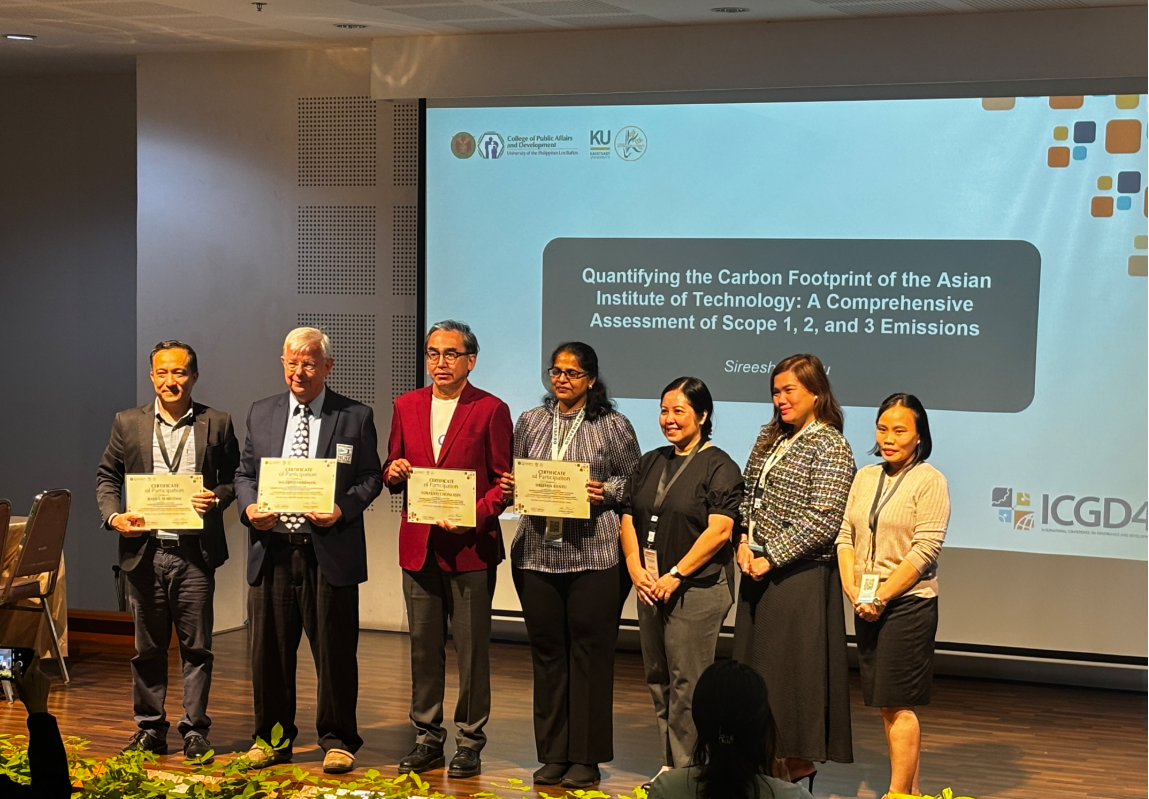
Final speaker Sireesha Banthu, Director of Office of Sustainability at AIT, concluded with a speech on “Quantifying the Carbon Footprint of AIT: A Comprehensive Assessment of Scope 1,2 and 3 Emissions for HEI”, aimed at reaffirming the need for urgent action in the face of the climate crisis. Highlighting AIT’s role as a global model of climate action, living laboratory concept and responsible for embedding sustainability in education equips, she mentioned energy consumption impact, travel-related emissions and waste management issues were closely monitored. She then presented the campus decarbonization roadmap (including paper reduction strategies, a SET NET ZERO building or nature-based solutions). She closed her speech by acknowledging AIT’s operational transformation sets a precedent worldwide and must thus live to this standard.
The HDFF team is very grateful for the opportunity to have heard first-hand from experts and scholars who have dedicated their time and expertise to topics as important as governance and development. All resources and contact of mentioned participants can be found in the ICGD 4 Book of Abstracts. All credit for above mentioned information goes to respective authors.
Comments are closed