Maritime Security in Southeast Asia/ASEAN: the South China Sea and the West Philippine Sea
Maryam Paredes

On Friday, October 3, 2025, at 10:00 a.m., an HDFF team attended a conference on maritime security in Southeast Asia, organized by Chulalongkorn University’s Faculty of Political Science. The panel was moderated by Thitinan Pongsudhirak, a political scientist and professor at the university. Among the panelists were Charmaine Misalucha, professor of international relations and security studies; former Thai Foreign Minister and former Thai Ambassador Kasit Piromya; former Supreme Court Justice of the Philippines Antonio T. Carpio; and maritime law expert and professor Chanintira Na Thalang.
Maritime security in Southeast Asia is a critical concern for both regional and global stability, particularly regarding disputes in the South China Sea/West Philippine Sea. The conflicts, characterized by competing claims, militarization, and environmental degradation, reveal ASEAN’s constrained capacity to address regional concerns.
This report examines the historical and legal context of maritime disputes, the political and institutional shortcomings of ASEAN, and the changing security and environmental issues in the region, as articulated by the speakers.
Historical and Strategic Context
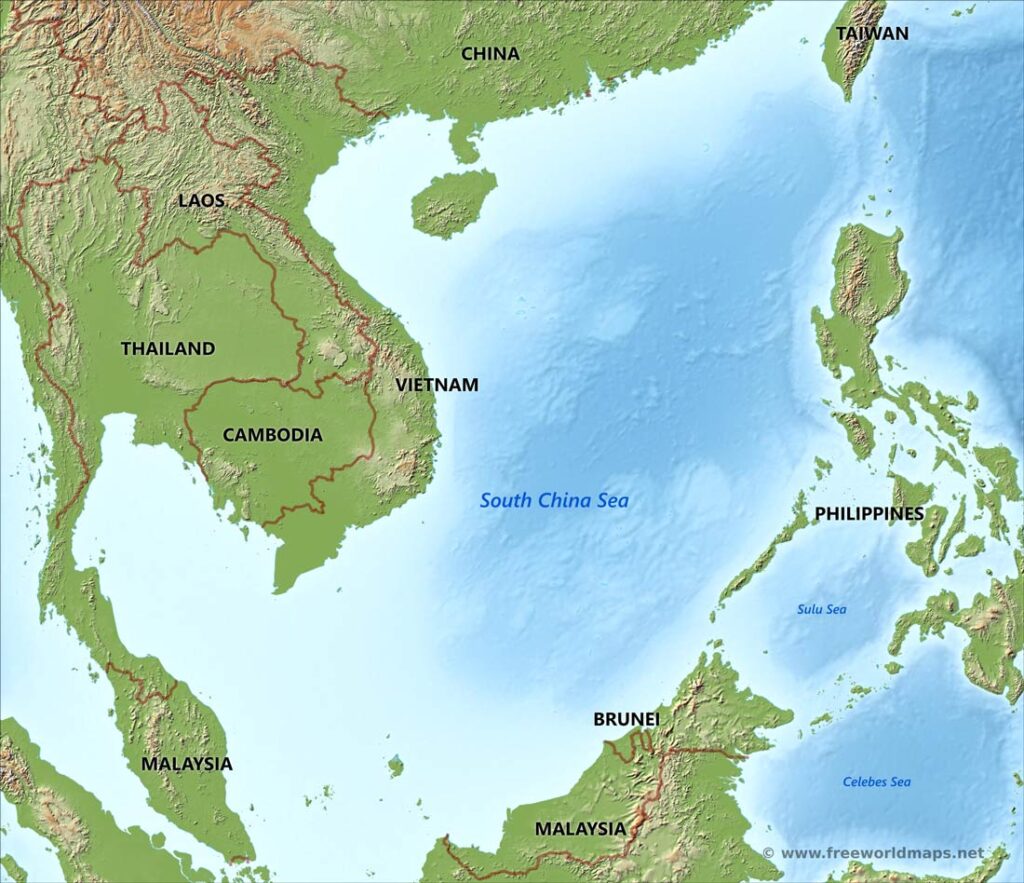
The post–World War II order, built on the UN Charter’s principles of peaceful dispute settlement and prohibition of force, faces increasing strain. China’s expansive South China Sea claims—exemplified by its 2012 takeover of Scarborough Shoal and rejection of the 2016 UNCLOS arbitration—challenge international law. ASEAN, lacking strong mechanisms to enforce collective action, has struggled to respond effectively.
These disputes have deepened the region’s security dilemma in three ways: rising military encounters at sea, accelerated militarization driven by sovereignty politics, and uncertainty over U.S. strategic commitments. Efforts to negotiate a binding ASEAN–China Code of Conduct have stalled for over two decades, with the latest 2027 target widely seen as unrealistic. China’s preference for bilateral negotiations, combined with legal disputes and ASEAN’s institutional limitations, continues to erode stability in Southeast Asia’s maritime region.
These external pressures underscore ASEAN’s internal vulnerabilities, revealing how divergent member interests and institutional weaknesses constrain collective action.
ASEAN’s Divisions and Institutional Weaknesses
Internal divisions hinder ASEAN’s ability to operate as a unified bloc. Cambodia and Laos align closely with China; Vietnam and the Philippines adopt more assertive positions, while Thailand and Indonesia pursue balancing strategies—rendering consensus difficult to attain. Scholars and policymakers, such as Antonio T. Carpio, have called for reforming the ASEAN Charter to include compulsory arbitration mechanisms similar to those under UNCLOS. Without such reform, ASEAN risks drifting into irrelevance, unable to mediate disputes even among its own members.
Beyond Sovereignty: Human and Environmental Security
Maritime disputes in Southeast Asia extend beyond geopolitical concerns. The South China Sea, rich in biodiversity and economically vital to regional livelihoods, faces threats from overfishing, land reclamation, and ecological damage that undermine food security and local economies. Current policy discussions emphasize the connection between environmental and human security and marine governance, concentrating on resource management, environmental protection, infrastructure, and supply chain resilience.
By broadening the concept of maritime security beyond territorial disputes, ASEAN can foster cooperative resource management and ecological stewardship, strengthening both regional stability and the organization’s credibility.
ASEAN Leadership and Contemporary Challenges
ASEAN once played a constructive role, as seen in Cambodia in the 1980s and Myanmar in the 2010s, but now faces a leadership void. In light of its 2016 legal arbitration victory and its frontline experience with Chinese coercion, the Philippines is regarded as strategically positioned to mobilize ASEAN in support of international law. Former Thai foreign minister Kasit Piromya and other regional leaders have urged ASEAN to rediscover its sense of unity and collective responsibility.
However, the obstacles to ASEAN unity remain profound. China’s dismissal of the arbitration ruling and its insistence on bilateral negotiations exacerbate ASEAN’s internal divisions. Meanwhile, ongoing crises in Myanmar and Cambodia further distract the bloc from maritime security issues. Reliance on external actors threatens ASEAN’s central role. Persistent inaction risks heightened militarization, strategic miscalculations, and environmental degradation; however, reforms—such as revising the ASEAN Charter, establishing binding arbitration mechanisms, and incorporating human and environmental security into maritime governance—could reinforce the organization’s credibility.
Conclusion
Maritime security in Southeast Asia stands at a critical crossroads. ASEAN’s reliance on voluntary dialogue, internal fragmentation, and limited enforcement mechanisms has constrained its effectiveness. Yet, by strengthening legal frameworks, integrating environmental and human security, and reaffirming unity, ASEAN can uphold international law and promote regional stability.
With decisive collective action, ASEAN has the opportunity to lead the South China Sea toward a cooperative, rules-based, and sustainable future, reinforcing its role in maintaining peace, prosperity, and security across the region.

Comments are closed