
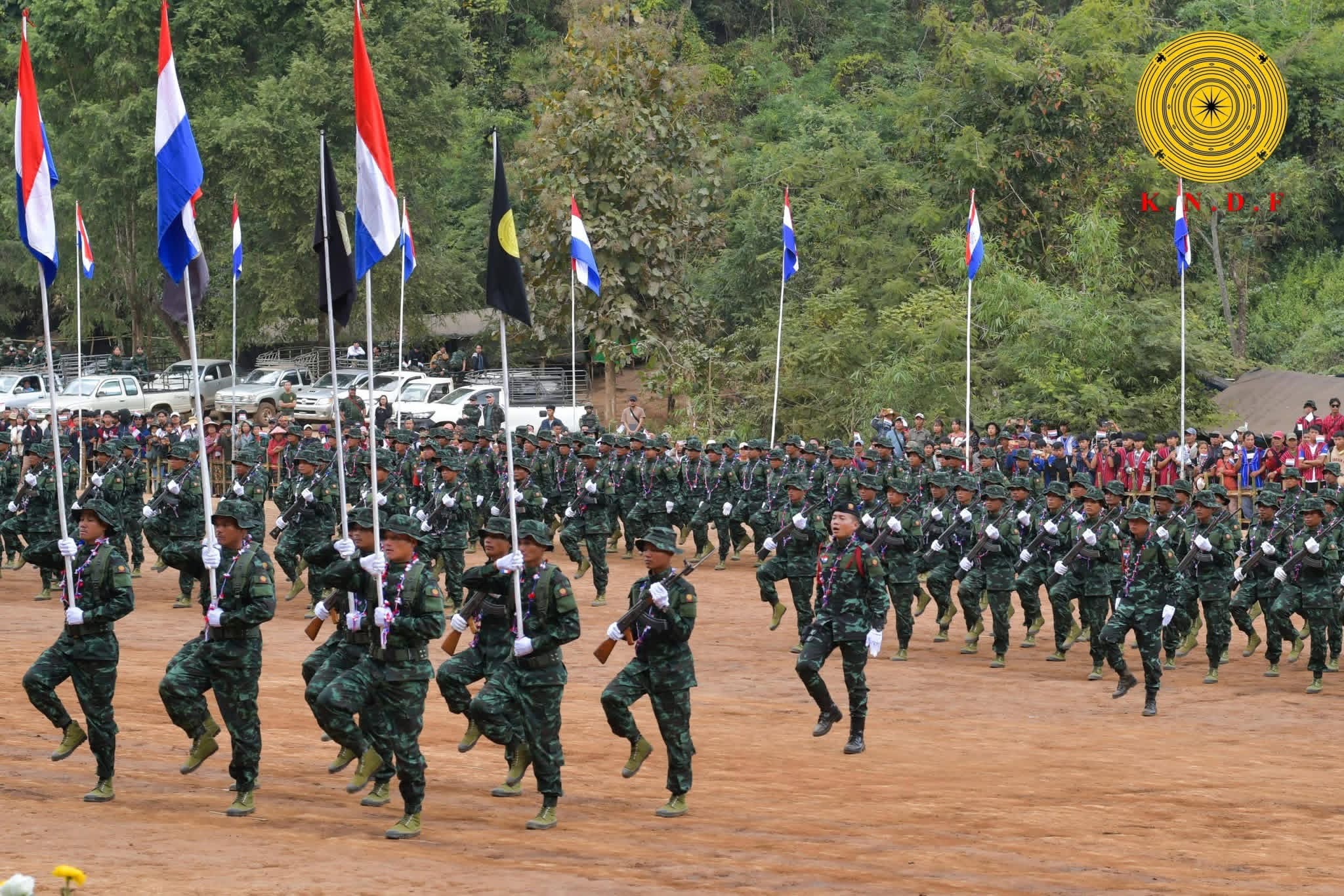
This policy brief offers a preliminary overview of conflict dynamics. A more detailed conflict analysis report will be released soon.
1. Executive Summary
Karenni (Kayah) State has emerged as one of Myanmar’s most consolidated resistance theaters since the 2021 military coup. Unlike fragmented conflict zones elsewhere, Karenni resistance forces demonstrate dense coordination between ethnic revolutionary organizations (EROs) and National Unity Government (NUG)–aligned forces. This policy brief maps the key armed actors, command structures, and border dynamics shaping the conflict, with particular attention to hybrid People’s Defence Force (PDF) arrangements and junta-aligned militias operating along the southern Shan–Karenni frontier.
2. Historical and Political Context
Karenni political identity is rooted in pre-independence autonomy arrangements recognized under British colonial treaties. Although the 1947 Panglong Agreement and the 1948 Constitution acknowledged Karenni State’s right to secession, post-independence centralization and militarization eroded these guarantees. Armed resistance consolidated under the Karenni National Progressive Party (KNPP) and its armed wing, the Karenni Army (KA), while later decades saw fragmentation through ceasefire politics and state-led development projects such as the Lawpita hydropower scheme.
3. Post-Coup Resistance Architecture
Following the 2021 coup, Karenni resistance rapidly reorganized. The KNPP/KA assumed a central political and military role, participating in national resistance coordination bodies including the National Unity Consultative Council (NUCC), the Central Command and Coordination Committee (C3C), and Joint Command and Coordination (J2C) mechanisms. State-level governance structures—the Karenni State Consultative Council (KSCC) and Interim Executive Council (IEC)—provide parallel administrative authority in resistance-controlled areas.
4. PDFs and Hybrid Command Structures
PDF units in Demoso, Loikaw, and Pekhon illustrate the hybrid nature of command in Karenni State. Some battalions operate as Regular PDFs under direct NUG Ministry of Defence command, while others function as Local Defence Forces aligned with the NUG but embedded in joint command frameworks with KNPP/KA and KNDF. This hybrid system has enabled operational flexibility, territorial control, and sustained resistance despite intensive SAC air and artillery campaigns.
5. Borderland Conflict and Adversaries
The conflict extends beyond Kayah State’s formal borders into Pekhon Township in southern Shan State, an area historically claimed by Karenni actors. Here, Karenni resistance forces confront both Tatmadaw/SAC units and junta-aligned militias, notably the Pa-O National Organisation/Army (PNO/PNA). The military’s reliance on allied militias and airpower contrasts sharply with the resistance’s coalition-based ground control strategy.
6. Implications for Policy and Engagement
Karenni State represents a critical case of resistance consolidation and hybrid governance in post-coup Myanmar. For policymakers and analysts, the Karenni theater underscores the importance of understanding joint command mechanisms, ethnic–PDF integration, and borderland dynamics. External engagement strategies should account for the KNPP/KA’s central role, the NUG’s differentiated command over PDFs, and the destabilizing effects of militia-backed counterinsurgency along contested ethnic frontiers.
Actor Alignment Matrix
| Category | Actors | Alignment | Notes |
| Core Karenni ERO | KNPP / KA | Anti-junta; federal democratic agenda | Political & military leadership in Karenni |
| Karenni Coalition | KNDF | Anti-junta; allied with KNPP/NUG | Primary frontline force |
| NUG MoD Forces | Demoso PDF, Pekhon PDF | Regular PDF | Direct MoD command |
| Joint / Hybrid PDFs | Loikaw PDFs | NUG-aligned (C3C/J2C) | Joint command with EROs |
| Kayan Resistance | KNA | Anti-junta | Post-2024 formation |
| Ceasefire Legacy | KNPLF | Defected from junta, allied with Karenni forces | first Border Guard Force to defect en masse |
| Ceasefire Legacy | KNLP/KNLA | Fragmented / marginal | Limited relevance post-2021 |
| Regional Ally | KNU/KNLA | Anti-junta | Training & logistics support |
| Junta-aligned | Tatmadaw/SAC, PNO/PNA | Pro-junta | Airpower, militias |
Key Armed Actors Overview
The armed landscape in Karenni State is defined by an unusually high level of integration between ethnic revolutionary organizations and National Unity Government–aligned forces. At the center of this configuration stands the KNPP/KA, which provides both political leadership and military coordination through state-level governance bodies and national resistance mechanisms such as the C3C and J2C. The KNDF operates as the primary fighting force on the ground, while township-based PDFs in Demoso, Loikaw, and Pekhon reinforce this structure through hybrid command arrangements linking local autonomy with NUG oversight.
This resistance architecture contrasts sharply with the opposing camp. The Tatmadaw/SAC relies heavily on airpower and allied militias, particularly the Pa-O National Organisation/Army, to contest resistance-held areas along the Shan–Karenni border. Among the older ceasefire-era groups, the KNPLF was the first Border Guard Force to defect en masse to the resistance, marking a significant shift in the conflict’s dynamic while the KNLP/KNLA play only marginal role, having been largely eclipsed by post-coup mobilization. Overall, Karenni State represents one of the clearest cases of consolidated resistance governance and joint command in post-coup Myanmar.
Comments are closed