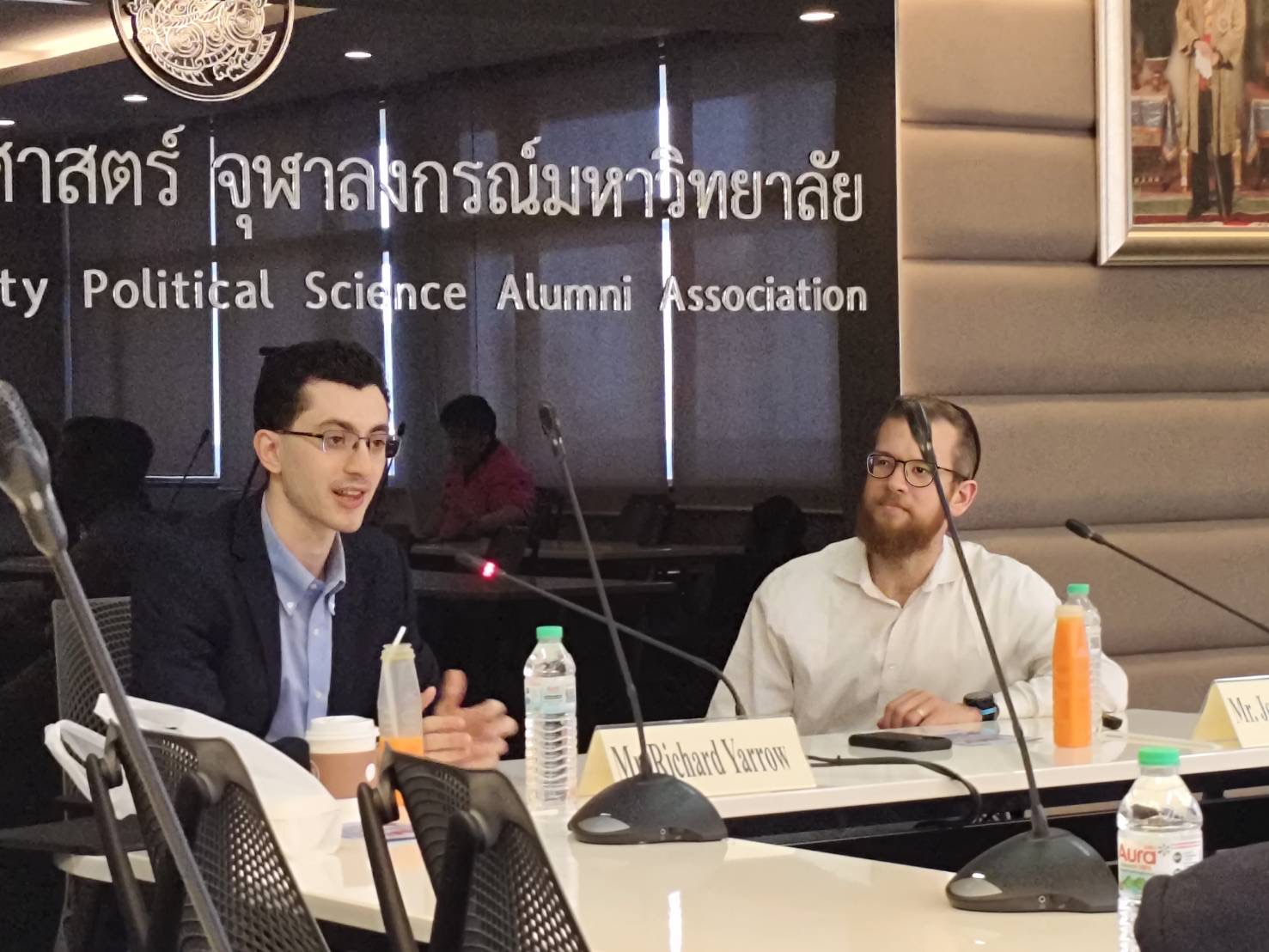
From left to right: Mr. Richard Yarrow (Visiting Fellow at ISIS Thailand and Research Fellow at Harvard Kennedy School) and Mr. Jeremy Furchtgott (Director at Baron Public Affairs)
On June 24, 2025, the HDFF team attended a public seminar hosted by ISIS Thailand titled U.S.-China Competition and Implications for Southeast Asia: Update from Washington at Chulalongkorn University. The discussion was led by Mr. Jeremy Furchtgott from Baron Public Affairs in Washington, D.C., offering a provocative analysis of U.S. strategic thinking toward China, the internal political dynamics in both countries, and the resulting pressures and opportunities facing Southeast Asia.
Fragmentation Within: Domestic Contradictions in China and the U.S.
Fuchtgott opened by challenging prevailing assumptions that treat China and the U.S. as unitary strategic actors. He underscored how internal divisions—in political leadership, geography, and elite incentives—shape foreign policy in both capitals. In China, he pointed to a longstanding contradiction: while Beijing claims to promote domestic consumption, actual consumption as a share of GDP has stagnated or declined. The country remains structurally export-dependent, creating long-term vulnerability to trade disruptions.
Perhaps more strikingly, Furchtgott revealed a disconnect between China’s economic geography and its political leadership. Provinces most exposed to international trade—such as Guangdong and Zhejiang—are underrepresented in top Communist Party leadership, which remains concentrated in northern provinces like Shandong. This, he argued, raises the possibility that tariff escalation may disproportionately hurt regions that are politically marginalized, and thus less protected by the Party’s strategic calculus.
In the U.S., Furchtgott described a similarly fractured landscape, mapping conservative factions along two axes: nationalist vs. globalist, and populist vs. institutionalist. He emphasized that current U.S. policy towards China—particularly under Trump-aligned actors—is being shaped not by a coherent national doctrine but by shifting coalitions, ranging from “Siliconservatives” and legal traditionalists to more ideologically driven factions like “Ultra-MAGA.” This fragmentation is also reflected in the topics dominating U.S. influence circles: issues such as CCP infiltration of U.S. institutions and Chinese tech influence (e.g., TikTok) have overtaken traditional concerns like Taiwan or the South China Sea.
Implications for Southeast Asia: Realism and Responsibility
For Southeast Asia, the implications of this fragmented strategic picture are profound. Furchtgott argued that the U.S. is moving toward a more regionalized and indirect security posture—favoring what might be called an “offshore balancing” approach. Instead of being the first mover in global conflicts, the U.S. increasingly expects allies to take the initiative, as seen in its recent response to Israel’s actions in Iran. He posed a provocative question: in the event of a future crisis in East Asia, which U.S. ally would be willing and able to act first?
On trade, Furchtgott acknowledged that Washington understands Southeast Asia’s need to maintain ties with both powers. However, he warned of growing scrutiny toward Chinese investment and ownership in the region. Third-party countries like Thailand may face reputational and regulatory pressure if they host companies that are effectively Chinese-owned, even if nominally local. “Transshipment” and origin-labeling loopholes are already under U.S. review.
During the open discussion, Thai policymakers and regional experts raised important counterpoints, particularly on the complexities of Chinese investment in Thailand. Members of Parliament and civil society leaders highlighted the contrast between earlier generations of assimilated Chinese-Thai communities and recent waves of “grey capital,” which remain economically embedded but socially detached from Thai society. There was concern that some of these newer investors actively leverage local networks for political influence while lacking long-term integration.
Participants also emphasized the need for the United States to recalibrate its diplomatic approach—moving away from overtly formal, bureaucratic models toward deeper, relationship-driven engagement more compatible with Southeast Asian political culture. Several questions focused on Taiwan’s precarious security position. Taiwanese attendees voiced frustration that while Taiwan has long sought to strengthen its defense and diplomatic presence, it is often constrained by international politics and arms access limitations. Furchtgott acknowledged these concerns, noting that despite rhetorical support, Taiwan’s perceived lack of “existential urgency” in Washington undermines bipartisan willingness to commit to robust deterrence. He stressed the fragility of Taiwan’s current reputation in U.S. policy circles and the importance of demonstrating credible self-defense capacity.
Conclusion: Navigating a Fragmented Strategic Landscape
The seminar closed with a shared recognition: Southeast Asia will continue to navigate a delicate balance between economic integration with China and security ties with the United States. But this balancing act is taking place in a world where both great powers are internally fractured and increasingly prone to strategic improvisation. For Thailand, this means preparing not just for economic or military alignment, but for a fluid, often contradictory international environment where credibility, consistency, and regional initiative may matter more than alliance rhetoric.
HDFF thanks ISIS Thailand for organizing this important dialogue and looks forward to continued participation in regional conversations on diplomacy, security, and strategic foresight.
Comments are closed