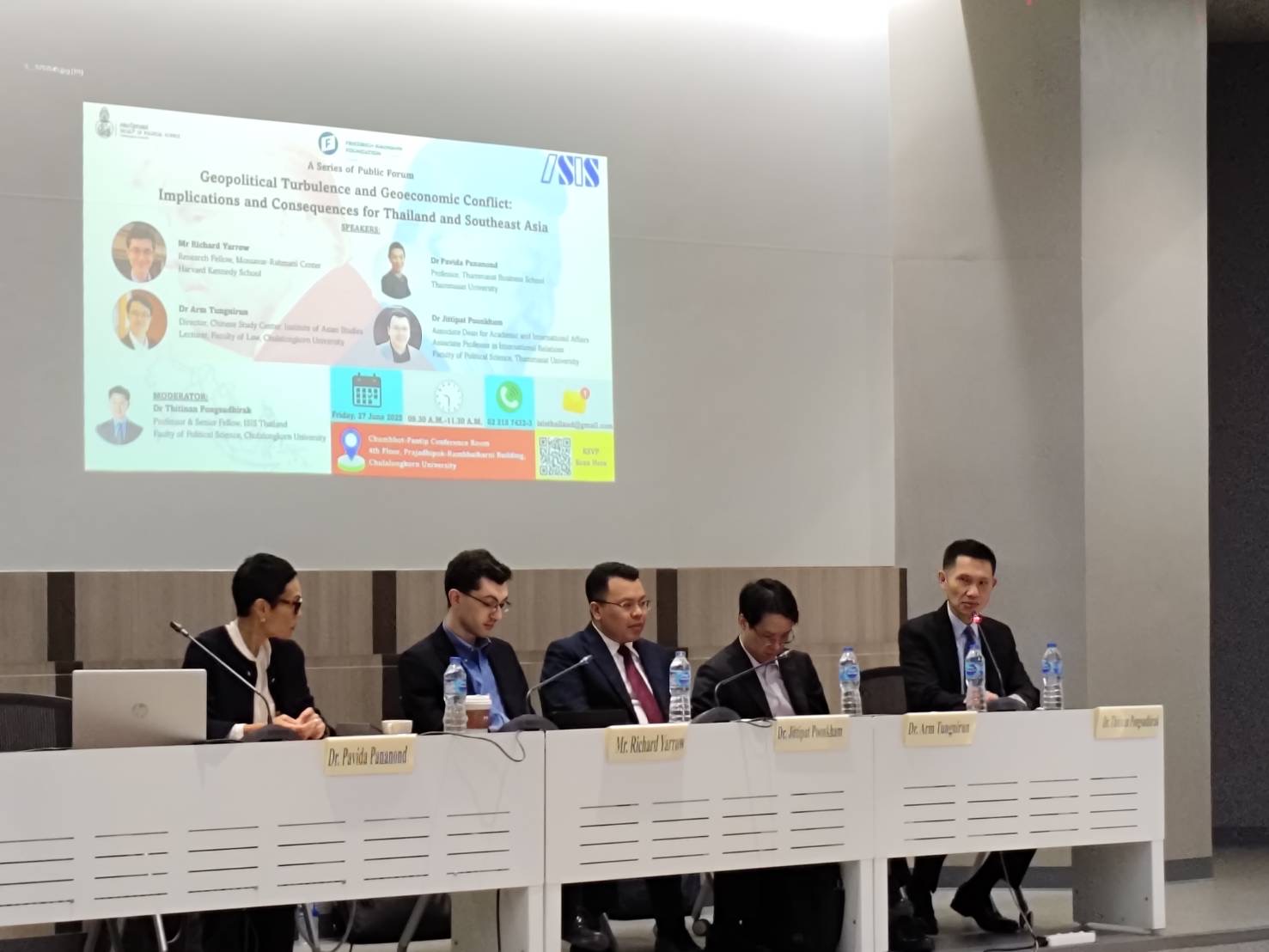
From left to right: Dr. Pavida Pananond (Thammasat University), Mr. Richard Yarrow (Harvard Kennedy School), Dr. Jittipat Poonkham (Thammasat University), Dr. Arm Tungnirun (Chulalongkorn University), and Dr. Thitinan Pongsudhirak (Senior Fellow, ISIS Thailand)
On June 27, 2025, the HDFF team attended the public forum hosted by FNF Thailand and ISIS Thailand titled “Geopolitical Turbulence and Geoeconomic Conflict: Implications and Consequences for Thailand and Southeast Asia,” held at Chulalongkorn University. This discussion gathered four experts to untangle how great-power rivalry is reshaping the region’s economic and security landscape. Moderator Dr. Thitinan Pongsudhirak framed the discussion with a blunt assessment: Southeast Asia is already splintered by crises ranging from the Myanmar crisis to the South China Sea standoff, and the next wave of U.S. tariffs threatens to pit ASEAN economies against one another as each scrambles for bespoke deals in Washington.
Mr. Richard Yarrow of Harvard Kennedy School explained the U.S. logic. Since the late 1970s, relentless capital inflows have inflated the dollar, hollowed out Midwestern factories and left Washington with two converging imperatives—domestic re-industrialisation and renewed control over strategic supply chains. Tariffs, large-scale industrial subsidies under the Biden administration, and proposed capital-flow controls were described as key components of a broader U.S. strategy aimed at reinforcing domestic economic resilience and aligning trade policy with national security objectives.
Dr. Arm Tungnirun provided insight into the Chinese side of the equation, noting that the surge in Chinese exports to Southeast Asia—particularly in sectors like electric vehicles—is less a deliberate state-led strategy and more a response to saturated domestic markets and intense internal competition. He noted that Chinese think tanks themselves are increasingly aware of regional pushback, and yet China continues to double down on investment-led growth and manufacturing dominance as short-term consumption stimulus remains politically and economically difficult to implement.
Adding a private-sector and value-chain perspective, Dr. Pavida Pananond highlighted how Thailand’s industrial ambitions may be constrained by both external shifts and internal limitations. She pointed out that key sectors like semiconductors are highly concentrated in upstream R&D, where value capture is greatest, while Thailand remains positioned in low-margin activities like assembly and packaging. Unlike earlier waves of Japanese investment that fostered long supply chains and local SME development, current Chinese investment trends are characterized by shorter value chains and less integration with local capabilities—raising concerns about Thailand’s long-term competitiveness.
Dr Jittipat Poonkham broadened the discussion to include geostrategic pressures, observing that Southeast Asia is increasingly exposed to the ripple effects of global insecurity, from Ukraine and the Middle East to the Taiwan Strait. He emphasized that the region is experiencing the “geopoliticization of everything,” where economic tools are used for strategic ends and vice versa. In this context, countries like Thailand face growing pressure to take sides, increase defense spending, and manage new forms of vulnerability across digital, energy, and industrial infrastructure.
The forum concluded that Thailand must act swiftly to reposition itself amid accelerating global shifts. Strategic recommendations included strengthening rules-of-origin enforcement, advancing a high-skill industrial workforce, and coordinating regionally on supply chain resilience. Without such measures, Thailand risks being left behind in a world increasingly governed by security-driven economic logic.
HDFF would like to thank ISIS Thailand and FNF Thailand for the invitation and opportunity to participate. HDFF is looking forward to future opportunities.
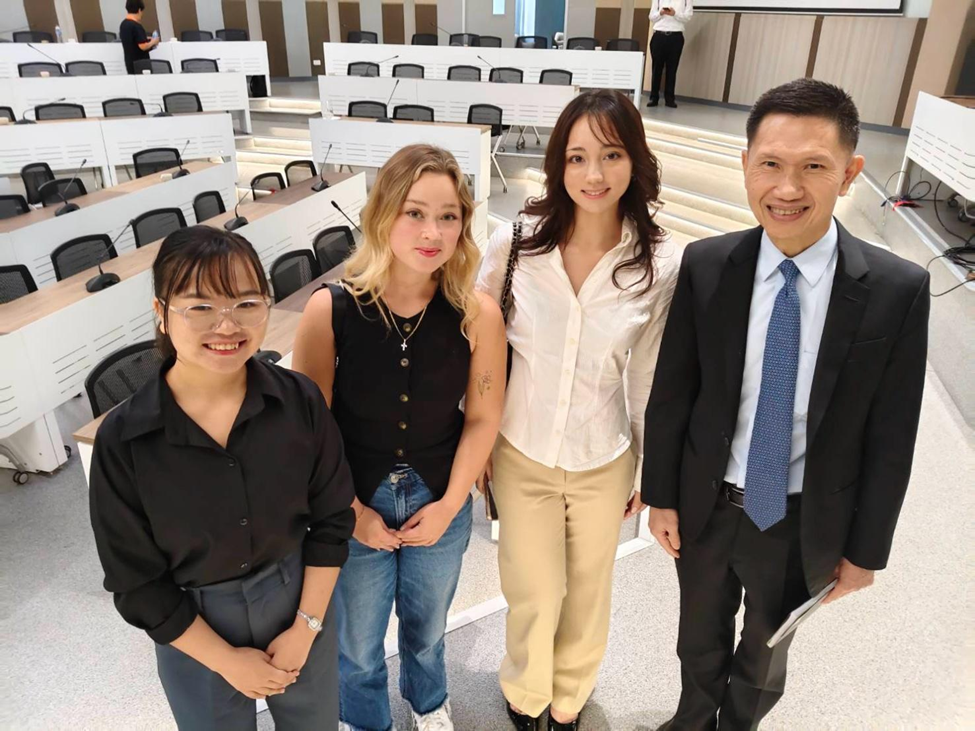
From left to right: Nang Shwe Yong (HDFF), Verity Kline (HDFF), Audrey Choo-Scott (HDFF), and Dr. Thitinan Pongsudhirak (ISIS Thailand)
Comments are closed