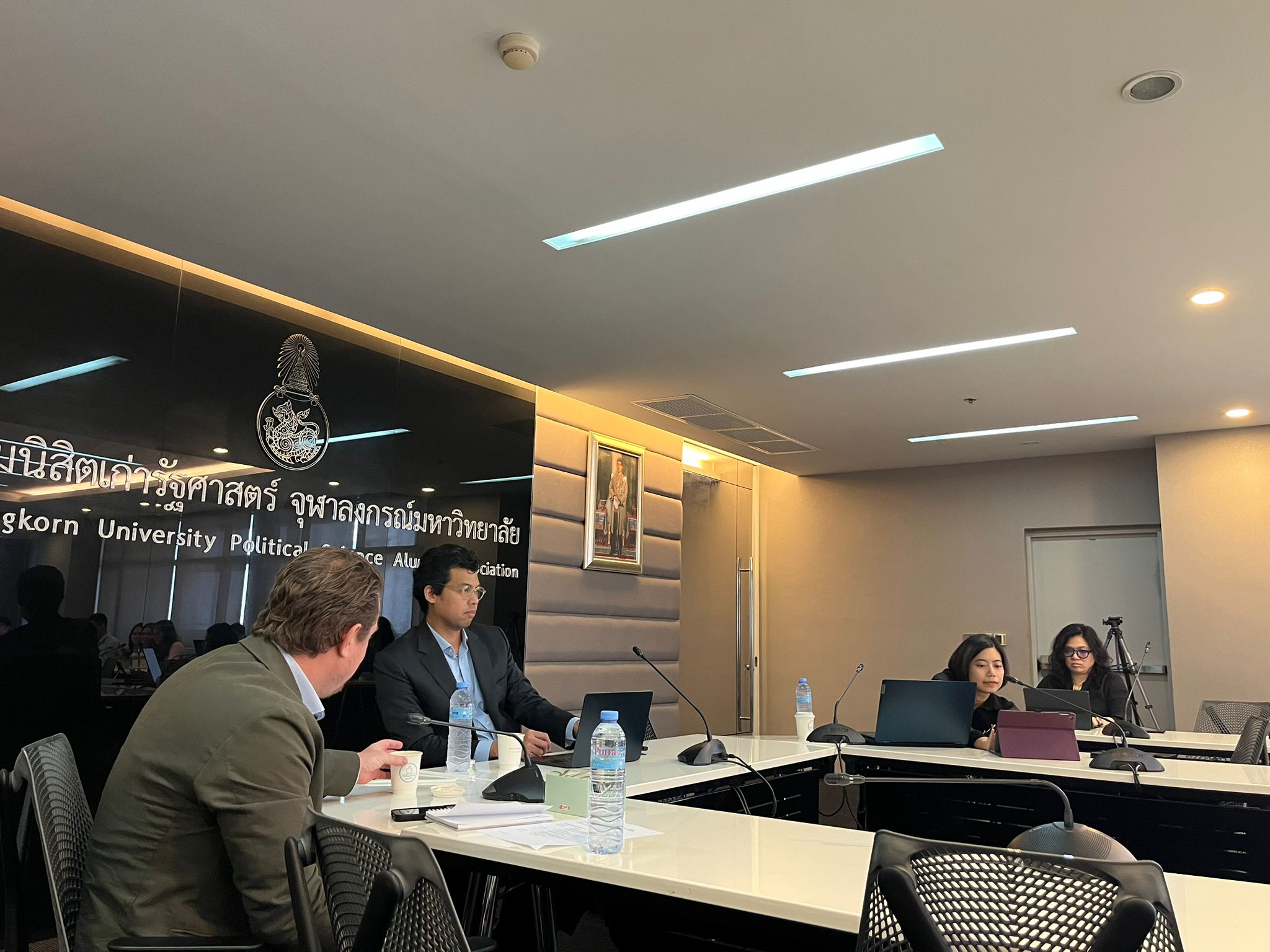
On the 13th of November 2025, HDFF was invited to the seminar titled “Enhancing Global Engagement with Myanmar”. The presenter was Dr. Fuadi Pitsuwan, an academic in the field of politics. Throughout the seminar, he discussed his views on current Myanmar events in light of the upcoming election by Myanmar’s military government.
Doctor Pitsuwan’s speech regarding Myanmar was a wealth of information that can be divided into the following four parts:
- A Review of the World’s Policies and Its Updates
- Paradigm Shift in The International Community’s Perception of Myanmar
- Rise of Thailand’s New Strategic Province
- Preliminary Data on Migrants in Chiang Mai Province
A Review of the World’s Policies and Its Updates
Doctor Pitsuwan started his presentation by showing an interesting graph. It was a policy matrix, filled with different policies throughout the years that were made to ease the situation in Myanmar. These policies were plotted according to their level of intervention and their level of optics. Intervention in this case was plotted based on whether the policy interfered with Myanmar in any way, while optics refers to whether the policy was able to get a higher number of people to discuss it (i.e., high public reach). An ideal policy would have both high optics and high intervention.
Special emphasis was put on a few suggested policies, namely constructive intervention, flexible engagement, and Responsibility to Protect (R2P). Constructive intervention was proposed by Anwar Ibrahim, the Malaysian Prime Minister, in 1997, and its major principle is that if there is a civil problem in a country, ASEAN should reserve the right to access the country and stabilize it; however, this was rejected due to its progressive nature.
Flexible engagement was proposed by Doctor Surin Pitsuwan in 1998, and it states that ASEAN should be able to get involved once a problem becomes transnational. This means that in today’s context wherein Burmese citizens are migrating to neighboring countries to take refuge, ASEAN would have been able to interfere with Myanmar if it was imposed, but the approach was rejected once again.
Finally, R2P was proposed by Bernard Kouchner, the former French Minister of Foreign and European Affairs, in 2008 after the destruction Cyclone Nargis caused in Myanmar, and it is a principle that suggests that in the event a country fails to protect their citizens, the international community has the right to intervene. This has been affirmed by the United Nations, although in the context of the cyclone, it was not evoked, as there was a consensus that R2P did not apply to natural disasters (Asia-Pacific Centre for the Responsibility to Protect, 2008). On the other hand, ASEAN has not fully implemented it due to the non-interference policy of the organization.
Interestingly, many policies that were suggested but not implemented, such as constructive intervention, flexible engagement, and R2P, were high in optics and intervention; however, once removed from the graph, the enacted policies were quite low in optics and intervention. Doctor Pitsuwan stressed the need for there to be more policies that are high in intervention and low in optics or high in intervention and high in optics.
Nonetheless, there is an opportunity for change. Although the priorities of Europe and the United States have greatly changed, thereby reducing their desire to engage with Myanmar, current ASEAN events have set a precedent for possible interventions. The current use of ASEAN Observer Teams (AOTs) during the Thailand-Cambodia border tension has sparked discussions about possible implementation in Myanmar, and there have been discussions on establishing long-term peacekeeping envoys to adhere to the “5-Point Consensus” agreed upon by members of ASEAN. Currently, the envoys change every time the chairmanship changes, which is every year. This has stalled the rate of change; as a result, a “long-term” envoy has been suggested and agreed upon by ASEAN states.
Looking forward to the future, Doctor Pitsuwan expressed that how the Philippines, the next ASEAN chairman, will respond to the election in Myanmar may determine whether ASEAN will bring about change, referring to it as a “test” for the Philippines. If they congratulate Myanmar rather than acknowledge that the election simply happened, that may legitimize the government when, in fact, it is not truly democratic.
Paradigm Shift in The International Community’s Perception of Myanmar
Due to the fragmentation of Myanmar that was caused by the 2021 coup, Doctor Pitsuwan believes that Myanmar’s respective ethnic communities need to be viewed as statelets that need to be engaged appropriately once the government has lost control over the territory. This is because many Ethnic Resistance Organizations (EROs) have decided to operate as de facto governments and become self-governing. They may not yet have a functioning government, but they are already providing services that a state would provide to their citizens. One example that was mentioned was the Karenni State, which has developed their own governing body.
The Karenni state was developed to protect citizens from the persecution of the junta and to promote a decentralized and democratic government. It focuses on inclusivity and “multiethnic collaboration” as advocated by the Karenni State Consultative Council (KSCC). To legitimize their status as a state, they created government branches, namely the executive branch, the judicial branch, and the legislative branch (Federalism From the Ground Up: The Karenni Model of Nation-State Building—Progressive Voice, 2024).
The executive branch, known as the Interim Executive Council (IEC), is in charge of providing various services to the public, such as education and healthcare. The legislative branch, the Karenni State Interim Parliament (KSIP), is in charge of overseeing the activities of the IEC, developing laws, and upholding democracy. Finally, the judicial branch controlled by the Karenni State Interim Judiciary (KSIJ) is made up of the supreme court, district courts, and township courts. They adhere to local laws and permit changes to be made as long as human rights are not impeded.
In light of the legitimacy of the Karenni State, it would be counterintuitive for the international community to intervene with Myanmar by only understanding the needs of Naypyidaw and the military government, as that would neglect the people of the country. In the words of Doctor Pitsuwan, “A policy that is focused on the central region only will fail to reach millions of people and ignore the legitimate governance system that is happening on the ground.”
The Rise of Ranong Port
The civil war in Myanmar has also affected Thailand economically, and this has unexpectedly caused the rise of Ranong port. The usual trade route from Mae Sot in Thailand to Myawaddy in Myanmar has been subject to various issues, including fights, as cited by Doctor Pitsuwan. According to the Bangkok Post (2025a), on the 18th of August 2025, Myanmar decided to close the route to prevent armed organizations from accessing the imported goods and earning money to fund the resistance. These reasons have caused Ranong Port, the only commercial port on the Andaman Sea Coast, to become a viable alternative.
Doctor Pitsuwan mentioned a few advantages of using the Ranong Port. One of these advantages is time-effectiveness. Before, it would take 14 to 21 days to trade with Yangon; however, with Ranong port, it will take only 3 days. Ranong port has also opened up a new avenue for trade with other South Asian countries such as India, Bangladesh, and Sri Lanka as part of the Bay of Bengal Initiative for Multi-sectoral Technical and Economic Cooperation. These sentiments have likewise been confirmed by Mister Kriengkrai Chaisiriwongsuk, the director-general of the Port Authority of Thailand (PAT) (Bangkok Post, 2025b).
Aside from these advantages, there are also drawbacks to the use of Ranong Port. The first disadvantage is that it is not yet feasible to transfer all land trade to Ranong Port, as the capacity will increase and lead to certain logistical issues as well as cause Mae Sot’s political relevance to dwindle. Another drawback is that highly sensitive products such as machinery and chemicals are highly controlled in Myanmar, so although it may take three days to get to Yangon, it may take longer to secure the licenses. Most importantly, the Mae Sot trade route has been used to supply EROs with funding for fighting and providing public services, so depriving them of the trade would lower their negotiating power and potentially cause them to turn to illicit activities for funding or be forced into a ceasefire by China.
Preliminary Data on Migrants in Chiang Mai Province
Finally, to end the seminar, Doctor Pitsuwan unveiled his research on the Burmese migrants currently living in Chiang Mai, emphasizing their economic status and their quality of life. This culminated in the fact that they contribute to the economy, and as such, visa restrictions should be eased to enable these migrants to work without any risk of being condemned by the law.
Upon interviewing 134 individuals in Myanmar, Doctor Pitsuwan learned that Burmese migrants were exponentially contributing to the economy with an average of 31,000 baht per rent, the emergence of 97 new businesses since the coup, 50,000 to 70,000 baht for university tuitions, and 95 percent of businesses sourcing goods from Thai suppliers. He also addressed the concern that these migrants are encroaching on public services by revealing that over half of the Burmese migrants in Chiang Mai prefer private hospitals over public hospitals, making the concern unfounded.
In spite of this, there are challenges that Burmese people face. The interviewees said that they had to pay 6,000 baht per month to authorities to keep their business running, and highly skilled individuals cannot work due to being unregistered or not having the right visa type. Many Burmese individuals in Chiang Mai have student visas, which forbid them from working. These challenges have not only limited the opportunities of Burmese individuals but also the economic opportunities of Thailand. Doctor Pitsuwan called for the simplification of visa pathways and an increase in transparency of regulations to prevent corruption.
He ended the seminar with a sobering thought. Thailand’s perception of Burmese residents as refugees can not stand, as it has limited its own opportunities. By reaching out with compassion, Thailand can grow as a more inclusive and economically developed country.
HDFF would like to thank the Hanns Seidel Foundation for the invitation to this informative event and HDFF’s team is looking forward to future opportunities.
Bangkok 14. Nov. 2025
References
Asia-Pacific Centre for the Responsibility to Protect. (2008). Cyclone Nargis and the responsibility to protect. In Myanmar/Burma Briefing No. 2. https://r2pasiapacific.org/files/582/briefing_no2_cyclonenargis_r2p_myanmar.pdf
Bangkok Post. (2025a, September 2). Tips given to reroute exports to Myanmar. https://www.bangkokpost.com. https://www.bangkokpost.com/business/general/3097053/tips-given-to-reroute-exports-to-myanmar
Bangkok Post. (2025b, October 2). Bigger role seen for Ranong Port. https://www.bangkokpost.com. https://www.bangkokpost.com/thailand/general/3114416/bigger-role-seen-for-ranong-port
Federalism from the Ground Up: The Karenni Model of Nation-State Building – Progressive Voice. (2024, October 9). https://progressivevoicemyanmar.org/2024/10/09/federalism-from-the-ground-up-the-karenni-model-of-nation-state-building/
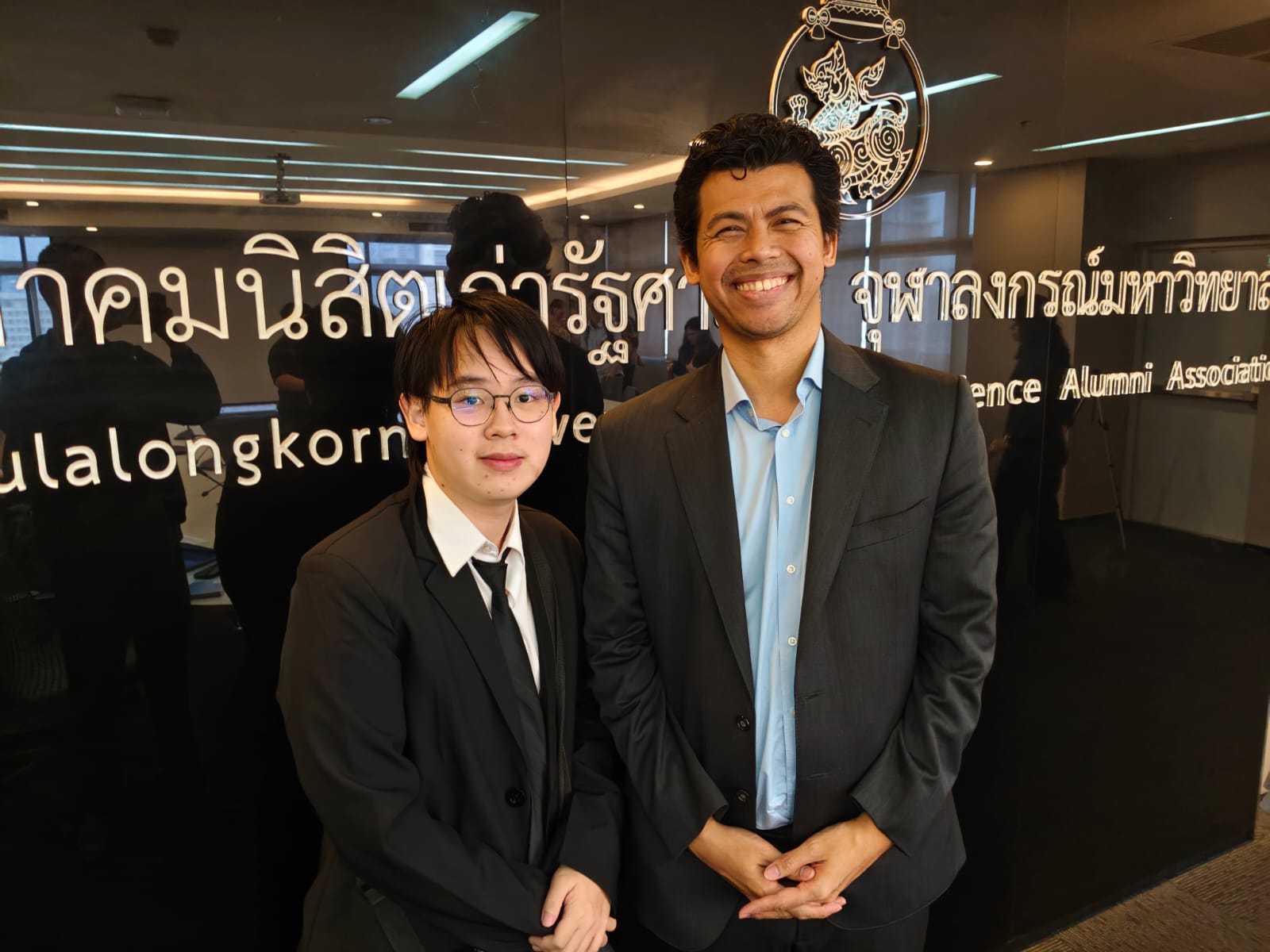
HDFF’s Parich Pattayakorn’s Meeting With Dr. Fuadi Pitsuwan
Comments are closed