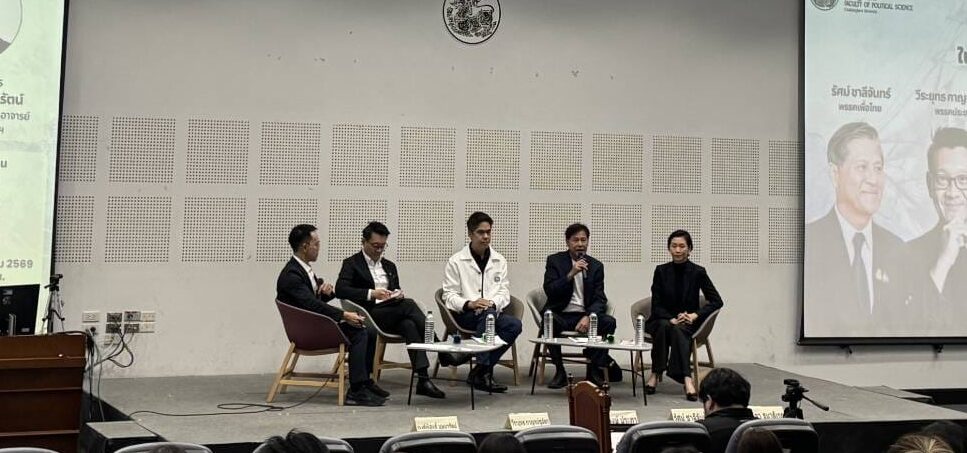
On the 28th of January 2026, a HDFF team attended a panel discussion with the title “Steering Thailand in Geopolitical Storms” that was hosted by the Institute of Security and International Studies (ISIS) of the faculty of political science of Chulalongkorn University.
The panel featured representatives from four different parties that are running in the upcoming Thai election. They were Mr. Russ Jalichandra from the Pheu Thai Party, Mr. Veerayuth Kanchoochat from the People’s Party, Ms. Rachada Dhnadirek from the Bhumjaithai Party, and Werapong Prapha from the Democrat Party.
The discussion centered around each party’s approach to Thai foreign policies, yielding the following noteworthy topics:
- Thailand’s General Approach to Foreign Policies
- Thailand’s Approach to the United States
- Thailand’s Approach to ASEAN
- Thailand’s Role in a Conflict Between Taiwan and China
Thailand’s General Approach to Foreign Policies
In a unanimous agreement, all the panelists believe that Thailand should position itself as a key player in the global supply chain and develop itself into a “strategically autonomous” country that is not under threat of foreign pressures. To establish these goals, various suggestions were made, which culminated into methods that Thailand can employ to form alliances.
According to Mr. Jalichandra, progress has already been made in this regard as the Pheu Thai administration under the former prime ministers, Srettha Thavisin and Paetongtarn Shinawatra, was able to secure a partnership with BRICS, while progress has been made to join the OECD.
In terms of economic proposals, Ms. Dhnadirek suggested that it is necessary for Thailand to start mapping its investors to allow the country to better understand their profile and meet their needs. Aside from that, she believes that it is vital for Thailand to also support countries in other dimensions, such as the environmental and the humanitarian dimension, to position Thailand as a reliable country on the world stage.
Furthermore, two panelists, namely Ms. Dhnadirek and Mr. Jalichandra, underscored the importance of digital frameworks and digital IDs in establishing an efficient trade system. By developing the aforementioned elements, it would be possible to increase Thailand’s productivity in trade.
Deviating from the panelists’ discussion on digital infrastructures, Mr. Prapha discussed Thailand’s foreign policy with reference to ASEAN, noting that since the United States will be focusing more on the Western hemisphere, it is necessary for ASEAN to become more united to ensure the region’s security and supply chain. He believes that the U.S. has drastically changed and as a result, ASEAN countries must adapt to the changes.
Finally, Mr. Kanchoochat elaborated on how the “Spaghetti Bowl” can be beneficial towards Thailand. The “Spaghetti Bowl” has a negative connotation, as it describes the overcomplication of trade caused by overlapping free trade agreements. However, the panelist believes that the concept should be revisited, as it may increase Thailand’s mobility and flexibility in trade, especially due to the economy’s current uncertainty and volatility.
Thailand’s Approach to the United States
In terms of trade, the panelists stated that it is necessary for Thailand to understand what it has that the United States wants. Mr. Prapha believes that “The Art of the Deal,” which was written by President Donald Trump, along with the “National Security Strategy” of the United States, can be used as blueprints to understand how Thailand should approach the United States, mentioning that “leverage is key.” This means that Thailand should position itself in such a way that it can negotiate with the United States, as the country has shown that its priority is its national interests.
In terms of global order, the panelists had varying views. As the U.S. has committed acts that have been deemed as going against global order and international law, Mr. Kanchoochat believes that Thailand should take a more proactive approach like Singapore. The rationale behind this is the belief that even if an issue is geographically distant from Thailand, it can create precedents that can affect Thailand in the long term. He essentially advocates for Thailand to help in reaffirming global order as violations are committed. In alignment with this view, Ms. Dhnadirek believes that international law must be adhered to.
On the other hand, Mr. Jalichandra believes that Thailand should not aggravate the United States even when they go against international law, noting that Thailand is a good ally of the country and should remain so. He noted that Thailand’s context is different from that of Venezuela, as Thailand has not threatened the U.S. or positioned itself as the country’s rival. This is in contrast to Venezuela, which has issues pertaining to drug trafficking, which has implications for the United States’ security.
Thailand’s Role in a Conflict Between Taiwan and China
According to the panelists, the role of ASEAN needs to be strengthened, and to do this, Thailand, after the chairmanship of the Philippines and Singapore, should make attempts to unite the countries and set the agenda for the year. Currently, ASEAN is different from the European Union, as the countries within ASEAN still view themselves as independent from the other member countries. This causes them to view these countries as competitors rather than collaborators.
To increase the synergy among the member countries, it is necessary for them to establish issues collectively. For instance, the issue pertaining to scammers should be viewed as a problem that the countries must collaborate to overcome. This would increase the functional role of ASEAN and allow for more unity.
China and Taiwan Conflict
In light of the tensions between China and Taiwan, the panelists discussed its implications for Thailand.
The panelists agreed that there are Thai workers in Taiwan, and as a result, the command center of Thailand needs to be capable of predicting the worst-case scenario and formulating a plan to evacuate the workers in the case that the scenario becomes a reality. Mr. Jalichandra underscored Pheu Thai’s experience in this regard, as the party was able to evacuate 10,000 individuals during the Israeli conflict.
Moreover, the Pheu Thai representative highlighted the economic implications of the conflict, noting that Thailand can rely on the southern Land Bridge that has been predicted to be completed in 2030 as an alternative to the Malacca Strait. The southern Land Bridge will connect the Gulf of Thailand with the Andaman Sea, allowing China to continue trading with Thailand by bypassing the United States-controlled Malacca Strait.
Meanwhile, Ms. Dhnadirek warned that Thailand’s position during the conflict is of utmost importance, referencing Japan as a vital example. After the Japanese prime minister, Sanae Takaichi, insinuated that Japan can take military action if China invades Taiwan, the Chinese government retaliated economically by imposing a travel advisory on Japan and banning the importation of their seafood. This suggests that in the case of a conflict, Thailand must be cautious to not aggravate China while ensuring the safety and security of their people.
Conclusion
Overall, with regard to foreign policy, there was a considerable amount of homogeneity among the parties, with deviation only in the case of foreign policies pertaining to the United States. Although the panelists agreed on the general foreign policy approach of Thailand, Thailand’s approach to ASEAN, and the role of Thailand during a conflict between Taiwan and China, the panelists had differing views on how Thailand should approach the United States when they violate international law.
HDFF would like to thank the Institute of Security and International Studies in Chulalongkorn University, Thailand for the invitation to this very comprehensive and informative event.
Comments are closed