On the 9th of March 2026, a HDFF team attended the seminar “Trends in Great Power Competition and Implications for Southeast Asian and Middle Powers” hosted by the Institute of Security and International Studies (ISIS) of the Faculty of Political Science of Chulalongkorn University.
Featuring Dr. John Lee Cheong Seong, the senior fellow of the Hudson Institute in Washington D.C., and Dr. Pongphisoot Busbarat, the director of ISIS Thailand, this timely seminar focused primarily on the following topics:
- China’s Geopolitical Goals
- The Goals of the United States and Its Allies in light of China’s Goals
- President Donald Trump’s View on Domestic and Foreign Policy
- Trump and the Middle Powers
China’s Geopolitical Goals
The seminar opened with an elaborate explanation of China’s goals. According to Dr. Seong, China wishes to become a legitimate power in the world rather than an authoritarian power. To accomplish this, the country has two objectives, which are (1) to maintain its economic power by stabilizing the economic leverage it has on other countries and (2) to weaken the economic, political, and military influence of the United States in the region.
To achieve this, China has the following five strategies:
- Reduce the number of strategic players involved in the region.
This decreases the complexity of the political field, making it so the geopolitical struggle is only between China and the United States. The Chinese ideal is that smaller states remain uninvolved in the geopolitical struggle.
- Grayzoning Taiwan and other countries in the South China Sea
By gray-zoning Taiwan and other countries in the South China Sea, China asserts its military, economic, and political dominance, causing the demoralization and weakening of the countries.
- Persuade countries to focus more on absolute gains rather than relative gains
This enables China to strike deals with other states, allowing for faster economic growth in the other state. The consequence of this is that it can cause the state to become overreliant on China for resources.
- Enhance China’s military capacity
China wants its credibility for escalation to be higher than the United States. This is a means of power assertion that China can exploit to coerce smaller states to adhere to its demands.
- Normalize Chinese behavior in foreign policy
By forcing the normalization and internalization of Chinese coercion and other tactics into countries in the region, China will be able to assert its influence and dominance over the region, facilitating the realization of its national interests.
The Goals of the United States and Its Allies in Light of China’s Goals
In light of China’s geopolitical goals, Dr. Seong briefly explained that for the United States and its allies, there are two goals that they must work towards, which are to (1) ensure that the power of the US does not shrink in the region and (2) ensure that even if the influence of the US does shrink, China’s relative power will not increase proportionally. These goals culminate in one primary objective, which is to prevent China from becoming a preeminent power in the region. For countries such as Australia and Japan, it is vital that this objective be upheld as a means of deterring China from pursuing their interests at the countries’ expense.
President Donald Trump’s Views on Domestic and Foreign Policy
To describe the United States’ approach to foreign policy, Dr. Seong touched upon the views of President Donald Trump in terms of foreign and domestic policy.
Based on his observation, President Donald Trump views foreign and domestic policy as an extension of his experience in the real estate world. He sees it as a “monopoly game” where the rules are heavily constrained and are decided by those that own the most land and therefore the most leverage. This can be linked to the reason as to why Trump wants the United States to regain its material dominance, as “all power and influence fundamentally stem from the material world.”
Trump’s criticisms of the policies of previous administrations that focused on the assistance of other nations stemmed from the notion that these investments were not being directed towards the development of the United States and only served to weaken the US’ material power. The president argued further that although the free trade agreements decreased cost, they only served to satisfy short-term customer satisfaction in a way that was disadvantageous to the country’s interests, attributing this to a stall in industrialization and innovation. This belief resulted in the utilization of tariffs to provide local manufacturers with a supposed advantage in the market. His aim, therefore, became to reindustrialize the country.
Trump and the Middle Powers
President Donald Trump’s approach to foreign policy has implications for the middle powers. These implications differ depending on whether the country is a western middle power or a non-western middle power.
In accordance with Dr. Seong’s observation, the western middle powers are having difficulty in adapting to the policies of the new administration due to their prioritization of downside risks, meaning that they are more focused on the possible demerits of the policies. Meanwhile, non-Western allies and middle powers are more focused on the upside risks, which means that they are more invested in the benefits the new administration will confer upon them.
This was attributed to the outdated and ineffective institutions in place that Trump views as disproportionately benefiting the Western countries. These western countries are concerned that the new administration will disrupt the status quo, while non-western countries are more willing to support the Trump administration in destroying these institutions, as the benefits they receive from the institutions are not comparable to those of their western counterparts. Examples of non-Western countries that are strategically aligned with Trump’s goal include Israel, Middle Eastern allies, Japan, and some sub-Saharan countries. This culminates in the notion that Western countries and middle powers are doing worse at faring with the new changes as compared to the non-Western countries and middle powers.
Conclusion
Dr. Seong’s speech touched upon a myriad of topics. He discussed China’s current geopolitical goals, the objectives of the United States and its allies in light of these goals, a glimpse of Trump’s rationale in foreign and domestic policy, and how the middle powers are faring with regard to the United States’ new approach to foreign policy. This all culminated in a vivid illustration of today’s geopolitical struggle between the United States and China.
HDFF would like to thank the Institute of Security and International Studies for the invitation to this informative event, and HDFF’s team is looking forward to future opportunities.
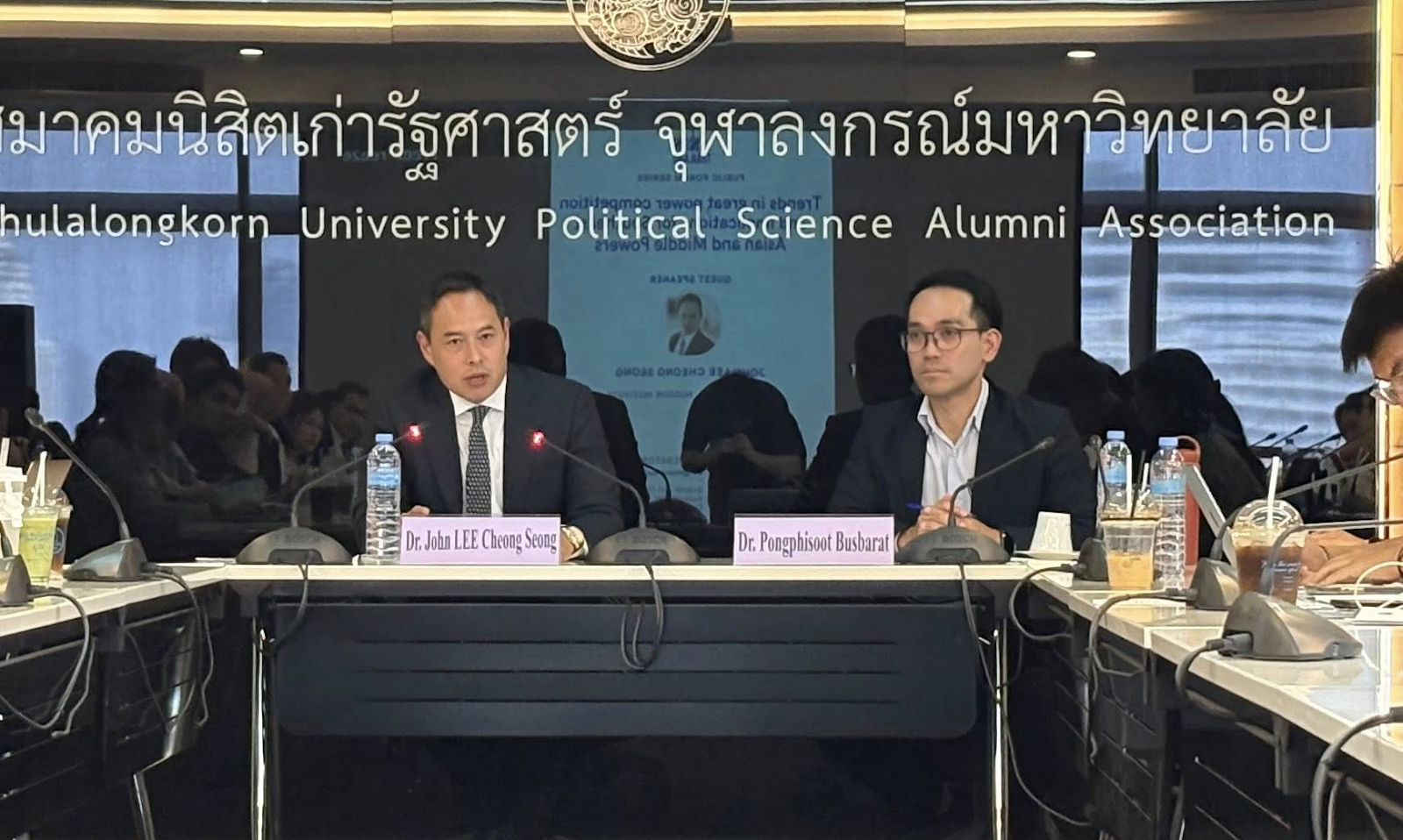
Dr. John Lee Cheong Seong and Dr. Pongphisoot Busbarat at the “Trends in Great Power Competition and Implications for Southeast Asian and Middle Powers” Seminar
Comments are closed