
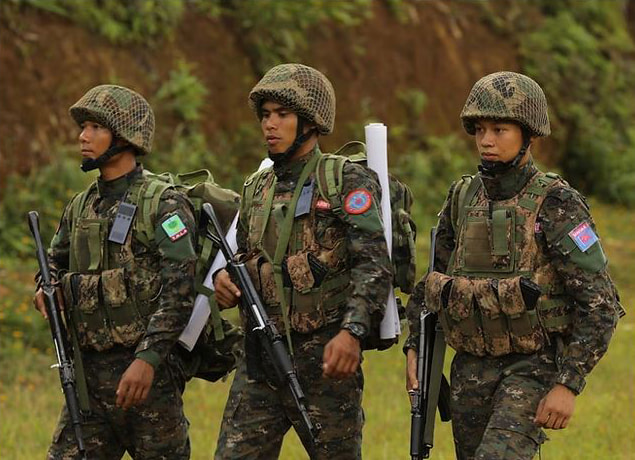
The Three Brotherhood Alliance (3BHA) has become one of the most powerful forces in Myanmar’s ongoing civil war. Comprising three ethnic armed groups, the Arakan Army (AA), the Myanmar National Democratic Alliance Army (MNDAA), and the Ta’ang National Liberation Army (TNLA), the alliance has led a significant military offensive against the Myanmar military regime in recent history, namely Operation 1027.
Formation and Members
The Three Brotherhood Alliance was officially formed in June 2019 to strengthen cooperation among three ethnic armed groups with long histories of resistance against the Myanmar military and demands for greater ethnic autonomy. The Arakan Army (AA), the largest member of the alliance, is based in Rakhine State with an estimated 30,000 troops and seeks political and military autonomy for the Arakanese (Rakhine) people. The MNDAA, which operates in the Kokang region of northern Shan State, represents the interests of the Kokang ethnic Chinese community and fields approximately 6,000 fighters. The TNLA, advocating for the rights of the Ta’ang (Palaung) people in northern Shan State, is believed to have around 8,000 troops. Altogether, the Brotherhood Alliance commands a combined force of roughly 45,000 to 50,000 troops, well-equipped with modern weapons and possessing strategic knowledge of the terrain in the regions where they operate.
Military Capabilities and Operation 1027
On October 27, 2023, the Three Brotherhood Alliance launched Operation 1027, a coordinated military offensive targeting key Myanmar military positions in northern Shan State and Rakhine State. The operation aimed to weaken the junta’s control over strategic territories, reclaim ethnic homeland, disrupt criminal activities such as cross-border online scam operations, and increase both political and military pressure on the regime. The MNDAA quickly retook the Kokang Self-Administered Zone, capturing critical border towns such as Chin Shwe Haw and Mong Ko. Meanwhile, the TNLA expanded its influence in northern Shan State by capturing towns, including Hsenwi. In the west, the AA launched parallel attacks in Rakhine, seizing several townships and even the Western Military Command headquarters in Ann Township. The Brotherhood Alliance employed modern military tactics, including drones and surprise assaults, which enabled them to seize a large number of weapons, equipment, and key infrastructure. Their efficient coordination and success took many by surprise, signaling a notable shift in the balance of power on the battlefield.
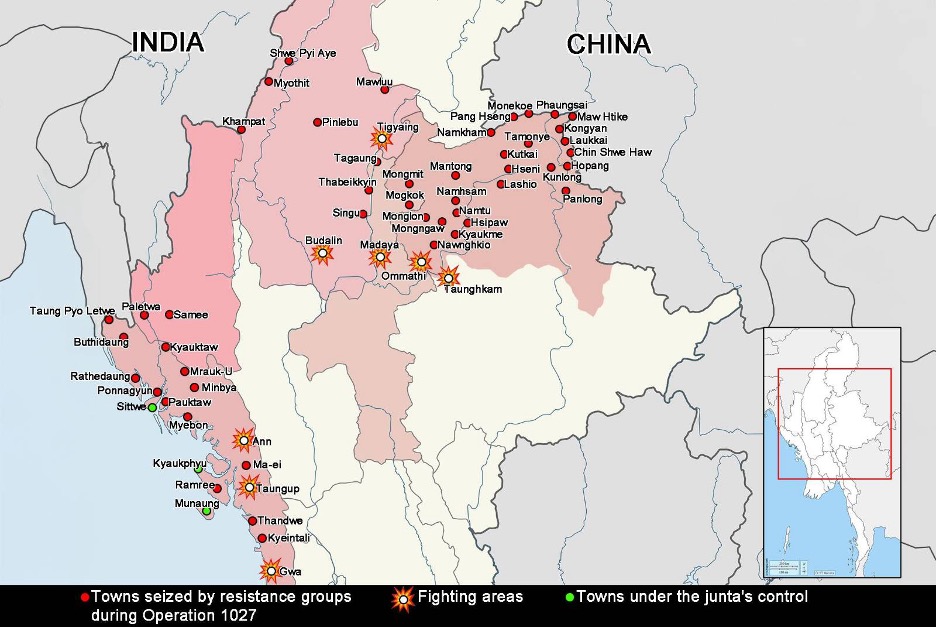
Operation 1027 mapping Credit The Irrawaddy
Political and Social Impact
The impact of Operation 1027 has gone far beyond the battlefield. The Myanmar military has struggled to respond, suffering from low morale, equipment losses, and manpower shortages. The junta has turned to forced conscription, which has caused mass youth flight and protests in urban areas. Economically, the loss of control over border trade routes has affected the regime’s finances. Thousands of civilians have been displaced, creating a growing humanitarian crisis, especially in Shan and Rakhine States. The Brotherhood Alliance has gained new political leverage, and many now view it as a central actor in the country’s future. Analysts believe that China’s shifting policy may have influenced the success of Operation 1027, especially along the border areas, where the Chinese government has shown increasing concern over criminal activities and instability.
The Road Forward
The Three Brotherhood Alliance is no longer a fringe coalition. With the launch and success of Operation 1027, it has become a powerful force capable of reshaping Myanmar’s conflict. The alliance now controls large areas of territory and has challenged the junta’s authority in ways few thought possible. What happens next is uncertain. Whether this military success will lead to political negotiations or deeper conflict depends on both internal decisions within the alliance and the reactions of regional and international actors. For now, the Brotherhood Alliance stands as one of the most influential groups in Myanmar’s rapidly evolving civil war.
Sources
Comments are closed