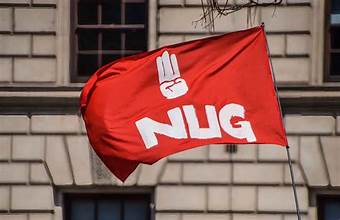
The National Unity Government (NUG) was formed after Myanmar’s military took control in a coup in February 2021. The NUG was created by elected leaders and other groups who opposed the coup, aiming to restore democracy and fight against the military regime and to represent the people of Myanmar and restore the country’s elected government. NUG has worked to unite different ethnic groups and pro-democracy activists in the resistance. It has also sought international support to pressure the military and protect the rights of Myanmar’s citizens. National Unity Government (NUG) and Ethnic Armed Organization (EAOs) are emerging as key political and military players but lack a safe base area, lacking legitimacy, arm and resources.
Internal Divisions Within the NUG
Internal divisions within Myanmar’s National Unity Government (NUG) and its resistance movement stem from conflicting priorities among various ethnic, political, and military factions. While some Ethnic Armed Organizations (EAOs) focus on self-rule and territorial control, others support the broader goal of restoring democracy across Myanmar. This diversity of goals leads to fragmentation, as some groups seek regional autonomy while others aim to overthrow the military junta. The lack of a unified command structure within the NUG’s armed wing, the People’s Defense Force (PDF), further complicates coordination. Despite the resistance movement’s significant size, with 65,000 fighters from the NUG-PDF and 135,000 troops from over 20 EAOs, internal tensions and differing political aims hinder the formation of a cohesive anti-junta alliance. Additionally, the NUG’s reliance on Aung San Suu Kyi, whose reputation has suffered due to the Rohingya crisis, complicates relations with both international actors and ethnic groups. The challenge remains whether the NUG and the National League for Democracy (NLD) can build effective partnerships with major ethnic armies and affiliated groups.
Regional Dynamics and the Role of Ethnic Armed Organizations (EAOs)
Since the 1962 coup, the Myanmar military has leveraged the fear of national disintegration to legitimize its rule, a narrative that was echoed during the 2021 coup. The 2008 Constitution entrenches military control by reserving key government positions and parliamentary seats for the army. After independence in 1948 Myanmar Army included battalions made up of different ethnic groups. General Ne Win later restructured the army, removed many ethnic minority leaders, and strengthened Burman dominance. By the 1962 coup, many ethnic groups had gone underground, forming armed resistance movements. Nowadays, groups like the Arakan Army, Kachin Independence Army, and Karen National Union are not seeking full secession but greater autonomy. Labeling their territorial gains as “disintegration” reinforces junta propaganda and undermines the Spring Revolution.
Ethnic Divisions and Power Struggles
The forces opposing Myanmar’s military junta are fragmented, with the National Unity Government (NUG), dominated by the Burman ethnic group, positioning itself as a government for the entire nation. In contrast, Ethnic Revolutionary Organizations (EROs) focus on establishing autonomous administrations in their own regions and sometimes engage in conflicts with one another, such as the tensions between Arakan and Rohingya communities. The NUG has faced criticism for spreading misleading narratives, including claims that opposition groups such as EROs and People’s Defense Forces (PDFs) control over 60% of the country and that they would remove the military junta by 2023. These ethnic disputes stem from the Burma dominated leadership’s historical disregard for the rights of other ethnic groups, fostering resentment and division. The NUG, accused of spreading false narratives about its control over the country, has been criticized for perpetuating a similar exclusionary mindset as the military junta, disregarding the aspirations and rights of other ethnic communities, which hinders national unity and stability.
China’s Influence and the Divisions within Resistance group
During the ongoing conflict in Myanmar, China attempted to exert influence over ethnic armed groups, including the Federal Political Negotiation and Consultative Committee (FPNCC), by hosting a meeting in Kunming, where it made five demands, including ensuring border stability and opposing collaboration with NUG and PDFs. Despite these pressures, the resistance groups, such as the Three Brotherhood Alliance (3BHA), ignored China’s demands and continued their attacks, including the capture of the Myanmar Northeastern Military Command in Lashio. In response, the Myanmar military, with Chinese support, launched airstrikes and cut off supplies. China also pressured the Myanmar National Democratic Alliance Army (MNDAA) to cease fighting, which led the MNDAA to declare its separation from the NUG and align more closely with China, highlighting a lack of unified political strategy among the resistance groups.
Sources
https://thediplomat.com/2024/05/myanmars-national-unity-government-must-be-doing-something-right/
https://www.voanews.com/a/myanmar-s-opposition-riven-by-internal-divisions-/7271753.html
Comments are closed