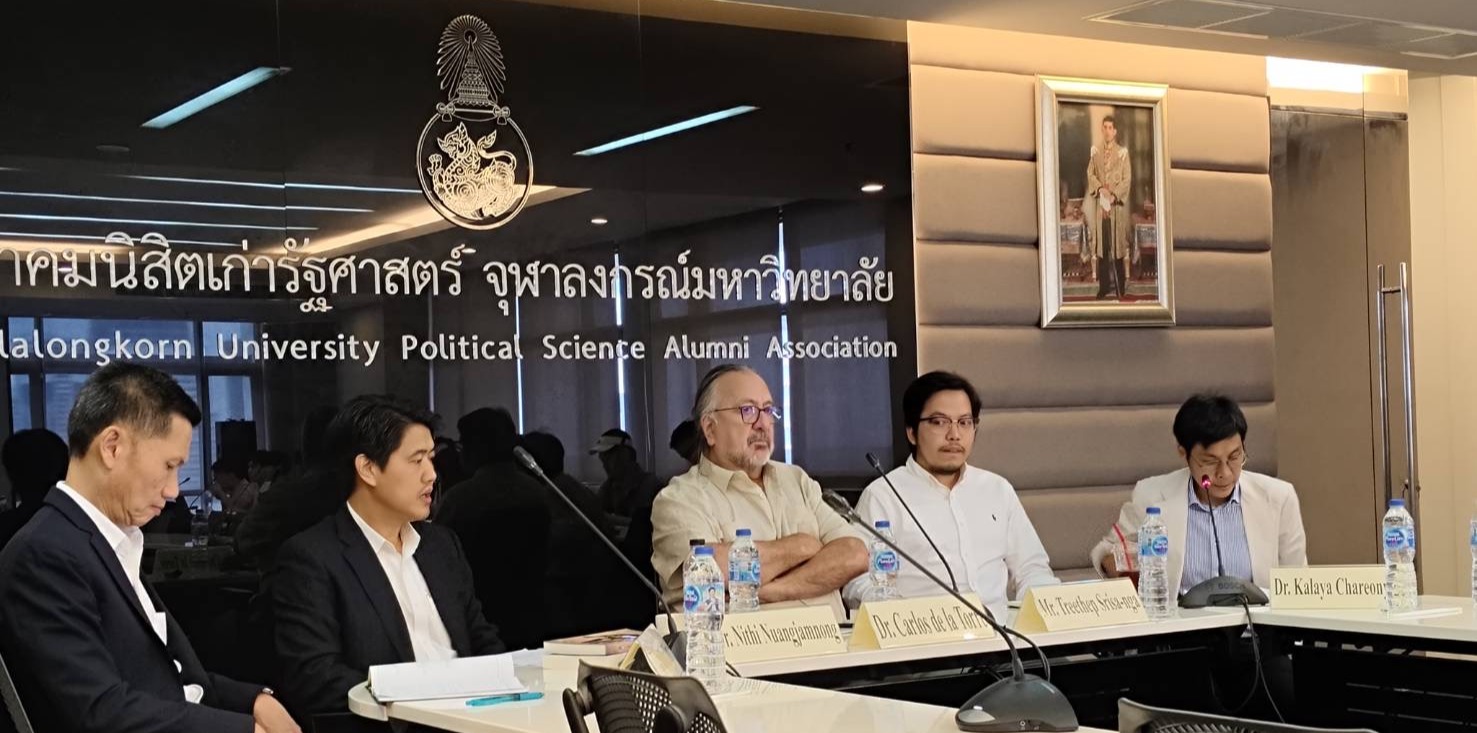
On July 18, 2025, a HDFF team attended a seminar titled “Populisms in the Global South: Lessons from Latin America, Southeast Asia and Thailand”, hosted by Chulalongkorn’s Faculty of Science, the Friedrich Naumann Foundation and ISIS at Chulalongkorn University.
The keynote speakers, Dr Carlos de la Torre —Professor, Center for Latin American Studies, University of Florida—, Mr Treethep Srisa-nga —PhD Student, Graduate Assistant, Department of Political Science, University of Florida—, Dr Thitinan Pongsudhirak —Professor and Senior Fellow, ISIS Thailand, Faculty of Political Science, Chulalongkorn University— and Dr Nithi Nuangjamnong —Assistant Professor, Political Science and Public Administration Department, Faculty of Social Sciences, Naresuan University— shared their insights on defining populism and applying it to the Global South.
Dr de la Torre and Mr. Srisa-nga began by reminding participants how their book “Global Populisms” had been written on the context of Trump’s denunciation of an alleged electoral fraud back in 2020, testifying to a tendency which cannot be reduced to the Global South.
Exploring Populism: Etymology, Leadership, and the Spectrum of Political Behavior
Dr de la Torre undertook the difficult task of defining populism, referring to two etymological perspectives:
- The Ideational school (among which Mudde) according to whom populism is a set of ideas dividing people and elites to appeal to the general will of the people.
- The Strategic school (among which Weyland), for whom populism is rather focused on accessing power than on politics, drawing on the division between organized and disorganized followers rather than on ideology.
Other definitions were also mentioned such as Laclau’s vision of populism as political versus administrative, using both the logic of equivalence and construction of enemies or Arato and Cohen’s ideal types. Hence, Dr de la Torre acknowledged there was no such thing as a unified definition of populism, but rather shared patterns of action, summarized as follows:
- Populism divides the political society into two antagonistic camps, based on pars pro toto dynamics (a logic of “part representing whole”) to construct a section of the population as the “authentic and real people” and automatically exclude others from belonging. In Venezuela, Chavez for instance depicted poor people as the “real people” whereas elites were perceived as the anti-people.
- Populism stems from a conception of leadership as embodiment, wherein the leader becomes the incarnation of the people being freed from oppression and fulfills their calling in doing so. Populist inclusion thus relies on the condition of surrendering to the leader, who as embodiment of the unitary people is unbounded by formal procedures, including constitutional provisions.
However, populism in itself is an umbrella word for a range of behaviors (from light to full-blown populists — such as Chavez who changed the name, emblem, and regime of Venezuela—), power (from seeking power, to the office, or as a fully implemented regime), ideologies (left to right, the latter often more authoritarian due to its willingness to make “others” leave the “people’s” land, as seen today in the US, whereas the former aims to free the oppressed by the oligarchy).
This attempted definition allowed him to differentiate radical rightwing populism and fascism, notably in regards to Trump’s current term by underscoring how although both embody politics as a struggle between the “friend” and “enemy” and pars pro toto dynamics, they diverge in may regards.
Populism for one relies on the containment of existential enemies through symbolic and rhetorical violence, is legitimated by elections, commits no obliteration of rights nor mass killings and cannot be confined to a historical time. Fascism however stands for the physical elimination of total enemy using violence through paramilitarism, internal and external war and is willing to abolish elections in favor of mass ascent. Finally, fascism holds totalitarianism aspirations and is perceived as referring to the 1920-30s in Europe.
Moreover, fascism uses physical violence against perceived enemies, relying on a vision of exclusionary nations requiring the forced removal of “others” to protect the nation, society, culture, and civilization. As observed today under President Trump these “enemies” often include nonwhite immigrants from colonial heritage, proponents of gender ideology or Marxists.
Yet, according to Dr de la Torre, as long as they are elected in free elections, leaders such as Trump and Bolsonaro still fall under the scope of democracy, although the former’s refusal to recognize defeat in 2020 marked a significant shift towards a dangerous for democracy leadership.
Analytical framework: Populism in Latin America and Thailand
Mr. Srisa-nga offered an analytical framework for the rise of populism framed around four axes, respectively crises, linkages, construction of the “people” and enemies as well as democratic and autocratic outcomes.
According to him, crises create fertile ground for populists. Economic shocks, like the one in Venezuela in 1988 that facilitated Chavez’s rise, along with corruption scandals in 1980s Latin America and recent ones in Argentina and Brazil, and public security emergencies such as those in the Philippines, all pave the way for populist regimes.
Linkages such as charismatic personalization and campaign style, organizations (through mass parties and digital networks), patron-client and programmatic policy channels as well as media ecosystems also help foster populist rhetorics and the construction of the “people” and enemies by mobilizing antagonism on a broader scale. However, in such context, the following question must be addressed: “Do populists thicken participation and inclusion or erode them?”.
Mr. Srisa-nga then presented four waves of populism in Latin America, respectively: classical, (neo)liberal populism, radical left and far right populisms. Utilizing such analytical framework, one for instance understands the rise of far-right populism in America through crises such as corruption scandals, governance fatigue, rising violent crime and gang violence; linkages like personalist digital campaigns, evangelical and military networks (taking the example of Bolsonaro) and the construction of people as “good citizens and taxpayers” versus a corrupt political caste, criminals, feminists…
In Thailand, Thaksin Shinawatra emerged as a prominent leader in a time of rural debt and rising inequality, the 1997 Asian Economic Crisis having discredited technocratic elites, fueled by a catch-all yet programmatic dynamic. Using a CEO-style rhetoric to put forward rural reforms and healthcare, the former relied on the construction of “rural poor and urban informal sector” as opposed to Bangkok elites. The Future Forward party likewise turned a context of military junta rule and stalled reforms to make use of generational frustration and digital economy precarity as a new politics versus old politics nexus. Both tell the tale of Thailand as a country prone to populist rhetoric, which should be watched closely in the future, since crises create openings for “ready narratives and solutions” while linkage structures shape durability and regime impact.
Dr Thitinan Pongsudhirak then made the case for populism as a systematically ex post anti-establishment mechanism and recalled the need to ask oneself: “Who are they populist against and populist for?”.
He also highlighted how thin the line between populism and royalism could appear, and how populists were predominantly men, wondering about a gendered aspect of such politics. Underlining how little some countries had been prone to populism (citing Nordic countries and Canada), he insisted on the importance of strong state institutions in addressing mass dissatisfaction. He then reflected on Asian countries as frequent autocracies rather than populist regimes and wondered whether in the case of China, North Korea or Vietnam, parties rather than people could be considered populist.
The risk of focusing solely on ideology: “A Tale of Two Populisms in the Philippines”
Dr Nithi Nuangjamnong then concluded with a key lecture on “A tale of two populisms in the Philippines”, describing the latter as the perfect myth-busting test disproving misconceptions about populism in Thailand when focusing solely on certain dimensions of populism such as actors, ideologies and policies.
He highlighted the nuance between the two trends of populisms in the country: movie star populism and penal populism, both of which arose without crises and did not engender democratic breakdown although they negatively impacted the country’s state of democracy.
After a reminder that the rise of populism in the Philippines is considered as the second wave of populism in Southeast Asia, the first having taken place in Indonesia under Sukarno and in Burma under U Nu and based mostly on anti-imperialism (according to Ben Anderson), he delved into the context which allowed populism to rise in the country.
In an oligarchy-colonial legacy from encomienda and hacienda systems, powerful political families ruled by “gold, goons and guns”, preventing mass political parties to emerge. Despite emerging largely intact from the 1997 Asian Economic Crisis, inequalities remained persistent with 5% of families occupying 83% of land, which facilitated Jospeh Estrada’s accession to power. An actor well-known for his characters helping the poor, he had no clear political program and yet with support from local political families managed to portray oligarchic elites as “the enemy” through his own portrayal as a friend of the people.
Meanwhile, Duterte was a populist of an entirely different kind. An ex-mayor of Davao, he waged a “war against narcotic drugs” and attacked elites and major political powers through a rhetoric of dark charisma, exaggerated numbers and revendicated violence. Yet, both managed to access power through performing crises rather than systemic crises, testifying to the range of faces of populism in accessing power.
Closing Remarks: The need to listen to populist critique
The lecture concluded on the factors able to prevent populism, among which were cited the lack of capacity to mobilize, to create duality and polarization, free and independent media as well as a strong civil society (the power of which was testified to for instance by the Black Lives Matter movement under Trump’s first term).
Nonetheless, speakers also emphasized populists do not create enemies out of nowhere, merely using existing fears in polarized societies to their advantage, hence highlighting the need to listen to populist critique in the face of globalization, personalism and post-colonialism.

HDFF would like to thank the Chulalongkorn’s Faculty of Science, the Friedrich Naumann Foundation and ISIS for the invitation and opportunity to participate. HDFF is looking forward to future opportunities and exchanges.
Comments are closed