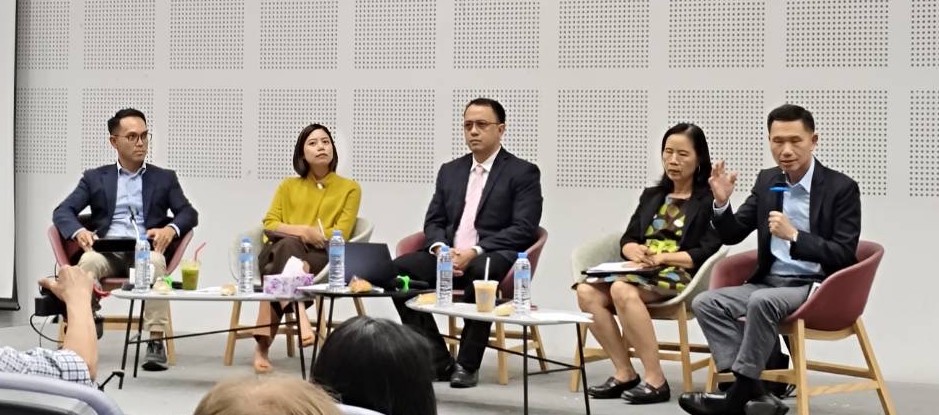
Moderator Dr Pongphisoot Busbarat – Director of Institute of Security and International Studies (ISIS), Assistant Professor in International Relations at the Faculty of Science, Chulalongkorn University – respectfully opened the panel with a moment of silence for all affected victims.
Experts Puangthong Pawakapan – Professor at Department of International Relations, Faculty of Political Science, Chulalongkorn University –, Thitinan Pongsudhirak – Professor of International Relations at Chulalongkorn, Senior Fellow at ISIS –, Dr. Kasira Cheeppensook – Associate Professor at the Department of International Relations, Faculty of Political Science, Chulalongkorn University, co-founder of the Nelson Mandela Center for Conflict Resolution, Atrocity Resolution and Human Security – and Dr. Hassachai Mangkang – Lecturer at the Department of International Relations, Faculty of Political Science, Chulalongkorn University, former company commander in the Royal Thai Marines – shared their insights on the current situation.
The session began by placing recent events into a context of deep historical wounds, having emerged in the long-lasting conflict between the Cambodian Hun Sen and Thai Shinawatra clans.
The 1893 dispute was notably cited, as it led both countries to feel like they were taken advantage of after the French drew their own border in the 1907 map proposal. While the latter was distributed over Europe, neither stakeholder was consulted and the map was thus wrongly considered adopted unanimously after the Second World War. Siam (former name of Thailand) thus had to return some of the land it had taken over, in what was perceived an unjust agreement, marking the opening of an old infested wound. Yet, such a feeling was mirrored in the Khmer kingdom, hence fueling mutual anger and feeling of powerlessness.
However, after decades of easing up relations, the Thaksin Era was marked by mutual cooperation, notably thanks to reciprocal business ties between his family and Hun Sen’s. The latter thus supported the former from 2006 onward, including through both coup d’etats.
How then, did we reach the recent conflict?
Such a change in dynamics stems from many reasons, among which the economic downfall of Cambodia (due to a high number of scammers and illegal businesses, 40% business being owned by the Hun family). This led to a regrettable gradual stripping of business relationships. In then Prime Minister Paetongtarn Shinawatra’ s phone call with Cambodian head of government Hun Sen early 2025, the former even asked the latter to go back to the “good old days” (before the call became the root of a political typhoon after its leak).
Relationships were yet relatively good until February 2025 when Cambodia “tried to change the border landscape in their favor”, as one expert put it, tensions then rapidly escalating until July 28th when Cambodia lost a soldier. Ever since, according to the panelists, Hun Sen has restlessly been using nationalism and social media to criticize Thailand. The latter, instead of focusing on launching an investigation on the death of the solider, perceived these statements as insults to its sovereignty and decided to close its border, further fueling Cambodian discontentment.
Hun Sen advocated for an unconditional reopening. Yet, even in a fragmented Thai political context with no check and balances, an interim Prime Minister and Minister of Defense and an independent army, this proposal was refused. In this regard, and considering all milestones of the conflict since 1904, panelists raised concern on the risk of escalating to a long-term conflict since in purely pragmatic terms, taking the case to International Court of Justice will necessarily last a couple years.
However, Cambodia’s own weaknesses and dependency on Thailand, as its economically and politically biggest neighbor limit its willingness for an open conflict. Despite tensions, this thus increases chances of maintaining an entry point of discussion. Likewise, Trump’s involvement in the region, notably through the coercive power of tariffs, has forced both countries to align on an initial ceasefire and the threat of future similar pressures force countries to engage in negotiations. Finally, the impact on ASEAN and the region’s legitimacy and negotiation power towards other regions encourages talks for bilateral agreements.
If external pressures thus facilitated the reaching of a ceasefire, what complexities initially prevented the two involved parties to find an agreement by themselves?
According to the panelists, one of the first factors is that, as in any conflict, the “truth has been left to die” (despite the Buddhist principle of always speaking the truth), a dynamic allegedly reinforced in Cambodia due to Hun Sen’s overruling of domestic and international affairs.
However, problems of international affairs processes were also reflected in the Thai gestion of the conflict. The country was notably criticized for its communication delays, more broadly reflecting issues in the workflow of the government and a blurry repartition of decision-making. In fact, panelists denounced how little has been heard from security agencies and how doubts remain on who is leading on the conflict.
This testifies to a broader issue which has repeatedly arisen in the country since the 2006 coup d’etat: ministers are increasingly appointed not for their competencies but for their link with the army. Despite attempts at pretending this did not affect Thailand’s reputation on the international scene, the US has since reduced military funding and the EU has limited cooperation too, calling for improved democracy. This has arguably pushed Thailand from a regional leader, notably within ASEAN, to a follower in certain regards.
Furthermore, the army’s independence has shown evident since it has appeared over the past two months, they did not need approval from the government in taking action at the border. It is thus crucial to carefully scrutinize the army’s strategies and ensure its actions align with policies and International Law. The panelist highlighted that while it was allegedly Cambodia who broke International Law first, Thailand’s recent claim it had seized 11 areas, including ones recognized as belonging to Cambodia, for instance gave a signal of vengeance rather than rightful war aimed at protecting the country.
They reminded the highest purpose must remain finding peace. Especially since the longer the conflict, the higher the number of casualties and the chances of UN agencies (such as the UNSC) having to step in, which is not in either country’s interest. While it may look like going back to an old and imperfect status quo, going back to the 2000 Memorandum of Understanding was presented as a realistic compromise, one which would allow Cambodia and Thailand to co-own and co-govern the area, as other countries have successfully done. This would allow time to then properly negotiate and move forward with a bilateral agreement. Yet, this seems unlikely given the current attitude of both countries as understood from a military point of view.
In regards to military experience and international standards, what is currently at stake?
According to panelists, both countries have diverging objectives as reflected by their different tactics. In their words, “Cambodia uses the offensive diplomatic tactic to focus on the land around temples and landmines in targeted areas to prevent Thailand from pushing back”, hence creating clash and injuries. Meanwhile, Thailand plays an alleged “defensive role by pushing down the army to protect disputed areas”. Yet, in the end, both want to claim ownership and assert authority.
Nonetheless, in their view, Cambodia sees a higher value than Thailand in the border disputed area because they do not see value of temples as a means to an end and acknowledge they have more to lose than the latter. Hence, it was predicted they will mobilize all of their regional troops and will not stop, especially due to a lack of governmental checks and balances.
Yet, the imbalance of power here is undeniable since Thailand has a much more significant global fire power. However, Cambodia allegedly has the “upper hand in cyberwarfare” according to panelists, hence gaining legitimacy and support by framing Thailand as an invader. The need to prevent bringing down morale as well as to solidify Thai leadership through a united front comprising diplomacy, information, socio-economic and military was thus underscored.
In such a complex conflict, what are then the potential ways forward?
A united front appears particularly important in a context marked by its post-truth dimension. This 2016 Oxford International Word of the Year refers to “circumstances where objective facts are less influential in shaping public opinion than appeals to emotion and personal belief”. In fact, today many narratives overlap on the online world and influence our stories. The goal is not to convince anymore, but to create emotional confusion, since attention equals upper hand.
This not only exacerbates hardships in bringing peace by dehumanizing the “other(s)” but by making third parties increasingly needed to bring external “objectivity”. Multilateral instruments such as monitoring from ASEAN or UN bodies (according to Art.33 of the UN Charter, recommending the use of a mediator) thus become central, despite Thailand’s repeated preference for a bilateral solving of the conflict. The latter has indeed expressed opposition to involving the International Criminal Court (ICC) in investigating Human Rights abuses, given its perception as a potential concurring authority to the monarchy.
Yet, multilaterals are not the only key players and Civil Society Organizations as well as experienced monitoring teams must be integrated since there will be no escaping this “vicious circle” without furthering from ever-fueling competing narratives. Shared history curricula, or transitional justice (through truth-seeking, retribution and restoration, reparation, and collective moving forward) must be studied as ways to break the ever-lasting narrative of conflict. Likewise, the removal from culprits from office and construction of a shared memory (through memorials and monuments for instance) should be considered. Finally, such changes should be fostered in political systems actively aiming for peaceful states. With these suggestions the discussion closed.
HDFF would like to thank the Chulalongkorn’s Faculty of Science, the Friedrich Naumann Foundation and ISIS for the invitation and opportunity to participate. HDFF is looking forward to future opportunities and exchanges
Comments are closed