1. Background of the Research
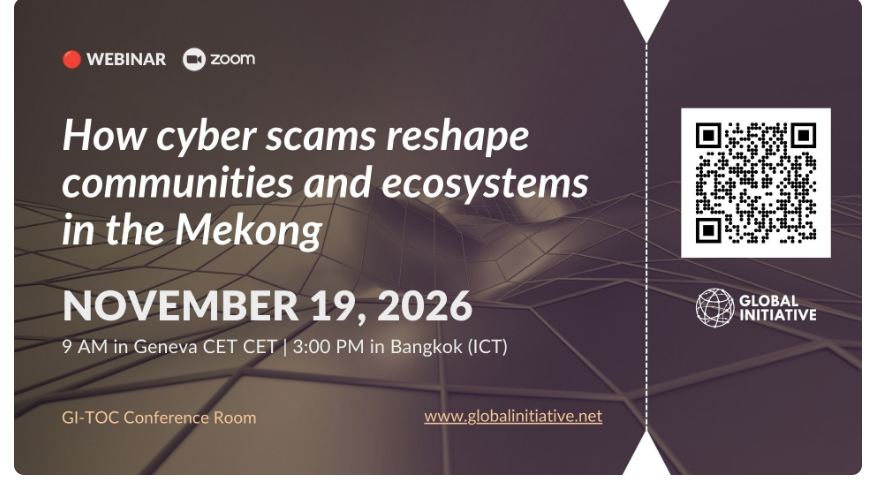
The webinar presented research conducted under the project Scamscapes: Cybercriminalities and Emerging Risks in the Global Digital Age.
Since 2022, the research team has investigated more than 10 sites and cities across Cambodia, including in-depth research in two secondary cities, Sihanoukville and Poipet. The main purpose of the research is to understand how the online scam industry affects local communities, local economies, and people’s everyday lives. Instead of looking only at cybercrime, the research also examines how scam operations have changed the way people live, work, and interact with each other.
The project also aims to identify the social and economic risks created by the scam industry, raise awareness among development stakeholders, and encourage different sectors to work together to address the problem. Another objective is to train researchers in field-based research methods and the analysis of the online scam industry.
2. Understanding the Local Economic Impact of Online Scams
During the webinar, the speakers explained that most existing research on online scams has mainly focused on how scam networks operate, their political and economic connections, and issues related to human trafficking and human rights.
However, the research presented during the webinar showed that the online scam industry is not only a criminal activity happening inside compounds. It is also connected to the local economy and has a direct impact on communities and people living nearby. Scam operations have changed local employment opportunities, land ownership, urban development, social relationships, and people’s everyday livelihoods. This means that the impact is not limited to people working inside scam compounds.
Local residents who have no involvement in these activities can also experience negative consequences.
One important point discussed during the webinar was the need to understand the everyday experiences of local people. Sometimes, the negative impacts of the scam industry are not immediately visible, but they can slowly change communities over time.
These include changes in:
- Land ownership
- Employment opportunities
- People’s mobility
- Environmental conditions
- Relationships within communities
The speakers also identified several areas in Cambodia with a high concentration of scam compounds and casinos, including:
- Koh Kong Province
- Pailin Province
- Mondulkiri Province
- Svay Rieng Province
These examples show that the scam industry is not only an online issue but is also connected to land development and changes in local communities.
3. How Scam Operations Affect Local Communities
One of the main presentations during the webinar focused on findings from the recent GI-TOC report Divided Lands, presented by Gabriel Fauveaud from the University of Geneva and Ronan Kemp.
The research showed that the scam industry has affected local employment, divided land ownership, changed people’s mobility, and disrupted their everyday livelihoods.
One of the most interesting parts of the webinar was a video showing the experiences of a Cambodian villager who lived near a scam compound.
The video provided a better understanding of how these operations affect people who live nearby, even though they are not directly involved in the scam industry.
According to the villager, construction around the compound continued 24 hours a day, with workers operating in both day and night shifts. Sometimes, the construction noise continued until 2 or 3 AM. Heavy machinery used for pile driving created very loud noises and strong vibrations. The villager explained that they could not sleep properly because the ground and their property were shaking.
Another major problem was wastewater and rubbish disposal. The villager explained that wastewater was pumped out from the compound and flowed directly onto their land. Since the land where the buildings were constructed was higher than their property, dirty water drained down onto their land.
The compound reportedly had at least 2,000 workers, but nobody appeared to collect or properly dispose of the rubbish. Instead, garbage was thrown around the area. This created bad smells and attracted mosquitoes.
The villager was also concerned about possible bacteria and skin problems when walking through the affected land or harvesting rubber.
This shows that scam compounds affect not only the people working inside them but also those living nearby. Local residents have to deal with noise, dirty water, rubbish, and possible health risks, even though they are not involved in these operations.
4. Safety Concerns and the Social Impact
Another serious issue discussed through the video was the safety of people living near the compounds.
The villager explained that people became concerned when Chinese workers started trying to escape from the compounds. In one incident, villagers reportedly witnessed around 600–700 foreigners breaking through a door to escape from one of the compounds.
At the time, police officers carrying electric batons tried to stop them, and some attempted to beat the escaping workers. The villagers were very scared by what they witnessed.
This incident shows how the situation inside scam compounds can also affect the sense of safety of people living nearby. Even though the villagers were not involved in the scam operations, they still had to witness frightening situations happening in their own community.
The villager also mentioned that before the crackdown on online scams, three of their friends had been lured into working in scam compounds. This shows how people can become victims after being promised good job opportunities and better salaries.
The problem also affects people’s mental well-being. Reports of people being confined, tortured, and forced to conduct online scams make local residents worried about their own safety and the safety of people they know.
The villager also expressed concern about Cambodia’s reputation. They did not want to see scam operations continuing in the country because these activities could damage Cambodia’s image and affect tourism. They also harm innocent people who are tricked by scammers.
5. Government Response and the Challenges Ahead
During the webinar, the speakers also discussed the importance of providing alternative livelihoods, stronger social protection, and better local development opportunities. This is important because communities need support to recover from the negative impacts of the scam industry.
Simply closing down the compounds does not mean that all the problems affecting local people will disappear.
This issue is also important for other countries in the Mekong region because online scam operations are not limited to Cambodia. Cross-border criminal networks, migration, casino developments, and changes in local economies can also affect communities in neighbouring countries.
Therefore, cooperation between countries is important, but there should also be more attention given to the people and communities affected by these activities.
6. Conclusion and Personal Reflection
Overall, the webinar helped me understand that the online scam industry is not only about cybercrime, human trafficking, or illegal business activities. It is also a local development issue that affects communities in many different ways.
What stood out to me most was the villager’s testimony in the video. It showed that people living near scam compounds can experience noise pollution, environmental problems, health concerns, and safety issues, even if they are not directly involved in the scam industry.
The examples of wastewater flowing onto private land, rubbish being dumped around the compound, and construction continuing throughout the night show how these operations can affect people’s everyday lives. The incident involving hundreds of foreign workers escaping from the compound also showed how the situation can create fear among local residents.
What I found particularly interesting was that the impact of cyber scams is not always immediately visible. Before this webinar, it might be easy to think of online scams mainly as a digital crime or human trafficking issue. However, the research presented during the webinar showed that these activities can also change the physical environment, local economies, and the everyday lives of people who have nothing to do with the scam industry.
I also think it is important to look at the problem from the perspective of local communities, rather than focusing only on government statistics or criminal networks. While shutting down scam compounds is necessary, more attention should also be given to the people who have experienced the negative impacts.
Comments are closed