

India and Myanmar, neighboring countries bound by geography, culture, and history, have long shared a complementary relationship rooted in mutual interests. From cross-border connectivity and energy cooperation to security collaboration and trade, their ties are deeply rooted in shared goals. For India, Myanmar serves a gateway to Southeast Asia and a crucial partner in its “Act East Policy”. For Myanmar, India represents both a market and a partner for infrastructure, technical cooperation, and regional balance. Despite the ongoing political instability in Myanmar since 2021, New Delhi has continued to engage pragmatically, recognizing the long-term importance of stable ties.
Border Proximity and Strategic Interests
India and Myanmar share a 1,643-kilometer land border that connects four northeastern Indian States, Arunachal Pradesh, Nagaland, Manipur, and Mizoram, with Myanmar’s Sagaing Region and Chin State. These regions are home to overlapping ethnic communities and historical trade routes. Stability and cooperation along this border are crucial for both countries, not only for trade and mobility but also for countering armed insurgency and managing refugee flows. India views a peaceful and connected Myanmar as essential for the development of its northeastern region. Meanwhile, Myanmar benefits from India development assistance, military assistance, transport projects, and increased trade access to a vast market. This shared border is more than a physical boundary; it is a zone of opportunity, and both governments have continued to emphasize infrastructure, connectivity, and stability in these frontier regions.
Connectivity and Infrastructure: Building Links
Infrastructure and connectivity stand out as a highly complementary area in the India-Myanmar partnership. Through its “Act East Policy”, India has prioritized building land and maritime routes that link to Southeast Asia via Myanmar. The most prominent of these is the Kaladan Multi-Modal Transit Transport Project (KMMTTP), which connects the Indian port of Kolkata to Myanmar’s Sittwe port, and onward to the northeast of India via inland waterways and roads. Despite delays, the project remains a key symbol of bilateral cooperation. Another initiative, the India-Myanmar-Thailand Trilateral Highway (IMT-TH), aims to create a road link from India’s Manipur state to Thailand through Myanmar. Once completed, this highway would reduce transport time and cost, opening up new opportunities for trade, tourism, and regional integration. These infrastructure projects are not only about logistics, they reflect strategic trust and long-term vision.
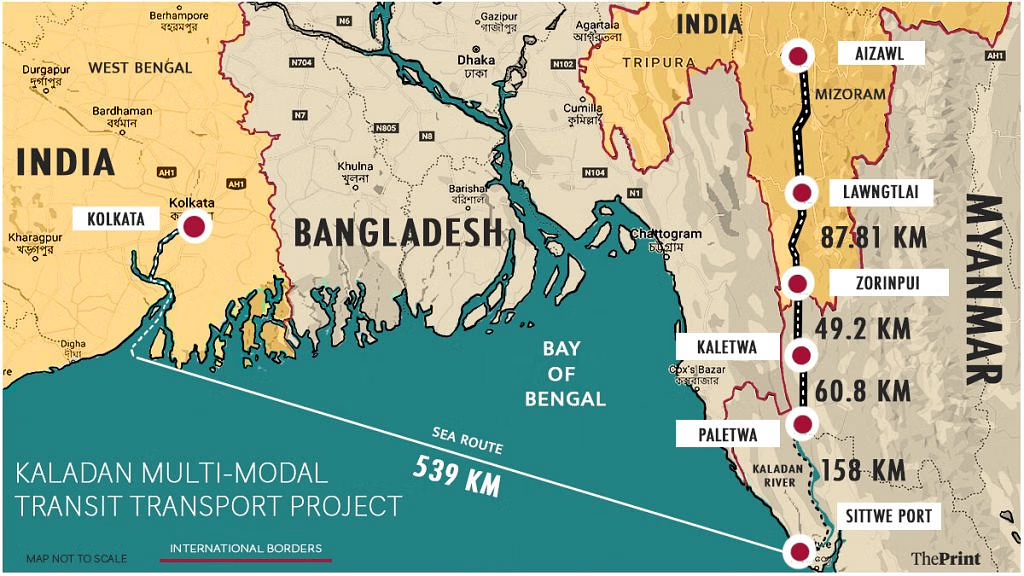
Kaladan Multi-Modal Transit Transport Project (KMMTTP) mapping Credit PMF IAS
Energy and Economic Ties
Energy cooperation is another crucial area where India and Myanmar complement each other. India imports natural gas from Myanmar, and India public-sector companies like ONGC Videsh and GAIL have invested in offshore oil and gas exploration, including in the Shwe gas field. These joint ventures help Myanmar generate revenue while securing reliable energy sources for India’s growing demand. Trade between the two countries, though still modest compared to its potential, shows a clear pattern of complementarity. Myanmar exports agricultural products, while India supplies pharmaceuticals, vehicles, machinery, and textiles. Informal trade also thrives along the border, with local economies depending on cross-border exchange for daily goods. India has also provided Myanmar through development aid, capacity-building programs, and technical assistance in sectors such as agriculture, IT, education, and health, helping build skills and infrastructure in areas still under development.
Political and Security Engagement
India’s approach to Myanmar following the 2021 political transition has been one of cautious engagement. While concerned about the human rights situation and the impact of conflict on civilians, India has avoided isolationist measures and continued to maintain working relations with various stakeholders in Myanmar. This approach stems from its long-term regional security interests, particularly in its northeastern border states. Security cooperation has included joint operations to combat insurgent groups operating across the border, regular military-to-military exchanges, and coordination to prevent cross-border smuggling and trafficking. India has also responded to humanitarian needs, including providing vaccines and medical support during the COVID-19 pandemic. In addition, India has engaged diplomatically through regional forums such as BIMSTEC and ASEAN, emphasizing dialogue and stability. During the 2025 BIMSTEC summit, Prime Minister Modi met Myanmar’s military leader, calling for a ceasefire and expressing readiness to support peace and recovery efforts. Despite continued unrest, India has sought to balance its strategic, economic, and humanitarian priorities, while maintaining a policy of non-intervention.
Complementarity Beyond Conflict
The India-Myanmar relationship demonstrates how two countries can build a strategic partnership grounded in practical needs, shared borders, and mutual respect. Their complementarity, in infrastructure, energy, trade, and security, has allowed them to work together even in times of political tension and uncertainty. As Myanmar navigates its internal challenges, and India continues its strategic outreach to Southeast Asia, the cooperation between two countries can serve as a cornerstone for regional connectivity, economic resilience, and long-term stability. While the road ahead may be uncertain, the foundation for a mutually beneficial partnership is strong, one built not just on diplomacy, but on complementarity in action.
Sources
Comments are closed